|
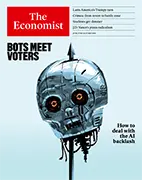
Год выпуска: июнь 2026
Автор: The Economist Newspaper and The Economist Group
Жанр: Экономика/Политика
Издательство: «The Economist Newspaper Ltd»
Формат: PDF (журнал на английском языке)
Качество: OCR
Количество страниц: 80
BOTS MEET VOTERS
How to deal with the AI backlash
- As AI’s potential expands, popular resistance is growing. Time to win the public around: leader, page 9.
- AI models’ values are very different from most people’s: briefing, page 16.
- Democrats and Republicans share a fear of AI, page 19.
- America’s data-centre backlash is putting the boom at risk, page 55.
- Why big AI labs are hiring philosophers to shape their products, page 68.
Latin America’s Trumpy turn
- Real problems, powerful incentives and a network of hacks have helped Donald Trump’s pals win a string of elections: leader, page 13, and analysis, page 25.
Crimea: from resort to battle zone
- Like Russia proper, Crimea is running short of petrol and patience, page 42.
Students get dimmer
- University-for-all harms poor students the most: leader, page 11.
- Some college and university students test no better than ten-year-olds, page 51.
J.D. Vance’s pious radicalism
- Mr Vance is heir to a more radical politics than Trumpism, if he believes what he’s saying: Lexington, page 24.
- The vicepresident fails to see his own vices, page 76.
The world this week Politics
- Sir Keir Starmer announced his resignation as Britain's prime minister, less than two years after winning a landslide majority at a general election. The trigger for Sir Keir’s decision to go was Andy Burnham’s victory in a by-election. The hitherto mayor of Greater Manchester is a Labour Party favourite who will stand for party leader in mid-July. Sir Keir’s time in office was plagued by broken promises and a series of U-turns, often forced by militant backbench MPs. His judgment was also questioned, as advisers and ministers, including his deputy, were forced to resign for inappropriate behaviour. Following disastrous local elections for Labour, seven ministers quit after falling out with Sir Keir.
No swansong for Starmer
- After Sir Keir announced his departure the European Union postponed a summit with Britain that had only recently been set for July 22nd. Sir Keir had promoted the summit as a chance to reset Britain’s relations with the EU, but the EU wants to wait until a new prime minister is in place.
- American and Iranian officials concluded a round of talks in Switzerland about the next stage of their peace deal.
- Qatari and Pakistani mediators reported “encouraging progress” towards a lasting agreement. But Donald Trump warned that “I can do whatever I want” after a 60-day pause in fighting. The president threatened to seize control of the Strait of Hormuz and resume attacks on Iran if it does not curtail Hizbullah, Iran’s proxy in Lebanon. At Iran’s urging, America imposed another ceasefire on Israel and Hizbullah in Lebanon. Lebanese and Israeli officials resumed talks in Washington.
- Iran’s chief negotiator said Iran would “administer” the Strait of Hormuz after agreeing to set up a “telephone hotline” for ships passing through the waterway. Marco Rubio, the American secretary of state, said no country would be allowed to charge fees for vessels traversing the strait. An increasing number of ships have been passing through it. Oil prices have fallen back to pre-war levels. Brent crude traded below $73 a barrel.
- The UN Security Council warned of more atrocities in Sudan, as the rebel Rapid Support Forces encircled El Obeid, the capital of the North Kordofan region. There are fears that the city’s 500,000 residents could suffer a similar fate to those in El Fasher, the capital of North Darfur, where the RSF massacred civilians last year.
- The American Congress passed a housing bill with broad bipartisan support. The legislation aims to expand the supply of housing by relaxing federal regulations in the hope that this will spur construction and lower costs, among other things. It does not tackle local restrictions on building. But a tetchy Mr Trump said he won’t sign the act until Congress passes his election-reform bill.
- Democratic socialists won three congressional primaries in New York city, and in two of the races booted out incumbents who were backed by the Democratic establishment and unions. Zohran Mamdani, the left-wing mayor, endorsed all three candidates, suggesting his popularity with voters has not waned since taking office in January.
- General Chris Donahue submitted his resignation as America’s top commander in Europe. Pete Hegseth, America’s secretary of war, has led a purge of the senior ranks in the military’s top brass and is reviewing America’s troop commitments to Europe.
- In India protesters demanded the resignation of the education minister over a decision to make 2.2m medical students resit their exams. The results of the previous exams were annulled after it was discovered that test papers had been leaked on messaging apps. The protests were led by the Cockroach Janta Party, a growing political movement for India’s discontented young voters.
- Colombia’s presidential election was won by Abelardo de la Espriella, a conservative who was endorsed by Donald Trump. His margin of victory over Iván Cepeda, a leftist senator, was less than 1%. The election marks a rightward shift in Colombia following Gustavo Petro’s term in office. Relations with America fell to a new low under Mr Petro; Mr Trump once described him as a “sick man”. Mr de la Espriella rode the right-wing wave that has brought other governments to power in South America, as voters vent their anger about rampant crime and the high cost of living.
- Underlining the tilt towards the right in South America, Keiko Fujimori seemed to have secured victory in Peru’s presidential election, which was held on June 7th. The latest tally of votes suggested that Ms Fujimori had taken an insurmountable lead over Roberto Sánchez, her left-wing rival. An official result is due in mid-July.
- Two powerful earthquakes hit Venezuela causing multiple casualties. The epicentre was San Felipe, 200km (125 miles) west of Caracas, but buildings collapsed in the capital too and transport systems were closed. America said it would send search-and-rescue teams and medical and humanitarian supplies to the country. The earthquakes struck during a national holiday, so many residents were at home and not at work. The casualties are expected to rise.
- Rodrigo Paz, Bolivia’s centrist president, declared a state of emergency that gives him broad authority to clear the roadblocks that protesters have being manning for weeks. The protesters want the government to curb its austerity programme and reinstate fuel subsidies, but the barricades they have erected on roads have impeded the transport of basic goods. The government in part blames Evo Morales, a former leftist president, for stirring up the trouble.
Rooting out the old regime
- Peter Magyar, Hungary’s new centrist prime minister, presented sweeping reforms to curb corruption. Nicknamed “Operation Cleansing Fire”, the measures include the creation of a powerful anti-corruption body and a review of the constitution. Mr Magyar also proposed a constitutional amendment to remove Tamas Sulyok as president. Mr Sulyok is an ally of Viktor Orban, the former prime minister.
- Much of western Europe boiled under a heatwave that smashed many temperature records. France recorded its hottest day since records began in 1947 when the thermometer hit 44.30C (111.70F) in Pissos, south of Bordeaux. At least 48 people died across France in drowning incidents as people plunged into rivers and lakes. The hot weather sparked Europe’s perennial debate about whether to install more air-conditioning.
The world this week Business
- SpaceX’s share price fell back to Earth, erasing some of the gains it had chalked up since an initial public offering on June 12th. The stock was listed at $135 at the company’s flotation, had climbed to over $200 in subsequent days and was trading at around $155 during the middle of this week. Some $400bn was wiped off SpaceX’s market value in one day, the second-biggest such loss for any company (Nvidia lost almost $600bn on January 27th 2025). Meanwhile, SpaceX launched its first bond offering, over a range of maturities, to institutional investors, which should raise $25bn. The company will use the proceeds to repay a bridge loan it took out in March when xAI, Elon Musk’s AI company, and X, his social-media platform, were merged with SpaceX.
- Other tech stocks fell heavily during the week, as concerns about the lofty valuations of AI-related firms and the prospect of higher interest rates once again rattled investors. The share prices of chipmakers such as Micron, Nvidia and Qualcomm dropped sharply. Alphabet’s stock slid by 5% after two senior AI researchers said they were leaving, one to join Anthropic and the other to join OpenAI.
- Micron cheered investors, however, when it published its quarterly earnings. The chipmaker’s revenue climbed by 345%, year on year, to $41.5bn, and net profit soared by 1,400%, to $28.2bn.
- Trading in South Korea’s stock market was also volatile. The KOSPI index, which is dominated by Samsung and SK Hynix, the country’s big chipmakers, dropped by 10% in a day. The volume of share trading was exceptionally high. The Korean stock exchange’s circuit-breaker was triggered for the fourth time this year. It wasn’t triggered at all in 2025.
- Meanwhile, SK Hynix filed papers to list shares in America for the first time. It plans to start selling American depositary receipts (enabling US investors to buy its stock) on the Nasdaq exchange on July 10th and hopes to raise 45.4trn won ($29.4bn).
If you can’t beat them…
- For the past few years investors have wondered how companies that provide stock pictures, video and graphics to the media and other creative markets will survive in the world of AI. Getty Images has provided an answer to that conundrum by striking a licensing agreement with OpenAI that will make its content available on ChatGPT, providing the chatbot with a trustworthy source of pictures. Getty’s share price surged.
- In what could be India’s larg-est-ever initial public offering, Jio Platforms, the country’s biggest mobile-network operator, filed a draft prospectus with regulators, starting the ball rolling on its stock-market flotation. Jio is a subsidiary of Mukesh Ambani’s Reliance Industries; the business tycoon described it as a “deeply emotional moment”. Jio hopes to raise $4bn through the IPO, which would give it a market capitalisation of $130bn.
- A regulatory filing from Oracle revealed that the software company has erased 21,000 jobs over 12 months, reducing its full-time global workforce to 141,000. Oracle is under pressure to reduce costs that have spiralled because of its expansion into data centres, but the job losses are higher than the forecasts of most analysts. Oracle said AI supplanted some of the workers.
- In China, Richard Liu, the boss of JD.com, predicted that robots will replace the e-commerce company’s 700,000 delivery workers “sooner or later”. Robots will eventually handle all deliveries, said Mr Liu, and workers will need to be retrained to maintain and repair their automated colleagues. China’s experiments with robot technology threaten to throw the country’s army of drivers in the gig economy out of work. Last year Shenzhen airport began a service that enables passengers to order food and have it delivered to their gate by a robot.
Forget LA law, here’s AI law
- A law firm that uses AI instead of lawyers won a case in the English courts, in what is thought to be a legal first for AI anywhere in the world. Garfield AI, which uses the technology to prepare its cases, helped a human-resources freelancer recover money owed to her by a firm, though a human barrister represented her in court. The freelancer spent £400 ($525) on AI legal services and was awarded £7,000, while the defending firm paid lawyers for their advice in the case.
- Tributes were paid to Alan Greenspan, who died aged 100. Mr Greenspan was chairman of the Federal Reserve from 1987 to 2006, the second-longest tenure of anyone in the job. Nicknamed the Maestro for his mastery of policy and his loquacious statements, Mr Greenspan once said, “If I turn out to be particularly clear, you’ve probably misunderstood what I’ve said.”
скачать журнал: The Economist | June 27th 2026
|