|
Год выпуска: июль 2026
Автор: The Economist Newspaper and The Economist Group
Жанр: Экономика/Политика
Издательство: «The Economist Newspaper Ltd»
Формат: PDF (журнал на английском языке)
Качество: OCR
Количество страниц: 88
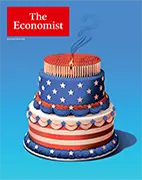
Fireworks
This birthday comes at an anxious moment in America’s history
- This birthday comes at an anxious moment in America’s history: leader, page 7.
- The nation that created the postwar order is tearing it down. What will rise from the rubble? Essay, page 13.
- An empirical look reveals a country that is mighty—but becoming less dominant, page 19.
- Donald Trump’s reflecting-pool debacle is a fitting birthday gift to America: Lexington, page 24.
- America at 250: the final chapter of our series, page 25.
- Happy birthday America, the ally Europe admires—questioningly: Charlemagne, page 52.
Venezuela: aftershocks
- If Donald Trump “runs” Venezuela, he has a responsibility to help its people: leader, page 9.
- The catastrophe sparks fury at the American-backed regime, page 32.
- Unpacking a peculiar sovereign-debt restructuring, page 73.
AI regulation
- Fable is free. But AI desperately needs better regulations: leader, page 8.
- The Trump administration now controls who gets access to the best AI, page 64.
The future of European defence
- Europe ponders how to protect its eastern flank as America pulls back, page 57.
How much sleep should you get?
- Is too much as bad as too little? Well Informed, page 79.
The world this week Politics
- The official death toll from two earthquakes that struck Venezuela on June 24th rose to 2,295, though that is expected to increase as more bodies are pulled out of collapsed buildings. With over 11,000 people injured and some hospitals damaged, the World Health Organisation said the country’s health system was under strain. An American general said 900 military personnel were helping search-and-rescue operations. Delcy Rodríguez, the interim president, described the earthquakes as Venezuela’s “most brutal natural catastrophe” ever, but anger mounted among Venezuelans about the government’s response. Many residents say the socialist state is providing little help.
- Iran’s revolutionary guards attacked a Singapore-flagged ship as it left the Strait of Hormuz. America responded by bombing military targets in southern Iran, which then fired missiles and drones at Bahrain and Kuwait. American officials signalled that the fighting was over and that vessels could “move freely” through the strait. Donald Trump said he was satisfied with ordering one-off strikes on Iran when it violates the deal with America. Indirect negotiations between America and Iran continued.
- Israel and Lebanon signed their first formal diplomatic agreement in 43 years, which in theory sets them on a path towards a lasting peace. The deal commits the Lebanese government to disarm Hizbullah, Iran's proxy in Lebanon. Israel would gradually withdraw from southern Lebanon, although not until the militants are uprooted. Hizbullah is not party to the agreement.
Oh say, can you see!
- America’s Supreme Court struck down Mr Trump’s executive order that had denied citizenship to children born to illegal migrants or temporary residents. The court found that the constitution grants such rights, using reasoning that looked back as far as the concept of citizenship in English common law, “which crossed the Atlantic and prevailed in ‘each and all of the states’ after American independence”.
- The court sided with Mr Trump in agreeing he could sack federal regulators, a big expansion of presidential powers. But it ruled that he could not fire Lisa Cook from the Federal Reserve’s board of governors, citing the central bank’s independence. And it also upheld a ban on transgender women competing in women’s college and school sports.
- Mr Trump’s financial disclosure for 2025 revealed that he reported $1.4bn in income from his family’s digital-currency assets. The president has relaxed regulation of the cryptocurrency industry since taking office. The White House said that neither he nor his family “has ever engaged, or will ever engage, in conflicts of interest”.
- Police in South Africa arrested 900 people during big antimigrant protests. One person was shot dead in Johannesburg amid the looting of shops owned by foreigners. The protests followed months of anti-foreigner mobilisation and marked a “deadline” set by vigilante groups for illegal migrants to leave the country. Shops and businesses remained closed in many cities.
- Uganda’s army shut down newspapers and radio and TV stations owned by Nation, east Africa’s most influential media group, the latest sign of repression in the country. The closure was ordered by Muhoozi Kai-nerugaba, the army chief, who is also the president’s son and his likely successor. In a rant on X Mr Kainerugaba said “I don’t believe in a free press!”
- Andy Burnham, who is likely to take over soon from Sir Keir Starmer as Britain’s prime minister, made a big policy speech in which he announced bold plans to relocate some governmental powers away from London. As part of his devolution vision, “Number 10 North” will be “the nerve centre of a rewired Britain” on a ten-year mission to rebalance the country. Regions would be tasked with producing “credible industrial ambitions”.
- In one of his final acts as prime minister Sir Keir committed £15bn ($20bn) to Britain’s defence investment plan over the next four years. A third of the money is earmarked for drones and autonomous weapons systems. The plan had been delayed and the previous defence secretary resigned saying it wasn’t enough to modernise Britain’s defence capabilities. Mr Burnham will have to find £4.7bn to meet Sir Keir’s commitment.
- South Korea announced that it would ramp up its production of drones, with around 11,000 to be produced this year alone. Drone and counter-drone units will be manned by some 500,000 “drone warriors” and tens of thousands of systems will be deployed across the front line with North Korea. Drones are now “a universal combat tool”, said the South Korean defence minister.
- In response to a suicide-attack in Karachi that killed three federal rangers, Pakistan conducted air strikes across the border into Afghanistan. At least 28 civilians were killed, according to the UN’s local mission. Pakistan said it had targeted militant bases. In retaliation Afghanistan launched a drone attack against what it described as an Islamic State base in Pakistan’s border province of Balochistan.
- New Caledonia held its first election since deadly riots broke out in 2024 over plans to expand voting rights for French citizens who live in the Pacificisland territory, which would have diluted the voting power of locals (the proposal was shelved). Independence-minded parties won 26 seats in the 54-seat assembly and “loyalist” parties took 24, leaving the non-aligned centrists with four.
- Ukraine launched another big attack on Moscow. Russia said it shot down more than 400 drones in the capital and elsewhere. Ukraine’s relentless assault on oil refineries has led to fuel shortages in some Russian regions, which Vladimir Putin now admits are causing “problems”. Russia hit Kyiv with another big bombardment, killing at least 17 people.
The welcome mat
- More than 1m illegal migrants have applied for citizenship in Spain under an amnesty programme. Migrants who have lived in the country for at least five months and do not have a criminal record will be granted temporary residence permits. When the amnesty was announced in January it was thought 500,000 would apply.
- Europe’s sweltering heatwave subsided, but not before more local record temperatures were set. Germany recorded 41.70C (1070F) at Coschen near the Polish border. Poland hit 40.50C in the town of Slubice. The Czech Republic recorded a reading of 41.10C in Doksany, north of Prague.
The world this week Business
- The Trump administration lifted its ban on non-Amer-icans using Anthropic’s latest Fable and Mythos AI models, which it had decreed in midJune. The ban was imposed over a potential breach of security protocols in Fable; as a result Anthropic closed all access to Fable and Mythos, even internally. The AI firm has implemented new safeguards and worked with the Commerce Department to resolve the concerns, but the issue has highlighted the ease with which the American government can restrict access to frontier AI. Anthropic said it underlined the need for the industry to find a consistent way to assess and fix potential evasions of AI safeguards.
- Despite the conflict with Iran and some bouts of volatility, stock markets recorded their best quarter in six years. The S&P 500 rose by 15% from April to June, the NASDAQ Composite by 21% and the pan-European STOXX 600 by 10%. Japan’s Nikkei 225 had its best three months ever, rising by 37%. South Korea’s KOSPI increased by 68%. Even so, the share prices of some big tech giants did not fare so well in June, with Apple, Meta and Nvidia all down. Microsoft’s stock fell by 17%, its worst month since December 2000.
- South Korea’s chipmakers were largely responsible for a 70.9% year-on-year rise in the country’s exports in June, the biggest such leap in 50 years. Driven by demand for memory chips, semiconductor exports were up by 200%. Samsung and SK Hynix, meanwhile, joined the government in announcing a $600bn investment for new chip factories in South Korea’s least-developed areas.
- The yen hit ¥162 to the dollar for the first time in 40 years, increasing the likelihood of Japan’s financial authorities intervening to defend the currency. Investors are betting that Japan will find it hard to curb inflationary pressures caused by higher energy costs.
- The future of the free-trade agreement between America, Canada and Mexico (USMCA) was in some doubt after the Trump administration declined to renew it. The US trade representative, Jamieson Greer, said America would now negotiate with Canada and Mexico about the USMCA’s “shortcomings”.
Accelerating change
- Reports emerged that Volkswagen will lay off 100,000 employees worldwide, about a sixth of its workforce, and end production at four factories in Germany. The carmaker has been aiming for 50,000 job cuts by 2030. VW’s powerful unions were not happy; reports suggested they had not been told of the extra redundancies. The company has been trying to catch up with the switch to electric cars and its sales in China are falling. It says American tariffs on EU vehicles and the conflict in the Middle East have also hurt its bottom line.
- Rocket Lab, a rockets-and-space firm founded in New Zealand but now based in America, said it would buy Iridium, a satellite operator. Iridium runs a network of internet satellites, but has been eclipsed by the success of SpaceX’s rival Starlink system.
- Another big shake-up to America’s media industry loomed, as Comcast said it would spin off its NBCUniversal and Sky subsidiaries into a separate company, leaving it to focus on its cable and tech business. It hopes to complete the spin-off by mid-2027, but noted there were no assurances the transaction would be completed.
- Nike announced a quarterly profit of $1.1bn thanks mostly to $986m it received in refunded tariff costs from the government. Its footwear sales rose in America but fell in Europe, and China, where they declined by 13%, year on year. Total revenue of $11bn was the company’s lowest since 2022. Nike’s share price is down by 30% this year.
- In Indonesia, the founder of Gojek, a superapp offering 20 services across South-East Asia, including ride-hailing and food deliveries, was sentenced to at least ten years in prison for corruption. Nadiem Makarim left Gojek to become the government’s education minister in 2019. He was found guilty of procuring overpriced Chromebook laptops running on software made by Google, an investor in Gojek, which the court decided was an abuse of authority. Mr Nadiem is to appeal against the verdict.
Park it
- Loved and loathed in equal measure, Lime started selling shares on the Nasdaq exchange in an IPO that raised $167m. The stock rose by 4% on the first day of trading. The company hires out white and palegreen electric bikes in 230 cities around the world and is backed by Uber, which allows users to rent Lime’s bikes through its app. Its global user base rose by 21% last year. In London local councils man hotlines to deal with complaints about rental bikes left strewn across pavements. Lime created a responsible-parking scheme in 2022; not much has been heard of it since.
скачать журнал: The Economist | July 4th 2026
|