|
Год выпуска: июль 2026
Автор: The Economist Newspaper and The Economist Group
Жанр: Экономика/Политика
Издательство: «The Economist Newspaper Ltd»
Формат: PDF (журнал на английском языке)
Качество: OCR
Количество страниц: 76
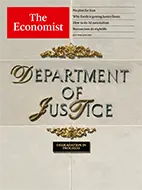
Degradation in progress
What the gutting of an institution means for America
THE PURSUIT of enemies grabs all the attention, and for good reason. Markets were shocked to see President Donald Trump set the Department of Justice (DoJ) on Jerome Powell when he was still the chairman of the Federal Reserve. Champions of press freedom cried foul last week when the department issued subpoenas to New York Times journalists for explaining the truth about Qatar’s gift of a jet to the president. But Mr Trump’s grievance agenda isn’t the half of it.
In a sign of how much he treats the department as his own personal law firm, he wants his actual lawyer to become attorney-general. Senate hearings begin this week for Todd Blanche, who is currently the acting attorney-general. Those on Mr Trump’s enemies list are not the only ones who should be worried. The president is also inflicting less-noticed harms on the DoJ that are as bad as the attention-grabbing ones. The damage is likely to be profound.
The DoJ is the government’s lawyer, but it also serves as the guardian of the law, especially since Watergate. In 2019 Bill Barr, then Mr Trump’s pick for attorney-general, said that Americans “have to know that there are places in the government where the rule of law—not politics—holds sway” and that the Department of Justice “must be such a place”. Mr Trump has no time for that. Less than halfway through his second term, he has turned the DoJ from an arm of the law into a muscular limb of the presidency (see United States section).
For a start, he has dramatically redefined the department’s priorities, which is legitimate, often by setting goals that blur policy and politics, which is not. Health-care fraud is being chased with particular zeal in states run by Democrats, such as California and Minnesota, where it can be used to discredit Mr Trump’s opponents, including the states’ governors, Gavin Newsom and Tim Walz.
The DoJ is also an effective tool for pursuing his political agenda. Election fraud is consuming ever more of its resourc-es—not because it is a real problem, but because it is a presidential obsession. The DoJ has sued states for access to their voter rolls. In January the FBI seized hundreds of boxes filled with ballots and other documents in Georgia’s most populous county, part of an investigation of the presidential election in 2020. More recently, some 260 FBI analysts were dispatched to pore over Georgia’s files, with a deadline to review records by July 17th. At the very least, this will shake voters’ faith that elections are trustworthy—indeed, that may be its sinister design.
Matters of genuine public interest are left to languish. About a quarter of the DoJ’s lawyers have left. Divisions that investigated cryptocurrency fraud and public corruption have withered. Financial-fraud indictments by prosecutors at DoJ headquarters and in Manhattan are down by 30% from the ten-year average. About 300 special agents who specialise in national security have quit the FBI, taking decades of experience in counterterrorism and cyber-warfare with them.
The department has also become more chaotic. Too often, cases encounter problems in court, though it is hard to distinguish sloppiness by DoJ staff from deliberate ill-intent. Nearly 100 times in Mr Trump’s first 14 months, the DoJ supplied courts with inaccurate information. It is quite something for the state to lose the benefit of the doubt in its own courtrooms.
More than 61,000 petitions from detained immigrants have bogged down courts and frustrated judges and federal prosecutors, who have moved lawyers from criminal divisions to help. By September last year, about a fifth of FBI agents had been diverted to immigration enforcement.
Meanwhile, the president’s powers are increasing. In Trump v Slaughter last month the Supreme Court ruled that the president could sack leaders of semi-independent agencies, such as the Federal Trade Commission (FTC) and the Securities and Exchange Commission (SEC). That gives the president the capacity to force agencies to work in league with the DoJ. Imagine a co-ordinated campaign of pressure, in which the DoJ opens an antitrust inquiry, the FTC explores consumer fraud and the SEC investigates corporate disclosures.
Unfortunately, the permanent appointment of Mr Blanche is unlikely to mark an improvement. He has done as much as anyone to advance Mr Trump’s agenda of prosecuting his enemies and protecting his friends—a powerful combination for encouraging people to comply with Mr Trump’s wishes. Under Mr Blanche, the DoJ has recently threatened state election officials with criminal prosecution if they knowingly let non-citizens remain on voting rolls.
Democrats and more than 1,200 former DoJ lawyers have demanded that the Senate reject Mr Blanche’s nomination. The Senate now has the choice of confirming him, and thereby seeming to endorse Mr Trump’s broader agenda, or blocking him in a rare rebuke to the president. Unfortunately, a rejection may not accomplish all that much. Mr Trump can retain Mr Blanche as acting attorney-general for months or nominate someone just as pliable.
The best Americans can hope for, in the next two years, is that courts stand firm. So far they have generally checked the DoJ’s worst impulses. On July 7th a federal judge blocked the department’s effort to subpoena the names of election workers in Georgia. On July 13th another federal judge nullified a settlement organised by the DoJ in response to a civil case brought by Mr Trump that would have protected the president and his family from tax audits.
In the dock
Even if Americans elect a president who wants to restore the DoJ, the damage will be hard to reverse. Mr Trump’s acolytes would see the ejection of his partisan lawyers as a witch hunt that justifies the next purge when they take back power. Once the arrival of any new administration routinely entails a fresh round of sackings, professionals who care about the rule of law will think twice about signing up. After Watergate, statesmanship and a bipartisan effort were needed to create the modern DoJ. Today the stakes are as high, and the task is harder.
Department of Justice
- What the gutting of the Department of Justice means for America: leader, page 7, and analysis, page 17.
No plan for Iran
- America’s president looks out of good options for solving the stand-off in the Gulf: leader, page 9, and analysis, page 34.
- Iraq’s new prime minister courts America but may not be able to shake off Iran, page 35.
Why Earth is getting hotter faster
- The planet is absorbing a lot more sunshine. That is bad news: leader, page 8.
- It is alarming scientists, too, page 63.
- Europe fears its carbon price will hurt competitiveness, page 40.
How to do AI nationalism
- Rules to make AI models safe are welcome, but the power wielded by America and China brings dangers: leader, page 10.
- For most countries, truly sovereign AI is a pipe dream, page 47.
- America’s quest for AI dominance is scary, but China is not the solution: The Telegram, page 50.
- Sir Demis Hassabis sets out his plan to harness AI safely, page 52.
Bureaucrats do nightlife
- America should stop making it so hard to have fun: leader, page 11.
- Encouraging party-going is serious public policy, page 20.
The world this week Politics
- The ceasefire between America and Iran all but collapsed, after Donald Trump reinstated a blockade of Iranian vessels in the Strait of Hormuz and ordered fresh strikes to degrade Iran’s ability to attack commercial shipping. Iran continued to target countries in the region, including Kuwait and Jordan, and struck two United Arab Emirates’ oil tankers with cruise missiles. America hit a tanker heading towards Kharg island, Iran’s oil-export hub. Mr Trump raised, and then quickly backed down from, the possibility of America charging a 20% fee on ships that traverse the strait. Oil prices jumped.
- Iraq’s new prime minister, Ali al-Zaidi, visited the White House. Mr Trump was effusive in his praise, describing Mr al-Zaidi as a “great leader”. The president had in effect blocked the return of Nouri al-Maliki as prime minister, viewing him as too close to Iran. Iraq’s new leader is under intense pressure to disarm Iranian-aligned militias that have launched attacks on American facilities.
- Israel’s general election is to be held on October 27th. Binyamin Netanyahu’s government will have served a full term when the Knesset is dissolved on July 17th.
- Oxford University launched the first trial of a vaccine against the strain of Ebola that has broken out in the Democratic Republic of Congo. Nearly 800 people have died and over 2,000 are infected. Scientists think that the current outbreak could be worse than the one that killed more than 11,000 people in west Africa ten years ago, unless there is an improvement in efforts to combat the disease.
- Lindsey Graham, a senior American senator from South Carolina, died unexpectedly at the age of 71. He had just returned from Ukraine and was pushing a bill to widen sanctions against Russia. Mr Trump described Mr Graham as a “great politician”, though the senator opposed Mr Trump’s first run for president, becoming a steadfast ally only after his victory. Mr Graham also supported Israel’s war aims and advocated for a tough stand against Iran.
- A suspect was arrested in the murder of Ann Widdecombe, a former MP and Conservative government minister in Britain who switched to the populistright Reform UK and was its justice spokeswoman. Ms Widdecombe, a devout Christian who converted to Catholicism and fiercely resisted the transgender movement, was found dead at her home.
- Reform called for better security protection for MPs after a man was arrested for threatening on social media to shoot its leader, Nigel Farage.
Into the sunset
- Andy Burnham easily secured the support of enough Labour MPs to become the party’s new leader, ensuring that he will take over from Sir Keir Starmer. Sir Keir took his last prime minister’s questions in the House of Commons. “I am proud of everything that we have achieved,” said the man with the worst satisfaction ratings ever recorded for a British prime minister.
- El Salvador’s president, Nayib Bukele, was nominated by his New Ideas party to run for a third term at next year’s election. When Mr Bukele was first elected in 2019 presidents were limited to one term. But in 2021 the country’s top court ruled that he could run a second time. Last year the legislative
- assembly passed a constitutional amendment scrapping term limits for the presidency altogether and extending the term in office from five years to six. Some observers fear that El Salvador is slipping back to the old Latin American model of one-man rule.
- The death toll from two recent earthquakes in Venezuela approached 5,000. The government is in discussions with the IMF about tapping its special drawing rights at the fund for humanitarian uses.
- At least 32 people died when a fire engulfed a bar in Bangkok. Survivors described how they encountered locked doors and poor signage when they tried to escape the inferno.
- More violent clashes broke out in Pakistan-administered Kashmir over seats in the local assembly that are reserved for refugees who live in other parts of Pakistan. A grassroots organisation, the Joint Action Committee, has been banned for stirring the protests; it claims the reserved seats weaken local representation. Nine people were killed in the recent trouble. Around 30 have died over the past few weeks.
- Almost 2m people were evacuated in China from the path of Typhoon Bavi, a gigantic storm that spanned 1,000km (620 miles) at its widest point. Bavi made landfall at Taizhou, around 300km south of Shanghai, before turning on Wenzhou, which is a little farther south.
- Volodymyr Zelensky shook up his cabinet, which resulted in Yuliia Svyrydenko stepping down as prime minister after just a year in the job. “Ukraine is changing its political strategy,” said Mr Zelensky. Mykhailo Fedorov, the defence minister who is widely credited with Ukraine’s successful use of new wartime technology, was also ousted after clashing with generals. Meanwhile, Russia attacked Kyiv with another heavy bombardment, its fifth this month.
- Lithuania’s ruling coalition approved Mindaugas Sinkevicius as the new prime minister. The coalition in parliament voted for his manifesto, which includes keeping spending on defence to at least 5% of GDP and an aim to keep American troops in the country for the long term. Although Russia is suffering heavy losses in Ukraine, it would be a mistake to think its “military threat is subsiding”, said Mr Sinkevicius.
- The Hungarian parliament, now with the centrists holding a supermajority after April’s election, passed a constitutional amendment that would remove Tamas Sulyok from the presidency and Peter Polt as head of the Constitutional Court. Peter Magyar, the new prime minister, said both men had put their loyalty to Viktor Orban, the previous right-wing prime minister, above the interests of Hungary.
A break for the border
- Border controls between Gibraltar, a British overseas territory, and Spain were abolished. Checks had been administered on people crossing to and from Spain, and thus the European Union, but during the Brexit negotiations with Britain the EU insisted on allowing free movement. Spaniards and Gibraltarians can now cross their border with ease. But as Gibraltar is now in effect part of the EU’s Schengen free-movement area, nonGibraltarians will have to endure the EU’s new and technically challenged electronic border system at the airport.
The world this week Business
- Kevin Warsh gave his first report to Congress as chairman of the Federal Reserve. Mr Warsh said the Fed was committed to “restoring price stability”, which would entail a “regime change in policy” to make the inflation surge of the previous five years “a thing of the past”. Mr Warsh has appointed task forces to assess each of the five areas that are central to the Fed’s policy. The task forces’ members include Lord Mervyn King, a former governor of the Bank of England, and Greg Mankiw, who led George W. Bush’s Council of Economic Advisers.
- Mr Warsh gave his testimony as the latest figures on American consumer-price inflation showed the annual rate falling in June to 3.5%, from 4.2% in May. Core inflation, which excludes volatile food and energy prices, also fell, to 2.6%. Energy prices declined by 5.7%, month on month, after rising for three months.
- Brisk activity in equities trading during the second quarter led to huge profits at America’s big banks. Net income at JPMorgan Chase was up by 41%, year on year, to $21.2bn. Profits surged by 80% at Goldman Sachs, by 45% at Citigroup and by 27% at Bank of America.
- South Korea’s central bank raised interest rates for the first time in three years, lifting its base rate to 2.75%. The boom in exports from the country’s mighty chipmakers is expected to “spill over into domestic demand”, said the bank. Higher oil prices, coupled with a weaker won to pay for energy imports, are also adding to inflationary pressures.
- SK Hynix’s debut on the Nasdaq exchange was a success. The South Korean chipmaker raised $26.5bn through a sale of stock in American depositary receipts (allowing American investors to buy its shares). In the days following the flotation the share price fell as investors banked profits from the sale, but it then surged again in another rollercoaster week for the KOSPI, South Korea’s main stock-market index.
Gobbled up
- Uber agreed to buy Delivery Hero, a German online foodordering company that operates in 65 countries. The acquisition values Delivery Hero, which will sell its Turkish business and make other divestments, at €13bn ($14.8bn).
- China’s economy grew by 4.3% in the second quarter, year on year. Apart from the pandemic era it was the country’s slowest growth rate since the early 1990s, when its GDP statistics were standardised. The domestic economy has remained subdued during a long slowdown in the property market. Exports are booming, however. Separate figures showed the value of goods sent abroad rising by 27% in June. Shipments of cars were up by 71% to more than 1m for the first time.
- Apple lodged a lawsuit against OpenAI, accusing it and two former employees of stealing trade secrets. The complaint relates to OpenAI’s expansion into consumer devices, the development of which is now “rotten to the core”, according to Apple. OpenAI denies the claims. OpenAI’s first device will be a portable speaker.
- The AI boom powered ASML to another bumper quarter. The Dutch maker of lithography machines used to produce high-end chips recorded a 21% jump in sales, year on year, to €9.3bn ($10.7bn) and raised its annual outlook. TSMC, the world’s biggest contract-manufacturer of chips, reported a 77% rise in net profit and also lifted its revenue projections.
- New York imposed a one-year moratorium on building large AI data centres, the first American state to do so. Residents are objecting to the facilities, claiming, often on dubious evidence, that they use too much water and raise electricity prices.
- SpaceX’s stock slipped below the $135 it was listed at in its initial public offering on June 12th. More than $1trn has been wiped off the company’s market value since the share price hit a peak in mid-June.
Visionaries?
- Speculation that artificial intelligence is causing a market bubble was dismissed as “absurd” by Masayoshi Son, the boss of SoftBank. Mr Son was an early backer of the technology. He indulged in some speculation of his own. By 2040 humans will no longer be the “highest life form”, predicted Mr Son, $5trn a year will be spent on AI, and data centres will be powered by nuclear fusion. In June Mr Son compared worries about an AI bubble to “blasphemy”.
- Sir Demis Hassabis, the cofounder of Google DeepMind, called for the establishment of a regulatory body to oversee potential threats from the most-advanced AI models to national security. The organisation should be led by America, said Sir Demis, and modelled on the Financial Industry Regulatory Authority, an American non-governmental body that protects investors.
скачать журнал: The Economist July 18th 2026
|