Навигация по сайту
Bloomberg Businessweek June 2026 |
|
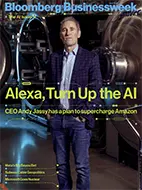
Год выпуска: June 2026 Автор: Bloomberg Businessweek Жанр: Экономика/Финансы Издательство: Bloomberg L.P. Формат: PDF (журнал на английском языке) Качество: OCR Количество страниц: 112 What a Smart Scarecrow Says About How AI May Change the EconomyIn 2020 two economists walked into a bar in San Diego and made a bet. Erik Brynjolfsson, head of the Stanford Digital Economy Lab, wagered that from 2020 to 2030, artificial intelligence would drive US labor productivity growth to more than 1.8% per year on average. Robert Gordon, an economist at Northwestern University, thought AI progress would be a little slower going. He put his money on productivity growth coming in below 1.8%. At stake: $400, to be donated to charity. As wonky and low stakes as the bet might sound, its outcome will have a much greater impact on our welfare than almost anything Polymarket could dream up. At the heart of the wager—and of the AI Issue of Bloomberg Businessweek—is a crucial question: How much is AI going to affect the economy? How fast? And will it be a good thing for workers, or are we all about to be AI’ed right out of a job? The best way to see how much the AI hype is actually manifesting on Main Street is to look at labor productivity, which has accelerated noticeably in the US in recent years. Productivity— basically, the amount of goods and services an economy churns out divided by the hours worked to generate that output—is one of the most important indicators of economic health. It’s also profoundly personal, says Diane Coyle, an economist at the University of Cambridge and author of The Measure of Progress. “It is the measure that most closely relates to how people’s living standards go up over time.” Technological breakthroughs like the steam engine, electricity, the internet and now AI help workers produce more. “Think about a construction site,” Coyle says. “A worker who gets a digger is going to be more productive than a worker who’s just got a shovel.” Innovation isn’t always welcome. In the 1900s pockets of farmers in the US and Britain vigorously resisted various forms of mechanization, from threshing machines to tractors. But at his farm in Surprise, Arizona, David Vose is embracing AI-enabled automation. Vose has run Blue Sky Organic Farms for more than 30 years, and in every one of those years he’s had to battle the birds: giant flocks of sparrows and yellow-breasted warblers that lay siege to his fields of cabbage, kale, beets and strawberries. “They just won’t go away, no matter what you do,” Vose says. “You have to stand in the middle of your field like a moving scarecrow.” One year, he took a day off when his lettuce plants were young. “I came back, and my crops were gone. Just wiped out. I had to replant everything.” Since then, Vose makes sure to have people constantly patrolling his fields. It doesn’t come cheap: Wages start at about $22 an hour, and shifts can be 10 hours long. During the growing season, battling birds can cost Vose upwards of $10,000 a month. Larger farms will have teams of more than a dozen people “walking up and down the fields every day banging on 5-gallon plastic pails with a stick,” he says. So when a group of engineers who’d graduated from Arizona State University approached Vose about testing their AI-powered scarecrow on his land, he gave them full access. Raghu Nandivada is chief executive officer of Padma AgRobotics, a startup based in Phoenix. He grew up on a farm in India, and when he heard Arizona growers griping about the birds, he realized AI could easily solve the problem. Nandivada developed a self-driving machine, roughly the size of a hot-dog cart, that can maneuver around delicate seedlings and scare birds off crops. His son suggested topping it with a wavy-armed inflatable figure like the ones outside car dealerships. The total cost for Nandivada’s “bird deterrent system” will likely be about $30,000, but for now he’s offering a subscription that lets farmers try out the system before committing to buy it. Even for a small farm like Blue Sky, it should pay for itself in a few months. Padma AgRobotics is also developing a self-driving sprayer and a contraption that can pick, clean and bundle cilantro. Each machine could save farmers millions of dollars a year. They could also put a lot of field-workers out of a job. This has always been the dark side of productivity. Workers can get left in the dust, as Northwestern’s Gordon notes, recalling when Microsoft Excel spreadsheets were introduced in 1985. “It decimated the ranks of bookkeepers,” he says. A version of this may be happening now: Tech layoffs were up 40% year over year as of March, and hiring has flatlined, especially for entry-level jobs. “I was talking to the CEO of a human resources company that has maybe 30,000 employees,” Gordon says. “She said, ‘A couple of years ago, we would hire 20 interns. This year we’re going to hire two.’ ” Yet one feature of what economists call general-purpose technologies—ones with applications across a broad swath of industries—is that while they can make certain jobs obsolete, they’ll also create new, better-paying ones. With the arrival of Excel, “a whole new set of occupations called financial analysts and financial managers opened up,” Gordon says. “Eventually, the number of people in those occupations grew as big as the shrinkage of bookkeepers.” Eventually. Therein lies the problem. The gap between a novel technology destroying jobs and creating new ones can be years. Gordon, for one, suspects that AI’s impact on the labor market will go far beyond anything Excel could conjure: Within the next five or so years, he estimates about one-third of white-collar jobs in the US will be transformed or eliminated. How long before the new crop of AI-enabled jobs arrives is harder to forecast. Writing in 1987, economist Robert Solow remarked that while personal computers were fast becoming ubiquitous in the workplace, they didn’t seem to be moving the needle in terms of productivity. “You can see the computer age everywhere but in the productivity statistics,” he quipped. Brynjolfsson, who as a graduate student assisted Solow in his research, later identified what he called the productivity paradox of IT. “It wasn’t enough to simply buy a computer and plug it in,” Brynjolfsson says. “You had to step back and rethink the whole business process to get the value from it.” In the case of the PC, it took nearly a decade for productivity to really take off. This is where the bet between Brynjolfsson and Gordon comes in. Companies are investing heavily in AI, but until they figure out how to retool their workflows to make the best use of the technology, productivity growth will likely be modest. A study from the Massachusetts Institute of Technology last year found that despite huge investments in AI, 95% of businesses reported no measurable return on investment. Three years from the deadline of Brynjolfsson and Gordon’s productivity bet, how are things looking? “I’m clearly going to lose,” Gordon says with a laugh. From 2020 to 2026, productivity in the US has increased by more than 2% on average (well above Gordon’s sub-1.8% wager). Still, he says, it’s unclear whether these gains will lift all boats the way the PC or Excel did. Right now companies like Meta Platforms, Microsoft and Amazon.com are making more money. Yet all three have announced significant layoffs in recent months, partly to compensate for the heavy investments they’re making in data centers and other AI infrastructure. Brynjolfsson says companies, along with industry groups and government organizations, need to address AI-related job displacement now. “It would be a tragedy if we took this growing pie and turned it into something that hurt a lot of people,” he says. “The most urgent challenge for our economy and our society today is navigating this transition. Shame on us if we turn it into a bad thing.” The rise of the robot scarecrow will not mean fewer jobs at Blue Sky Organic Farms, according to Vose. “I’ll probably hire and pay more money to some people that maybe have greater skill levels,” he says. “I might build a new farm store.” Vose says AI is having another unexpected effect in his neck of the woods: Prices for land in and around Surprise are soaring, which may put a damper on his expansion plans. “Thirty years ago, when I came here, the land was dirt cheap. Now it ain’t dirt cheap.” The reason? Data centers, being built to power AI. “They’re cranking them up around here like nobody’s business.” Remarks
In Context
In View
The AI Issue
Pursuits
Exit Strategy
скачать журнал: Bloomberg Businessweek June 2026
|