|
Год выпуска: июнь 2026
Автор: The Economist Newspaper and The Economist Group
Жанр: Экономика/Политика
Издательство: «The Economist Newspaper Ltd»
Формат: PDF (журнал на английском языке)
Качество: OCR
Количество страниц: 80
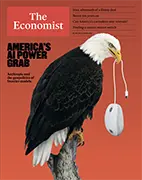
America’s AI power grab
Anthropic and the geopolitics of frontier models
- Uncle Sam has become the gatekeeper to frontier AI—a new source of extraordinary leverage: leader, page 9.
- Anthropic, the cult-like firm that is battling with the Trump administration for control of frontier models: briefing, page 15.
- How Europe must respond to America’s AI warning shot: By Invitation, page 14.
Iran: aftermath of a flimsy deal
- Donald Trump takes a huge gamble: leader, page 11.
- War has strengthened the Islamic Republic. Peace could split it, page 37.
- No one yet knows if this deal can do more than pause the bombing and restart the oil, page 38.
- Republicans are keen to move on from Iran, page 20.
Brexit, ten years on
- After a lost decade, it is time to focus on the future: leader, page 10.
- A special Britain section on how Brexit has, and has not, changed the country, after page 46.
- In the EU Brexit was followed by a modest shift towards federalism, page 42.
Can America’s carmakers stay relevant?
- America’s carmakers cannot escape competition from Chinese EVs for ever, page 55.
Finding a cancer master switch
- How a promising pancreatic-cancer drug could spawn a new class of treatments: Well Informed, page 75.
The world this week Politics
- America and Iran signed a 14-point preliminary agreement to end their almost-four-month war. Donald Trump and Masoud Pezeshkian, Iran’s president, signed the document separately. The Strait of Hormuz will be reopened to shipping as peace talks begin that aim for a final deal in 60 days. A $300bn reconstruction fund for Iran is one stickingpoint. It was unclear what this would entail, but Mr Trump said America would not contribute. America may lift sanctions on Iran, however, depending on negotiations about its nuclear programme. Earlier, Mr Trump noted that the agreement was only a memorandum of understanding, and “if they don’t behave, we’ll go right back to dropping bombs”. Back home, Republicans expressed dismay at the deal.
- The draft agreement also calls for an end to the fighting in Lebanon, though there was some debate as to what that means. Mike Huckabee, America’s ambassador in Jerusalem, said it did not refer to Hizbullah, which continues to fire missiles into Israel. And Israeli and American officials suggested it did not entail Israel pulling out from southern Lebanon, where it has been fighting Iran’s proxy militia. Talks progressed on a ceasefire between Israel and Lebanon that may allow residents who fled the area to return home.
- Cyril Ramaphosa, South Africa’s president, warned against the scapegoating of migrants, amid a wave of violence directed against workers from other African countries that has forced the repatriation of many of them. Unions also told their members not to participate in anti-migrant protests.
- The G7 issued a statement at its latest meeting that gave full support to Ukraine’s territorial integrity and pledged to impose more sanctions on Russia. America supported the statement. Mr Trump, who attended the summit in the French lakeside resort of Évian-les-Bains, described his meeting with Volodymyr Zelensky as “very good”. “Russia should make a deal,” the American president said, and “I’m gonna do whatever I can” to get one.
- Before the summit Russia struck the Kyiv Pechersk Lavra monastery, a UNESCO heritage site, badly damaging the complex. The monastery was founded in 1051 and is one of the foremost centres of Orthodox Christianity in eastern Europe. Eleven people were killed across Ukraine in a single Russian attack wave. Ukraine struck Russia’s biggest oil refinery with drones, starting a fire.
Who rules the waves?
- Britain's Royal Navy boarded a vessel from Russia's shadow fleet in the English Channel. The operation passed without incident, but some reports questioned the timing, as it followed a political row in Britain over defence spending that resulted in the resignation of the defence secretary and the minister for armed forces. Both men have criticised Sir Keir Starmer’s commitment to invest in defence. After the boarding a Russian frigate fired warning shots to avoid colliding with a British yacht.
- The Court of Appeal in Britain ruled in favour of the government’s ban on Palestine Action, reversing a lower court’s decision that had overturned the proscription. Although it noted that many supporters of the activist group are peaceful, the court found that it is “a fundamental mistake to overlook the fact that Palestine Action overtly promotes unlawful violence amounting to terrorism”. Four of its members were recently imprisoned for attacking an Israeli defence firm’s premises in Britain and fracturing a police officer’s spine with a sledgehammer.
- Voters in Switzerland rejected a proposal to cap the country’s population at 10m. The current population is just over 9m, but it is growing at a faster rate than those of Switzerland’s neighbours. The measure would have forced the Swiss government to start curbing growth once the population passed 9.5m, violating the country’s freedom-of-move-ment deal with the EU.
- The Hungarian parliament backed a change to the constitution that limits a prime minister’s time in office to a cumulative total of eight years. The measure is designed to stop Viktor Orban, who was booted out at a recent election, from returning to power. The winner of that election, the Tisza party, has a two-thirds supermajority in parliament. A future government with a similar supermajority could rescind the term limit.
- Eduardo Bolsonaro, the youngest son of Jair Bolsonaro, a former Brazilian president, was convicted by Brazil’s Supreme Court of trying to interfere in the trial of his father. Mr Bolsonaro senior is serving a sentence for plotting a coup. Eduardo Bolsonaro was found guilty of asking the Trump administration to put pressure on the court’s justices. He now lives in the United States and has accused the Brazilian court of persecuting his family.
- Niño Guerrero, the leader of Tren de Aragua, a Venezuelan criminal gang, was killed in an American strike, according to Mr Trump and his secretary of war, Pete Hegseth. The Venezuelan government said it had shared intelligence with the Americans and co-operated in the attack in Venezuela’s Bolívar state. America considers Tren de Aragua to be a terrorist organisation.
- The government of India issued a temporary ban on Telegram, after medical students were caught leaking test papers over the messaging app. The results of nationwide exams have been annulled and 2.2m students will have to resit them.
- Mr Trump said he would visit India, after he held a meeting with Narendra Modi, India’s prime minister, on the sidelines of the G7 summit in France. The new-found warmth between the two leaders is a change of tone to their tetchiness over the past year, especially over a free-trade deal.
- Min Aung Hlaing, a former military officer who led the coup against Myanmar’s government in 2021 and now claims the presidency, went to China for a state visit and a meeting with Xi Jinping. China invests heavily in Myanmar and controls several Belt and Road infrastructure projects in the country.
Sitting in his cage
- Donald Trump celebrated his 80th birthday by hosting an Ultimate Fighting Championship event on the White House lawn, the first-ever professional sporting occasion to be held on the building’s premises. Around 4,000 invited spectators attended the mixed-martial-arts tournament, and another 85,000 fans watched from a nearby area. The FBI said it had arrested several people who were planning to attack the event with drones.
The world this week Business
- The Federal Reserve left interest rates on hold, its first decision under Kevin Warsh as chairman. With inflationary pressures on the rise, the Fed abandoned the trajectory it maintained at previous meetings towards an easing of monetary policy. No one on the policy committee voted for a rate cut. In an indication of the start of the Warsh era, the central bank’s statement was very short, asserting that it would deliver price stability.
- The Bank of Japan lifted its key interest rate from 0.75% to 1%, taking it to its highest level since 1995. After two decades of deflation consumer prices in Japan rose steadily after the pandemic. The annual inflation rate has been well under 2% this year, but higher energy prices as a result of the Iran conflict are driving up costs. Wholesale inflation soared in April and in May, to 6.3%.
- The Trump administration imposed export controls on Anthropic’s most advanced AI, ordering the firm to block non-Americans from accessing its latest Fable and Mythos models. The government issued the decree apparently after Andy Jassy, the boss of Amazon, alerted officials to a “jailbreak” his researchers had found in Fable that bypasses safety protocols. Lacking the ability to distinguish between citizen and non-citizen users, Anthropic suspended access to Fable everywhere, even internally. The government’s decree underlined America’s control of AI frontier technology, and heightened angst among America’s allies about how far they lag behind the US.
- The European Parliament approved the trade deal with America that was agreed to in principle last year. European legislators postponed previous votes on the pact because of rows with the Trump administration over Greenland and the uncertainty caused by the Supreme Court’s reversal of Donald Trump’s tariffs. Mr Trump had threatened to increase duties on imports of European cars unless the parliament approved the agreement by July 4th.
- Fox Corporation, an entertainment and news company, advanced its ambitions in streaming by agreeing to buy Roku, which sells streaming hardware and software and operates streaming channels, for $22bn. In 2020 Fox bought Tubi, a free ad-supported streaming service. Last year it launched Fox One, its own app.
We have lift-off
- The share price of SpaceX soared by 50% in the days following its initial public offering, lifting it to a market valuation of almost $2.7trn and challenging Amazon for the spot of world’s fifth-biggest listed company (behind Nvidia, Alphabet, Apple and Microsoft). The company raised $85.7bn on its first day of trading once underwriters bought additional shares, smashing the record for the world’s larg-est-ever IPO. Elon Musk’s personal wealth has jumped to $1.3trn according to Bloomberg. Even if that was reduced by $1trn he would still be the world’s richest person.
- The oil and gas industry in the Gulf should see a gradual recovery if the peace deal between America and Iran holds, according to the International Energy Agency. Mines still have to be removed from shipping lanes and supply chains will take time to normalise, it said. The IEA doesn’t expect the market to heal fully until next year, when supplies will surge, lowering the price of oil considerably and allowing countries to restock their depleted reserves.
- Flushed with success, SpaceX agreed to buy Cursor, which uses AIto automate computer coding, for $60bn. The acquisition will allow xAI, Mr Musk’s AI business, which is now owned by SpaceX, to boost its presence in the lucrative business of AI coding for company systems.
- For years Pizza Hut’s sales have struggled as consumers have become more health conscious, and now its owner, Yum Brands!, has decided to shift some weight by selling the franchise. In two deals Pizza Hut’s 15,000 restaurants outside China were sold to a private-equity company, and the outlets inside China were acquired by Yum’s Chinese holding company. It plans to expand Pizza Hut in China, where it is already the largest casual-dining brand.
- When marketing goes wrong Starbucks Korea, which operates the coffee-chain franchise in South Korea, said all its staff would receive training in historical awareness. The firm faces a backlash after a “Tank Day” marketing gimmick was seen to be making light of a pro-democracy protest in 1980, at which hundreds were killed. Lululemon also found itself mired in controversy for ignoring local sensitivities, after it held a promotional event on the Great Wall of China that featured a Japanese drum. Amid renewed tensions between China and Japan the yoga-gear-maker apologised, blaming “limitations in our professional knowledge”.
скачать журнал: The Economist - June 20th 2026
|