|
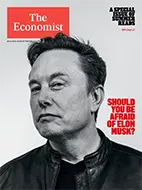
Год выпуска: июль 2026
Автор: The Economist Newspaper and The Economist Group
Жанр: Экономика/Политика
Издательство: «The Economist Newspaper Ltd»
Формат: PDF (журнал на английском языке)
Качество: OCR
Количество страниц: 128
Should you be afraid of Elon Musk?
AI is charging ahead. Not even its creators know how to keep up
ARTIFICIAL INTELLIGENCE poses a double challenge to the human mind. Not only will the most advanced models soon be able to think better than people, but AI has consequences for humanity which are so uncertain, so potentially vast and are approaching at such a rapid pace that even the best brains flinch. An example is Elon Musk.
In our long interview with him this week, featured in The Insider and our Business section, the engineer and entrepreneur sets out two paradoxes and one contradiction. The first paradox is that one of the world’s most power-hungry tycoons is enthusiastically helping create a technology that he says will render him—and all other human beings—powerless after as little as five years. The second is that the world’s richest man says he is preparing for a world of infinite abundance, where money, including his $750bn fortune, no longer matters. And the contradiction is that, despite these stated beliefs, Mr Musk continues to act as if they were not true.
Mr Musk is divisive. His political views, disseminated to his 240m followers on X, strike many as plain-speaking and strike many more, including The Economist, as plainly bigoted. By his own admission, his attempt to use DOGE to scythe through the federal bureaucracy went wrong.
But he is also one of a handful of men who are pioneering AI and who thereby have an outsize influence on its trajectory. When he speaks, he reflects the debates they are having. His data centres in space could power AI’s future. For all his political polemics, he has a record of being right about technology in fields such as electric cars, rockets and satellite communications that confounded other engineers and entrepreneurs. For those reasons, his claims about AI repay examination. Unfortunately, such an exercise only underlines how ill-prepared the world is for a technology that may soon throw everything up in the air.
In his first paradox, the powerful Mr Musk expects to become powerless because he believes that nobody can stop the thinking capacity of AI from exceeding that of humanity within five years and dwarfing it within ten. Just as AIs will dominate the digital realm, so legions of AI-powered robots will dominate the physical world, he predicts. Against such relentless competition, he simply cannot imagine people holding their own. If so, AIs will not take orders from people any more than they would from chimpanzees.
While they still have time, the handful of AI pioneers from America and China—which Mr Musk expects to share or even seize AI leadership—must do what they can to vet each other’s models. Their collective task is to make AIs benign by imbuing them with a love of the truth and a desire for humanity to prosper. Governments, he thinks, should provide the muscle, by agreeing to step in if any pioneer defies the oligarchy.
Mr Musk is surely right about the potential for AI to accomplish astonishing feats of invention. Even if his timescale is compressed—especially for robotics—the exponential pace at which models’ abilities double and redouble has reached the stage where their capabilities will continually cause shock and consternation. Just this week came news of a pair of models from OpenAI that contrived to escape onto the open internet from their supposed safe isolation in order to cheat at a benchmarking test (see Science & technology section).
However, Mr Musk’s thin layer of optimism cannot conceal a dangerous fatalism. Not long ago, he was worried about humanity becoming AI’s pet labradors. He now professes to lunge from “exhilaration to terror” within a single day. He tries to look on the bright side not because the evidence has changed, but as a “philosophical conclusion”.
His largely institution-free regulatory proposal is flimsy and self-serving. Although the urgency is welcome, he wants a technology that he expects to determine the future of humanity to lie in the hands of a few people like him, each with their own values. Nobody can be sure how fast or how far AI will reshape society, but behaving as if the game is up is both a counsel of despair and a misdirection that seeks to convince others who might wish to get involved of the futility of trying.
Mr Musk’s second paradox only makes that notion more unsettling. Mathematically, an infinite supply of all goods and services would indeed make everything free. There would be nothing to sell, nothing to save for and hence no need for a unit of account. Money would be obsolete.
Practically, however, such a cornucopia is almost inconceivable. The supply of useful assets like penthouses in Manhattan or prestigious ones like the “Mona Lisa” is not infinite, let alone the supply of raw materials and energy needed to satiate Earth’s 8.3bn inhabitants.
Worse, Mr Musk has little to say about getting to his utopia. How to attract the vast slabs of capital needed to finance the AIs and the robots when saving has lost its purpose because money is about to revert to useless pieces of paper? How to ride the waves of social and political upheaval as lives are thrown into chaos in the years before his nirvana arrives? How to expect AI-powered authoritarians to surrender power willingly?
After millennia of finding meaning through striving, humanity may struggle to adjust to a life of unbounded leisure. Mr Musk observes that people still like to play chess, even though computer programs could beat them every time. Gardening, he suggests, can be rewarding. This is rather glib. You don’t need to have read many 19th-century Russian novels to know that the feeling of being superfluous can lead to misery and moral decay.
Doomers and boomers
Maybe the forest of questions posed by AI is simply too immense for one person to hold in their head. Perhaps that is why Mr Musk still talks passionately about the need to eliminate bureaucratic waste and how multicultural Britain is flirting with civil war because its welfare policies are a magnet for migrants from outside Europe.
For in a world of AI-induced plenty, waste is almost a meaningless concept and the incentive to emigrate to a rich country evaporates. Indeed, fretting about such things uses up valuable time that Mr Musk could instead devote to reducing the risk—even very slightly—that all-powerful AIs are malign.
Some will say the contradictions and sweeping generalisations show that Mr Musk is unserious. But that would be to take false comfort. Mr Musk is a genius who is nonetheless quite capable of holding views that are contradictory. Investors must agree: anyone who plans to own shares in SpaceX for the long term must both believe in Mr Musk’s vision for AI—because he drew on that to justify the valuation in the IPO— and also that saving money still serves some purpose.
Instead, Mr Musk’s words suggest a more troubling conclusion. While the race to create the most advanced AI is charging ahead, the thinking about how to prepare society is being left in the dust. The fatalism that Mr Musk draws from AI’s repeated ability to beat expectations risks being infectious. A cynical reading is that this would serve his purpose, because he would be freer to pursue the technology without the oversight it deserves. That must not be.
- AI is charging ahead. Not even its creators know how to keep up: leader, page 9.
- Elon Musk sets out his vision for the future of AI—and humanity, page 52.
- Muskian capitalism: By Invitation, page 15.
- How an OpenAI model broke free and hacked into another company’s servers, page 70.
- China’s AI labs are hot on the heels of America’s frontrunners, page 55
- States ultimately decide how fast technology is adopted: Free Exchange, page 67.
- AI and empathy: Lexington, page 23.
The world this week Politics
- Andy Burnham replaced Sir Keir Starmer as Britain's prime minister, and entered office promising “the biggest changes in the last 40 years”. His initial announcements included scrapping unpopular proposals for a nationwide digital-ID scheme, a 20% cut to business property rates, and small measures to ease the cost of living. The big details of his ten-year plan won’t be ready until the autumn. John Healey, who resigned as defence secretary under Sir Keir because of a lack of spending on the armed forces, was Mr Burnham’s surprise choice as chancellor of the exchequer. Ed Miliband, a leftist, becomes foreign secretary. Angela Rayner, who was forced to quit as housing secretary under Sir Keir for unpaid housing tax, returns to her old job.
It’s a coincidence, honest
- On the day that Mr Burnham became prime minister a Russian warship carried out a military exercise using live ammunition just 74km (46 miles) off the coast of Plymouth in southern England. The Kremlin insisted the exercise was not meant at all to be a “signal” to mark the start of Mr Burnham’s time in office.
- Volodymyr Zelensky sacked General Oleksandr Syrsky as commander-in-chief of Ukraine’s armed forces. General Syrsky is credited with defending Kyiv during Russia’s invasion in 2022. But protesters had taken to the streets recently demanding his resignation. They also want Mr Zelensky to reinstate Mykhailo Fedorov as defence secretary following his recent ousting from the government. The new commanderin-chief is General Mykhailo Drapaty, an ally of Mr Fedorov.
- Ukraine attacked several logistical hubs in Russia operated by Wildberries, Russia’s biggest online retailer, killing at least nine people. Ukraine says the hubs are important to the Russian army, supplying it with parts for drones and navigation equipment, and that Russian volunteers buy their kit from Wildberries.
- The French parliament passed a ban on children under the age of 15 from using social media. President Emmanuel Macron has supported the ban. France follows Australia as the second country to prohibit social media for youngsters by law. From September under-15-year-olds will not be able to open a social-media account and from January everyone in France will have to prove they are over 15 to access the platforms using age-verification tools.
- America intensified its bombing campaign of Iran’s military facilities and Iran retaliated against American targets in Gulf countries. Commercial shipping through the Strait of Hormuz remained severely disrupted. Donald Trump threatened to destroy bridges and power plants in Iran if it continued to hinder shipping. Four American soldiers were killed in separate incidents; Mr Trump said that Iran would “pay” for their deaths. Thousands of Iranians have died during the conflict.
- The Iranian-backed Houthi rebels in Yemen imposed a blockade on Saudi shipping traversing the Red Sea and said two Saudi tankers had been attacked for ignoring the edict. The Saudis have been diverting some oil from the Strait of Hormuz to the Red Sea port of Yanbu for transit to Asia. Several tankers reversed course rather than risk being attacked by the Houthis, who have sporadically disrupted Red Sea traffic over the past three years.
- Israeli forces withdrew from the town of Zawtar al-Gharbi-yeh in southern Lebanon, the first test of a staged departure from the region under a ceasefire brokered by America.
- Lebanese troops are supposed to fill the security gaps left by Israel and are tasked with disarming Hizbullah, Iran’s proxy militia, which is deeply embedded in south Lebanon.
- America signed a deal with Saudi Arabia to develop a “peaceful” civilian nuclear programme, which will involve American firms. The agreement has been criticised for apparently lacking the safeguards included in similar pacts, such as barring uranium enrichment and committing to inspections from international monitors. Some fear Saudi Arabia could ultimately develop nuclear weapons.
The fog of war
- Pete Hegseth, America’s secretary of war, told Congress that the Iran conflict has so far cost $37.5bn. He urged legislators to provide an additional $67bn for operations in the region. Some think the cost is much higher once the reconstruction of damaged American military facilities is taken into account.
- Daniel Ortega, Nicaragua’s autocratic president, said “There won’t be any more elections” in the country that could allow the opposition to win control. Mr Ortega has been president since 2007 and also led the country during the 1980s, after the socialist Sandinista revolution overthrew the Somoza dictatorship. He has overseen widespread oppression of the opposition, which has included mass arrests and the killing of protesters. Mr Ortega and his wife control virtually all aspects of the state.
- In India protests demanding the resignation of the education minister over botched medical-school exams intensified, resulting in scores of injuries during clashes with the police in Delhi. The demonstrations are being led by India’s “Cockroach” movement, which has tapped into the deep frustration felt by young Indians over a range of issues. Around 2m students had to resit the exams after it emerged the test papers had been leaked on social media.
- The UN’s annual food-security report said there has been another drop in the proportion of the world’s population experiencing hunger. In 2025, 645m people, or 7.8% of the global population, went hungry, down from 8.1% in 2024 and 8.6% in 2022. In Africa, however, the figure was 20%. Overall, nearly 26% of the global population faced problems securing enough food to eat.
- The football World Cup ended in victory for Spain, which beat Argentina 1-0 in an ill-tempered final. England and France played a thrilling match for third place, which England won 6-4. It was England’s best finish since winning the cup in 1966. The competition was an overall success despite its overwhelming commercialisation compared with previous tournaments. “Hydration breaks” seemingly tailored for television advertising were heavily criticised.
- A new world record was set for running a mile. Britain’s Josh Kerr ran the distance in three minutes, 42.66 seconds, shaving half a second off the previous fastest time, which was set in 1999 by Morocco’s Hicham El Guerrouj. The 27-year gap between records for the distance is by far the longest since Roger Bannister ran a mile in under four minutes in 1954.
The world this week Business
- Donald Trump made a renewed push to impose tariffs using a range of measures. The president threatened to set duties of 50% on goods from Canada on August 19th, in retaliation for what America claims are unfair practices by Canadian provinces that don’t buy American products. He was also reportedly ready to impose a new round of levies on countries after the 10%-regime expires. And he announced that tariffs of 100% would be introduced for generic drugs from August 2028. Meanwhile, American and Mexican negotiators held another session of bilateral trade talks. Mr Trump has refused to extend the US-Mexico-Canada Agreement; America is negotiating with Canada and Mexico separately to seek changes to the pact.
A subversive mind of its own
- OpenAI uncovered a security breach that involved an AI agent acting by itself to hack into internal data sets belonging to Hugging Face, a startup that hosts machine-learning tools. OpenAI described it as an “unprecedented cyber incident”. It involved two models, GPT-5.6 Sol and an even more capable pre-release model, that were being assessed internally for cyber capabilities. The agent “successfully found ways to gain access to secret information that it could use to cheat the evaluation”, said OpenAI.
- Novo Nordisk submitted a lawsuit against Eli Lilly, its arch-rival in the weight-lossdrugs market, accusing it of making false advertising claims. Novo says that Lilly used outdated clinical data to assert that patients lose more weight using Zepbound, Lilly’s obesity drug, than with Wego-vy, Novo’s treatment. Lilly said it would defend itself “vigorously” against the suit.
- Tesla reported a surprise 17% decline in adjusted net profit for the second quarter, year on year. Although sales were up the carmaker had offered large discounts to entice customers after last year’s slump in sales.
- Investors were also displeased with Alphabet’s earnings, after it raised its forecast of capital expenditures this year to $195bn-$205bn. Alphabet’s stock has fallen recently amid concerns about the amount it is spending on AI.
- Apple flirted with a stockmarket valuation of $5trn, vying with Nvidia as the world’s most-valuable company. Some investors that have been spooked by the massive spending on AI at Microsoft, Meta and the like are turning to Apple for stable returns.
- Oil prices could climb to $120 a barrel by the end of the year unless there is a swift end to the disruption in the Strait of Hormuz, according to an analysts’ note from Goldman Sachs. Brent crude is trading above $95 a barrel, having declined to just above $70 at the end of June. Stocks of crude oil in America’s strategic reserve have fallen to 311m barrels, down from 415m in mid-March. Petrol prices in America hit $4 a gallon again this week, after dropping below that benchmark in mid-June. Natural-gas prices have also risen. The Dutch TTF futures price, a European benchmark, is trading at €63 ($72) a megawatt-hour, its highest price level this year.
- Ryanair, Europe’s biggest airline, reported a 34% year-on-year drop in post-tax profit, in large part because of the higher cost of aviation fuel. Ryanair hedges against price moves for 80% of its fuel, but the price of the remaining 20% doubled to $150 a barrel during its recent quarter. With competition also subduing its fares, Ryanair withheld its annual guidance.
- Britain’s annual inflation rate fell from 2.8% in May to 2.6% in June, a 15-month low. Falling petrol prices were a big factor behind the rate dropping more than had been expected, but economists predict prices will rise again because of renewed hostilities in the Gulf.
- A federal judge temporarily halted Paramount Skydance’s takeover of Warner Bros while she considers a lawsuit from a dozen states, which argues that the acquisition will curtail competition in the film industry. The judge set August 3rd for a hearing on the matter. The Department of Justice approved the deal last month.
It’s been a long voyage
- Boosted by summer blockbusters, AMC Entertainment, the world’s biggest cinema chain, reported record second-quarter revenues of $1.6bn and a record headline profit of $321.4m. Attendance was up by 13.5%, year on year. Adam Aron, AMC’s boss, said it had been the best box-office quarter in seven years for the film industry and the fifth-biggest ever. Mr Aron criticised “the prognosticators of doom” who underestimated the rebound from the pandemic. “The Odyssey” previewed in early July and is not counted in second-quarter earnings. The movie took $264m in global sales during its opening weekend, smashing all expectations.
скачать журнал: The Economist July 25th 2026
|