|
Год выпуска: август 2026
Автор: The Economist Newspaper and The Economist Group
Жанр: Экономика/Политика
Издательство: «The Economist Newspaper Ltd»
Формат: PDF (журнал на английском языке)
Качество: OCR
Количество страниц: 76
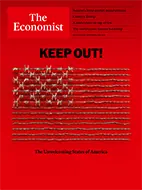
KEEP OUT!
The Unwelcoming States of America
- By trying to change its demographic trajectory, Donald Trump will make America weaker: leader, page 7.
- His deportation machine is now quieter, but more effective: briefing, page 15.
- What will his high-tech border wall achieve? Page 19.
- The economic consequences of zero net migration, page 60.
Bessent’s bond-market misadventures
- America will regret the treasury secretary’s market meddling: leader, page 8.
- He is also making trouble for the Fed, page 57.
Carney v Trump
- Canada’s prime minister must defuse a trade war not of his making: leader, page 8, and analysis, page 25.
A Sino-American tug-of-law
- Obeying an American law can mean breaking a Chinese one. Multinationals beware: leader, page 11.
- Like America, China wants its laws to apply everywhere, page 32.
The world’s most famous bookshop
- Shakespeare and Company is turning 75.
- Is its success replicable? Page 68.
The world this week Politics
- Scott Bessent, America's treasury secretary, announced a new set of sanctions against Iran that he claimed would be “the single greatest financial offensive ever marshalled against an adversary”. He also threatened secondary measures against Iran’s trading partners but said they would be given time to comply. Iran vowed to retaliate, warning that “not a single drop of oil” would leave the Gulf if the pressure continued. China, which last year bought 90% of Iranian oil exports, said that its trade with Iran “should not be interfered with or disrupted”.
- The commander of the Syrian Democratic Forces, a Kurdish-led militia, said it would disband and merge with the Syrian army. The SDF was once America’s main partner in fighting Islamic State in Syria and controlled the country’s north-east for more than a decade. Meanwhile, America removed Syria from its list of state sponsors of terrorism, lifting a barrier to private investment in the country.
- Muhoozi Kainerugaba, the head of Uganda’s armed forces, said he would run in an election to succeed Yoweri Museveni, his father, as president in 2031. General Kaineru-gaba has played a key role in helping his father, who has ruled Uganda since 1986, hang on to power. He is notorious for his social-media posts, including one from 2022 in which he talked about invading Kenya (some of the posts were in jest).
- In Haiti around 50 people were killed when gangs attacked Kenscoff, a hillside neigh-bourhood in Port-au-Prince at a strategic point above the capital. More than 3,000 people have been killed in Haiti in the first six months of this year, according to the UN. The government is still hoping to hold an election in December, its first in a decade.
- Canada was on the verge of an all-out trade war with the United States, after Mark Carney, the prime minister, rejected a trade deal that had been endorsed by Donald Trump. In a speech to Canadians, Mr Carney said that America had “asked too much and they offered too little”. Canada is threatening to impose $20bn-worth of retaliatory duties on American goods on September 8th, which allows some time for a solution to be reached. Mr Trump is threatening to raise tariffs to 50% on vehicles and car-part imports from Canada. He is also talking about renaming Lake Ontario “Lake America”.
The seeker
- Darline Graham won the Republican primary run-off for the South Carolina Senate seat that had been held by her brother, Lindsey Graham, who died in July. Endorsed by Mr Trump, Ms Graham took 52% of the vote in the primary and is now seeking victory in November’s midterms. She is heavily favoured to win.
- In an emergency sitting outside its regular term, the Supreme Court decided that the Trump administration could for now continue with its plans to restrict postal voting while a lower court considers the issue. Under the plan the Postal Service would deliver ballots only in states that shared electoral lists with it. It is unclear whether the system would be in place for November’s midterm elections, and it is bound to face other legal challenges.
- The Trump administration suspended applications for immigrant visas globally while consular officers are trained to screen out applicants who might need public assistance. It has also begun revoking visas issued to people who entered the United States on shortterm business or tourism visas and subsequently claimed asylum. Around 200,000 such visas could be cancelled. Meanwhile, the Department of Homeland Security proposed charging $103,265 for H-1B visas for skilled workers. A similar proposal was struck down by a federal court in June.
- Ukraine expanded its attacks on Russian e-commerce sites by targeting logistics hubs owned by Ozon, Russia’s second-largest online retailer. Over the past month Ukraine has carried out strikes on Wildberries, the biggest e-retailer, part of a strategy to bring the war home to ordinary Russians and further disrupt the Russian economy.
- Mykhailo Fedorov, who was ousted as Ukraine’s defence minister by Volodymyr Zelensky, took another shot at his former boss, blaming an “absence of vision” that has led to Ukraine “gradually, slowly losing” the war. Mr Fedorov stunned Ukrainians recently by calling for an election.
- On his first overseas trip as Britain’s prime minister, Andy Burnham went to Kyiv, where he chaired a meeting of the “coalition of the willing”, 34 countries that have pledged support to Ukraine. Mr Burnham announced that the Ukrainians would be allowed to access classified information on SCALP, a long-range missile, so that it can be built in Ukraine. The Kremlin said Britain was adding “fuel to the fire”, to which Mr Burnham responded, “Who started the fire? That’s the question, isn’t it?”
- In a parliamentary election in Kazakhstan Kassym-Jomart Tokayev tightened his grip on power. Adilet, a new party stuffed full of loyalists to the president, got over 70% of the vote, weakening allies of Nursultan Nazarbayev, the former president. Constitutional changes have reduced the Kazakh parliament to one chamber.
- Hundreds of people, including many foreign travellers, were missing following flash floods and mudslides in Nepal, close to the border with Tibet, where heavy casualties were also reported. Scores of people were confirmed to have died. The floods engulfed towns and villages, sweeping buildings and bridges away. It is thought a glacier may have partly collapsed, hurtling huge amounts of ice into rivers and causing water levels to surge.
- The UN Human Rights Office issued a report on Myanmar, where human rights have reached “a new low”, in part because of the “ever-worsening brutal abuse of the Rohingya population”. Unrelenting violence, an unregulated economy and the absence of the rule of law have meant that Myanmar’s people are living in “untold misery”, said the UN.
You’re the only one
- Tributes were paid to Dolly Parton, who died at the age of 80. The singer-songwriter’s career spanned six decades, during which she took country music from rural America to the mainstream, writing over 3,000 songs along the way. Born in Tennessee to a mother who bore 12 children and a father who was once a sharecropper, Ms Parton’s first hit came in 1967 with “Dumb Blonde”. She once quipped that “I know I’m not dumb, and I’m not blonde either.” Her husband of59 years died last year.
The world this week Business
- Meta agreed to pay up to $17bn to settle claims brought by American states that it designed Facebook and Instagram to be addictive to children. The settlement came amid a blockbuster federal trial in which the plaintiffs were seeking much higher penalties. As part of the agreement Meta promises to improve underage enforcement and to put daily limits on teenage users, among other things. It does not admit to any wrongdoing.
- SpaceX announced that it would spend $100bn on a new launch complex in Louisiana, which it described as “the perfect site”. The 50,000 hectares (125,000 acres) area will host ten launchpads for the firm’s gigantic Starship rocket, which is vital for its plan to put thousands of data centres into space. There was little detail about how SpaceX would spend the $100bn, nor a timetable for reaching its goal of launching the first Starship from the site in 2029.
- The yields on American long-dated government bonds stabilised after a choppy week. The yields on 30-year bonds recently reached their highest levels since 2007, before a surprise intervention from the Treasury, through which it doubled its bond repurchases. That had the immediate effect of pushing yields lower, though they climbed soon after as investors questioned the wisdom of the plan. Speculation increased that Scott Bessent, the treasury secretary, would increase the size of the bond buy-backs by tapping the Treasury’s General Account, held at the Federal Reserve.
- Mexico’s economy grew by 1.4% in the second quarter compared with the first quarter, when it contracted by 0.3%. Despite surging energy prices and trade turbulence, it was the country’s strongest GDP expansion since early 2022.
The bargain store
- Following years of delays, Shein launched its initial public offering; it is expected to start selling shares in Hong Kong on September 1st. The Chinese purveyor of ultracheap clothing had considered listing in London or New York, but ran into regulatory hurdles. American politicians also wanted assurances that the company does not use forced labour, an accusation that it denies. The IPO could value Shein at $27bn, far below the $100bn it was worth in privatemarket valuations in 2022.
- After rising by 460% on the first day of trading, Unitree’s share price plunged by 30% over subsequent days. The IPO of the Chinese maker of humanoid robots had been vastly oversubscribed, but questions are being asked about the ease with which institutional investors could “pump and dump” (buy up the shares in a frothy market then sell them quickly to make a profit).
- Nvidia reported another set of blockbuster earnings. Revenue in its latest quarter came in at $96.2bn, up by 106% year on year, and it made a net profit of $59.7bn, an increase of 126%. The company forecast a 70% rise in sales next year.
- Bolstered by record profits, Samsung announced a programme to return 90-110trn won ($65-$79bn) to shareholders, the most ever for the company. Earlier, SK Hynix, another South Korean chipmaker benefiting from the huge global demand for memory chips, said it would return 40trn won to stockholders.
- In what it described as the largest-ever expansion of its international schedule, United Airlines said it would start flying non-stop from America to ten new destinations, including Marseille, Okinawa and Valencia, and add more flights to Milan, Osaka and Paris. The airline already offers more international routes than its domestic rivals.
- Waymo, the robotaxi business owned by Alphabet, chose Munich as the first city in the EU to launch its service. It will start offering paid-passenger fully autonomous rides towards the end of 2027. Waymo operates in 11 American cities, providing 500,000 paid rides a week, and is expanding into 19 others. Itis also testing vehicles in London and Tokyo.
It’s all wrong but it’s all right
- The Australian music industry banned songs that have been wholly or substantially created by AI from the music charts, after it emerged that a hit cover of Madonna’s “Like a Prayer” was generated by AI. The Australian Recording Industry Association said its aim is to “promote the human nature of artistry”. One recent study reckoned that 40% of new music worldwide contains at least some AI. But the kids think it’s all right.
- Bill Gates published a lengthy essay in which he warned that governments were not doing enough to prepare for the disruption from AI. Mr Gates called for jobs in some industries, such as health care, to be “human reserved”. He used the term to invoke nature reserves, which are walled off from development.
скачать журнал: The Economist August 29th 2026
|