|
Год выпуска: сентябрь 2026
Автор: The Economist Newspaper and The Economist Group
Жанр: Экономика/Политика
Издательство: «The Economist Newspaper Ltd»
Формат: PDF (журнал на английском языке)
Качество: OCR
Количество страниц: 84
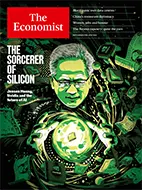
THE SORCERERІ SILICON
Jensen Huang, Nvidia and the future of AI
- Nvidia is powering the AI boom. Good: leader, page 7.
- Will the chipmaking superstar’s financial support for its customers prove a boon or a boondoggle? Briefing, page 13.
- Risks loom over the rapidly growing neocloud industry, page 60.
- Will anybody use AI as much as coders? Page 59.
- When Nvidia’s boss returns to his native Taiwan, things get a little weird. Shailesh Chitnis gets a dose of Jensanity: 1843, page 55.
Moral panic over data centres
- Americans’ growing hatred ofAI infrastructure is shaping the midterms, page 17.
- China’s restaurant diplomacy It is full of contradictions, but some countries welcome it as an alternative to Western power: Chaguan, page 36.
Women, jobs and honour
- In many countries the biggest barrier to prosperity is in the home: leader, page 9.
- The love of money is the root of quite a lot of good, page 51.
The Bayeux tapestry: quite the yarn
- What a 950-year-old piece of linen has to teach about survival: leader, page 10.
- The treasure’s many mysteries, page 76.
- The tapestry is a post-Brexit symbol of Anglo-French co-operation, page 50.
The world this week Politics
- Fighting broke out between America and Iran in the countries’ biggest exchange of fire in over a month. America struck Iranian air defences, radar installations, shipping and mine-laying facilities. Iran targeted American bases in Bahrain, Iraq, Jordan and Kuwait. Several oil tankers in the Strait of Hormuz were attacked, one of which was sailing a route close to the coast of Oman, a maritime course that America has said is under its protection. Oil prices jumped. Meanwhile, reports suggested that an American naval blockade has successfully cut off Iranian exports of crude oil through the strait to China, Iran’s biggest customer. China still has access to oil stocked on ships in Asia.
- On a visit to Egypt Xi Jinping called for a new security apparatus for the Middle East, and said that China was ready to help protect strategic shipping routes in the region. China is helping build Egypt’s new administrative capital and is a big investor in the ports and industrial areas that line the Suez canal.
- The Pacific Islands Forum held its annual summit, which this year took place in Palau. Palau is one of only a dozen countries to have diplomatic relations with Taiwan, which was invited to the summit, to China’s fury. Its officials accused “independence separatists” of making “sneaky visits” abroad, bringing “disgrace” to their hosts. Palau’s president told China, diplomatically, to mind its own business. During the meeting Australia pledged A$600m ($430m) and America promised $150m for several security measures. New Zealand said that, with America, it would finance the refurbishment of a strategic port in the Cook Islands. The three countries are seeking to limit China’s clout in the region.
- The death toll from flash flooding on the border of Nepal and Tibet passed 1,000, with more than 4,000 people still missing. China at last cleared the road leading to the Gyirong border crossing, enabling the deployment of heavy machinery to the devastated area. The flooding was triggered by a partial glacier collapse in the Himalayas.
- Venezuela’s legislature backed Donald Trump’s deal creating a private joint venture that gives America preferential access to more than 65bn barrels of proven oil reserves, a fifth of Venezuela’s total. The American government said the agreement would bring $100bn in private investment to Venezuela; Mr Trump believes the pact will lower petrol prices for Americans. The details were hazy, especially on the involvement of America’s big oil companies.
“Let data reign”
- Mr Trump criticised the growing number of local communities in America that are opposed to building data centres, saying they would end up “backwards and poor”. That didn’t stop California’s state legislature from passing several bills imposing new regulations on data centres, including environmental-impact reviews and requirements to report electricity and water usage to state agencies. Gavin Newsom, the Democratic governor, vetoed a water-disclosure bill last year, but now, as he contemplates running for president, says he is “leaning in” to the idea.
- A 23-year-old man pleaded not guilty to the murder of Charlie Kirk, a conservative activist. The judge overseeing the case in Utah allowed the prosecution to seek the death penalty because of aggravating factors, such as the defendant shooting into a crowd at the college where Kirk was holding an event a year ago. A trial is still months away.
- Dan Driscoll resigned as secretary of the army amid a clash with Pete Hegseth, the secretary of war, over the sacking of senior commanders. In April Mr Hegseth fired several topranking officers, including General Randy George as army chief of staff, in part because of disagreements over a restructuring of the service that was supported by Mr Driscoll. Mr Hegseth’s wider purge of the top brass has even got Mr Trump concerned, according to reports.
- The USS Abraham Lincoln docked in Thailand after spending 286 consecutive days at sea, thought to be a record for not berthing in port in the US navy’s modern era. The aircraft-carrier was deployed last November. The 5,000 sailors and marines on board will get a well-deserved break in Thailand. Reports surfaced earlier this year about the mental stress that some personnel were under because of the long voyage.
- Iceland held a referendum on whether to reopen talks on joining the European Union. Voters rejected the proposal by 53% to 47%; only Reykjavik, the capital, voted in favour. Turnout was nearly 83%. Supporters of the measure put trade and Arctic security at the centre of their campaign, but that was not enough to overcome concerns that Iceland’s fishing industry would be put in jeopardy by joining the bloc.
- Germany blamed Russia for a drone attack on Leipzig airport in early August. The drone didn’t explode, but a cargo plane hit a second drone, suffering no damage. A third drone was reportedly found in the area ten days later. NATO and the EU backed Germany’s claims. The German government announced a series of modest measures to enhance security, including stricter border controls for Russian nationals.
- Russia’s slaughter continued in Ukraine, as it launched waves of missiles and drones targeting Kyiv, killing 12 people in one attack alone. It also hit a printing press that was gearing up to issue textbooks for the new school term. Russia has been targeting printing presses and publishers in an effort to stifle Ukrainian culture, destroying some 12m books.
- European officials complained about the presence of Russia’s finance minister at a meeting of G20 finance ministers in Asheville, North Carolina. It was the first time Anton Siluanov physically attended aG20 meeting since Russia’s invasion of Ukraine in 2022. He was invited by the US Treasury in a spirit of co-operation.
1066 and all that
- In London, King Charles and Emmanuel Macron inaugurated the Bayeux tapestry exhibition at the British Museum, days before it goes on public display. The tapestry was embroidered in England more than 900 years ago and illustrates the epochal events of the Norman invasion and Battle of Hastings, where King Harold, the last Anglo-Saxon monarch, was killed by an arrow to the eye, or so the tapestry depicts. It has been kept in France for centuries, but the French government announced the loan in 2018, two years after Brexit.
The world this week Business
- Renewed concern among investors about inflation, triggered in part by the flare-up in fighting in the Middle East, led to another rout in government bonds, pushing up yields. The yield on ten-year American Treasuries was above 4.8%, the highest level in three years. The yield on Japan’s ten-year bond hit 3% for the first time since 1996, while yields on German ten-year Bunds were at their highest since 2011. The yield on British ten-year gilts climbed above 5.2%; that’s higher than at any time since 2008, including when Liz Truss was brought down as prime minister in part by the bond markets in 2022.
- Kevin Warsh struck a hawkish tone in a keynote speech to central bankers gathered at Jackson Hole. The Federal Reserve’s chairman said it still had “work to do” to curtail inflation, which markets took to mean an interest-rate rise is on the cards, possibly at the Fed’s next meeting.
- The euro area recorded a 3.3% year-on-year rise in the consumer-price index for August. In July the CPI rose by 2.9%. Higher inflation makes it all the more certain that the European Central Bank will lift interest rates again when it meets on September 10th. In June it increased rates by a quarter of a percentage point.
- Brazil’s economy grew by 0.5% in the second quarter compared with the previous three months, or by 2% on a year-on-year basis. The GDP data were the last to be released before the presidential election on October 4th.
- Shein’s share price closed down slightly on its first day of trading on the Hong Kong exchange, then tumbled the following day. The ultra-cheap clothing retailer was valued at $26bn at its IPO, a fraction of its worth four years ago, when it started its quest to become a public company. Meanwhile, France began imposing fees on cheap fast-fashion firms such as Shein and Temu. This is part of a new law that its supporters say will curb sales in a business that floods markets with environmentally unfriendly disposable clothing.
Time for Ternus
- John Ternus took over from Tim Cook as Apple’s chief executive. He takes the reins as the company negotiates a rocky path incorporating AI into its products. It is also expected soon to launch a foldable iPhone, the biggest change yet to its most-important device. In addition, Apple is fighting OpenAI in court for allegedly stealing trade secrets. The dispute centres on OpenAI’s hiring of former Apple staff. OpenAI argues that staff are free to “leave a company like Apple that has struggled to adopt AI and move to an exciting startup”.
- Uber embarked on a big restructuring of its business, shedding 3,300 positions, or about 10% of its global workforce, mostly in management. The company’s rapid growth over the past decade has seen it become bloated, according to Dara Khosrowshahi, the chief executive, and it needs to streamline in order to invest more in ride-sharing, delivery and robotaxis, its core activities. It is also limiting the number of employees who can work remotely, to 1% of staff. Uber has expanded its New York office, the biggest outside its San Francisco headquarters, to accommodate more people.
- The Federal Trade Commission and 22 states filed a lawsuit against Amazon, alleging that it “secretly” manipulated auctions for advertisement placements on its website and mobile app, “illegally” extracting $20bn from 1.2m ad customers. Amazon is purported to have said that the complaint is “misguided”.
- The latest deal struck by an AI firm to expand its data capacity saw Anthropic reportedly pay $35bn to Lambda, a cloudcomputing service backed by Nvidia. As part of the agreement Nvidia will hold the lease on a new data centre in Texas, according to reports, the latest instance of the chip company helping fund AI infrastructure.
- SLB expanded its business in data centres by agreeing to buy Kelvion, a firm specialising in cooling and heat-transfer applications, in a $4.1bn deal. Better known as the world’s biggest oilfield-services company, SLB also builds prefabricated infrastructure for data centres such as electrical rooms and server halls, which it then assembles on site. Kelvion provides technology that cools the equipment. Revenue from SLB’s data-centre business in America grew by 121% last year.
Smile, you’re on camera
- The world’s first electric toothbrush with a built-in camera went on sale. Made by Dyson, the CameraJet enables users to inspect their mouths for cavities and ulcers, but also uses an AI algorithm (of course) to blast mouthwash into the tiny gaps between teeth. Its “antigravity tank” works better than other flossers, Dyson claims. Retailing at $499, some people may prefer to use more traditional toothbrushes to keep their ivories pearly white.
скачать журнал: The Economist September 5th 2026
|