|
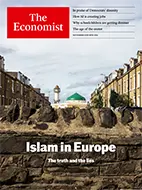
Год выпуска: сентябрь 2026
Автор: The Economist Newspaper and The Economist Group
Жанр: Экономика/Политика
Издательство: «The Economist Newspaper Ltd»
Формат: PDF (журнал на английском языке)
Качество: OCR
Количество страниц: 84
Islam in , Europe
The truth and the lies
- Islam poses no serious danger to Europeans. But Islamism and the fear of Islam do: leader, page 7.
- Few Muslims want to subvert European democracy, but there is no easy way to counter those who do: briefing, page 15.
- Muslims in Britain, page 46.
- How Bangladeshis fit into British life, page 48.
- The assassination of the world’s only openly gay imam: 1843, page 53.
In praise of Democrats’ disunity
- Republicans show that party unity is overrated: leader, page 8.
- Democratic voters are almost as cross with their leaders as they are with the president, page 19.
- The swing voters of 2024 have abandoned Donald Trump, page 21.
- Despite his unpopularity, Republican candidates have no choice but to cling to their leader: Lexington, page 26.
How AI is creating jobs
- The apocalypse is postponed. A mini boom is at hand, page 65.
Why schoolchildren are getting dimmer
- Machines are getting brighter; teenagers are not: leader, page 10.
- The latest global school tests reveal shocking declines, page 50.
The age of the orator
- The transmission of ideas is moving away from text and back to the spoken word, page 76.
The world this week Politics
- The Alternative for Germany (AfD) took 44% of the vote inan election in the eastern German state of Saxony-Anhalt, its best-ever result. The AfD is now close to becoming the first populist-right party to win control of a German state since the second world war. Friedrich Merz, Germany’s chancellor, described the result as “seismic”. His Christian Democrats slumped to just 17% of the vote. The AfD fell short of an overall majority in Saxony-Anhalt and the established parties have ruled out working with it. One route to power may be a deal with the BSW, a small populist party that shares the AfD’s pro-Russian sympathies and hostility to immigration.
Diplomacy amid the drones
- Jared Kushner and Steve Witkoff, Donald Trump’s envoys, held talks with Volodymyr Zelensky in Kyiv and Vladimir Putin in Moscow. The Americans spoke of a new impetus to finding peace, but nothing substantive was announced. Russia resumed its bombardment of Kyiv, which it had suspended while Mr Kushner and Mr Witkoff were in the Ukrainian capital. Soon after, a drone reportedly exploded in Moldova, delaying Mr Zelensky’s plane as he travelled en route to the funeral of Norway’s King Harald.
- Russia and North Korea opened their first cross-border road link. Spanning the Tumen river, the bridge is around 200km (125 miles) from Vladivostok, Russia’s main Pacific port. Both countries said the crossing would encourage tourism and improve cargo links, but observers think it could also be used to speed the flow of North Korean weapons to Russia.
- The Hungarian government expelled ten Russian diplomats for “unacceptable” activities. It was another clear indication of Hungary’s tougher approach to its relations with Russia after the fall of the previous proRussian government led by Viktor Orban. Hungary pointed out that the expulsions did not equate to a break in diplomatic relations, but Russia says its response to the “Russophobic lobby will be harsh and painful”.
- In Serbia, thousands of people attended the funeral of Ratko Mladic, a Bosnian-Serb commander who was convicted of overseeing the massacre of 8,000 Bosniak men and boys at Srebrenica in 1995 and of conducting the siege of Sarajevo. He died in a UN hospital while serving a life sentence. The outpouring of grief for Mladic in Belgrade was condemned by the European Union, which described it as a “glorification of war criminals” that had no place in a country seeking EU membership.
- Meanwhile, the Serbian government asked Aleksandar Vucic, the president, to call a snap election. Mr Vucic and his government have faced a series of long-running anti-corruption protests, triggered by the collapse of a railway station roof in 2024 that killed 16 people. He has been president since 2017, but wants to run again for prime minister, a job he held from 2014 to 2017.
- The EU said it would provide another €200m ($235m) to Greenland for investments across numerous projects. On a visit to the Danish territory, Ursula von der Leyen, the president of the European Commission, said that “Greenland can count on the EU.” Meanwhile, Donald Trump posted an image of the American flag overlaid on Greenland, Iceland and other countries. The Icelandic government summoned the American ambassador for an explanation.
Old grudge, new oil
- The British government confirmed its “unwavering” support for the wish of Falkland Islanders to remain British. This came after Javier Milei, Argentina’s president, reiterated his country’s claim to the islands, which lie 480km (300 miles) off the Argentine coast. Argentina’s government then filed criminal charges against an Israeli firm involved in an offshore oil project, claiming that any oil near the islands belongs to Argentina. In 1982 an Argentine dictator started a war with Britain by invading the islands, which have never belonged to Argentina, and lost. In a referendum in 2013, 99.8% of voters in the Falklands favoured staying British.
- America and Iran escalated attacks on each other. America hit five Iranian tankers, including four in the Gulf of Oman and one near Kharg island, after Iran targeted one of its warships. Iran responded by launching missiles atan American base in Jordan and claimed to have attacked two American vessels and eight oil tankers in the Strait of Hormuz. It warned of a “faster, heavier and more painful” response to American attacks.
- The Iranian government announced that it would double the price of petrol for any purchases above a quota of 110 litres a month for each motorist, indicating that American attacks on oil refineries and a blockade of Iran’s ports are having an effect.
- The Houthis, an Iranian-backed rebel group in Yemen, attacked four cities in Saudi Arabia. Their targets included a large refinery belonging to Saudi Aramco, the national oil company, in the city of Jizan. More than 70 people were wounded. Saudi Arabia vowed to retaliate. Pakistan, which has formed a military alliance with Saudi Arabia, reportedly warned Iran to restrain its Houthi allies.
- In co-ordination with other countries, Britain’s foreign secretary, Ed Miliband, imposed sanctions on illegal Israeli settlements in the West Bank. There is little direct trade with settlements to restrict and Mr Miliband stressed that Britain does not want to isolate Israel and will continue trading with “Green Line Israel”. That led observers to conclude that the announcement’s main intent was to stop the flow of Muslim voters from the Labour Party to the Greens. Israel said it would close the British consulate in Jerusalem, among other retaliatory measures.
- William Ruto, Kenya’s president, warned foreigners running small businesses that they had 90 days to ensure they were in the country legally or they would have to cease trading. Mr Ruto had earlier said all foreign “hawkers” must leave by September 7th to protect native traders, sparking vigilante attacks on foreign stallholders and panic among migrants.
- The Republicans gathered for a convention in Dallas ahead of November’s midterms. Party conventions are normally held in presidential-election years, but Mr Trump used the event to rally MAGA troops and give airtime to candidates who are running in tight races. He also promised a $5,000 pay out to all adults if the Republicans keep control of Congress, which would cost $1.3trn if it were ever enacted. J.D. Vance prepared to give a keynote speech, hinting that he should be their presidential nominee in 2028.
The world this week Business
- Oil prices spiked again amid renewed fighting in the Middle East; Brent crude rose above $100 a barrel for the first time since July. Traders worry that oil stocks are lower than at the start of the conflict in February. In America the national average price for a gallon of unleaded petrol rose to $4.14 over the Labour Day weekend, the highest it has ever been for the holiday. Rising fuel costs are becoming a headache for the Republicans ahead of the midterms.
- The yen traded around ¥153 to the dollar, a seven-month high. Scott Bessent, America’s treasury secretary, who helped Japan prop up the currency in July, warned traders against betting on a reversal: “I am the house now…Bet against me if you want.”
- Canada slapped retaliatory tariffs worth C$27bn ($20bn) on American goods after trade talks collapsed. America followed up by banning imports of Canadian dairy, alcoholic drinks and other products. Donald Trump also called for a boycott of Bombardier. The Canadian aerospace company responded by pointing out that it has created tens of thousands of jobs across the United States and its supply chain includes approximately 2,800 American companies.
- American employers created 162,000 jobs in August, more than the previous three months combined. The rebound has raised expectations that the Federal Reserve will increase interest rates after it meets on September 15th-16th.
- OpenAI released its latest model to much acclaim. The firm claimed that GPT-6 Astra “represents a generational leap in capability” and would lead in fields such as science and software engineering, vaulting it ahead of Anthropic. Meanwhile, a researcher at Anthropic quit his job, warning that the AI industry was ignoring safety in its race to build superintelligent AI, which “could kill us all by the end of the decade”. His post has 140m views , so far.
- Apple held its first product launch under John Ternus as chief executive. The company unveiled its first foldable iPhone, the Duo, with a hefty price tag starting from $1,999. It also took the wraps off its next-generation iPhones, the 18 Pro and 18 Max. The basic iPhone 18 model will, unusually, arrive later (next year). Apple is betting that consumers will pay up for its devices. The foldable phone could be a game-changer, although Samsung and other manufacturers have long sold foldable devices.
Cuts reimagined
- Volkswagen announced “Future Plan 2030”, a strategy that includes slashing 50,000 jobs in addition to 50,000 earlier cuts. Germany’s biggest carmaker said that aligning its workforce with “economic reality is essential”. Costly domestic workers have become a problem for VW as Chinese competition grows. Britain is contending with the same issue. Jaguar Land Rover unveiled 4,000 job losses over two years as part of its “Growth Reimagined” strategy. JLR’s decision is a blow to the ten-year plan pushed by Andy Burnham, the new prime minister, to reindustrialise British regions.
- Meanwhile, VW struck a deal to switch production at its Osnabrück factory from cars to making parts for Israel’s Iron Dome air-defence system, securing employment at the plant. Although car manufacturing is on the wane in Germany, the government is ramping up defence spending, causing a rush of international defence and aerospace companies to set up operations there.
- China announced $54bn in capital injections for state-owned banks and insurers, in an effort to strengthen their balance-sheets and support economic growth. Most went to the Industrial and Commercial Bank of China and the Agricultural Bank of China, two of the country’s biggest lenders. But the injection is small beside China’s $74trn banking system, which is struggling with weak loan demand, a property slump and vast local-government debts.
- A software glitch in Britain’s air-traffic control system caused chaos at the country’s airports, leading to hundreds of flight cancellations. Airlines criticised NATS, the publicprivate partnership that provides the system, pointing out that the problem was similar to another failure that occurred three years ago, and hadn’t yet been fixed.
The grape depression
- French wine production is expected to fall by 6% this year, leaving the country with one of its smallest harvests in three decades, according to the agriculture ministry. Champagne output could plunge by 48%. Unusually hot and dry weather has battered vineyards. But France also has too much wine for a shrinking market: consumers are quaffing less, prompting growers to rip up their vines.
скачать журнал: The Economist September 12th 2026
|