|
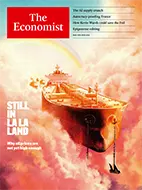
Год выпуска: май 2026
Автор: The Economist Newspaper and The Economist Group
Жанр: Экономика/Политика
Издательство: «The Economist Newspaper Ltd»
Формат: PDF (журнал на английском языке)
Качество: OCR
Количество страниц: 76
SNTILL LA LA LAND
Why oil prices are not yet high enough
- Oil prices are up sharply but still have much further to rise: leader, page 9.
- The crisis in oil markets will get bigger before it goes away: briefing, page 16.
- The UAE walks out of OPEC: leader, page 13, and analysis, page 36.
The AI supply crunch
- The rush for artificial intelligence is hitting a bottleneck. It will reshape the economics of the technology’s diffusion: leader, page 12.
- And it will get only worse, page 52.
Autocracy-proofing France
- Political centralisation heightens the danger if the populist right wins, page 41.
How Kevin Warsh could save the Fed
- There is much to like about the new chairman—if his backbone holds: leader, page 11.
- Will he Trumpify America’s central bank? Page 58.
Epigenome editing
- Tinkering with genomes can be risky. Better, perhaps, to focus on the epigenome? Page 64.
The world this week Politics
- The United Arab Emirates said it was leaving OPEC after nearly 60 years as a member. The UAE has long resented the quotas on output that the oil cartel imposes to keep prices stable, and preferably high, and has regularly broken them. However, the Emirates is unlikely to be able to ramp up production or exports in the short term. The decision highlights a deepening rift with Saudi Arabia, OPEC’s biggest exporter. It also underscores the tensions among Gulf countries that have intensified as a result of the Iran war.
Impasse, so ships can’t pass
- Diplomatic efforts stalled between Iran and America to find a deal to end their conflict. Donald Trump cancelled a trip by his peripatetic envoys, Steve Witkoff and Jared Kushner, to Islamabad for more talks. Iran put forward a new proposal to end the conflict and reopen the Strait of Hormuz, which would leave negotiations over the country’s nuclear programme to a later date. America rejected the idea. America and Iran maintained their blockades of the strait. In a social-media post Mr Trump said that Iran “better get smart soon”.
- Mali’s defence minister was killed in an apparent suicideattack, as militants from JNIM, the Sahel’s dominant jihadist network, and ethnic Tuareg separatists staged co-ordinated assaults on military targets across the country. The attacks weakened the grip of the military junta that has ruled Mali since a coup in 2021, and raised doubts about the capability of the Russian mercenaries it has hired for protection.
- A commission appointed by Tanzania’s president concluded that over 500 people were killed in violence around the election last October. It blamed the deaths on “trained agitators” supported by “outside forces”. Human-rights groups and the opposition reckon the real number is far higher and that most victims were killed by security forces.
- Romania’s Social Democrats decided to team up with the Alliance for the Union of Romanians to try to bring down the government with a motion of no confidence. The Social Democrats recently pulled out of the centrist governing coalition led by Ilie Bolojan, the prime minister, claiming his austerity measures had gone too far. The party’s alliance with the hard-right AUR has raised eyebrows in Europe. The AUR is Eurosceptic, and wants to enlarge Romania by creating a union with Moldova.
- Two Jewish men were stabbed and wounded in Golders Green, a London neighbourhood where around half the residents identify as Jewish. The assailant was arrested. It was the most serious episode in a recent spate of antisemitic attacks in the capital. The police are treating it as a terrorist incident. Shortly before the stabbings a memorial wall in Golders Green was set ablaze.
- Claudia Sheinbaum, Mexico’s president, told the American government that her country’s “constitution and national security law” must be respected in any co-ordinated security operation. Two Americans, who reportedly worked for the CIA, died in a car crash recently following an anti-drugs raid in Chihuahua. Mexico’s federal government hadn’t known about their operation. Meanwhile, America’s Justice Department charged the governor of Sinaloa state and nine current and former Mexican officials with conspiring with the Sinaloa gang to import drugs.
- In Brazil the Senate rejected the nomination of a judge to sit on the Supreme Court. It was a stinging defeat for Luiz Inácio Lula da Silva, who is the first president in over a century to have his nominee to the court blocked.
- A bomb on the Pan-American Highway in southern Colombia killed at least 20 people, the worst attack on civilians in decades. The leftist government offered a record reward for the leader of a dissident group of former FARC rebels suspected of being behind the bombing. The incident thrusts the issue of security into the presidential election, the first round of which is on May 31st.
- The Argentine government said it would like to initiate negotiations with Britain over the Falkland Islands. This came after a leaked memo from the Pentagon suggested that America was preparing to drop its support for Britain’s sovereignty of the islands in retaliation for not supporting the Iran war. The British government reiterated that sovereignty was a matter for Britain, and the “islands’ right to self-determination is paramount”.
- A 31-year-old man was charged with trying to assassinate Donald Trump, the third attempt on his life within two years. The gunman rushed past security at the annual White House Correspondents’ Association dinner that is attended by senior politicians and the media elite. The suspect travelled from his home in Los Angeles via Chicago and checked into the same hotel in Washington that was hosting the dinner, reportedly concealing two guns and knives.
- The state visit of King Charles to America went ahead, despite concerns over security after the assassination attempt. The king’s trip came amid Mr Trump’s annoyance at Britain’s lack of support for the Iran war, but the president spoke warmly of America’s ally, saying that “Americans have had no closer friends than the British”.
- The Supreme Court struck down Louisiana’s new congressional-district boundaries, which were designed to create another black-majority seat. The court said this was racial gerrymandering, but it upheld the broader constitutionality of the Voting Rights Act, legislation that protects minority-voting rights. The court’s liberal justices dissented, arguing that the ruling would “eviscerate” the spirit of the act. Meanwhile, Florida’s legislature approved a new district map that could give the Republicans four more seats in the congressional midterms.
- The uneasy truce between Afghanistan and Pakistan seemed to be in jeopardy, after the Taliban government in Kabul accused Pakistan of attacking a university in the border province of Kunar. Pakistan denied it had targeted a university, describing the claim as fake news. It is the first allegation from either side of breaking the truce since China hosted talks in early April.
Human endurance
- Sabastian Sawe of Kenya became the first person to run a marathon under two hours in race conditions. Mr Sawe’s finishing time at the London Marathon was 1:59:30. Eliud Kipchoge was the first person to run under two hours with a time of 1:59:40, but the event in 2019 was specifically tailored for him to achieve that aim. The winning time at the first modern marathon in 1896 was 2:58:50, and that was over 25 miles, not 26.
The world this week Business
- The Federal Reserve kept interest rates on hold, pointing to the possibility of higher inflation from surging energy costs. It was Jerome Powell’s last meeting as chairman; the Senate Banking Committee approved the appointment of Kevin Warsh as his replacement shortly before the end of the Fed’s meeting. Mr Powell will remain at the central bank as a governor. In his final press conference he warned of the threat from Donald Trump’s “legal assaults” to the independence of the Fed. The Justice Department has announced that it is dropping its investigation into Mr Powell, though one official has suggested the case could be reopened.
Steady as she goes
- The Bank of Japan also met and made no change to interest rates, though three of the board’s nine members voted for an increase. Ueda Kazuo, the governor, said the bank was still pondering the implications for inflation from the Middle East conflict. Markets think it will lift rates in June.
- Alphabet’s revenue from Google Cloud rose by 63% in the latest quarter, year on year. Investors were also delighted by earnings reports from Amazon and Microsoft. But Meta’s results struck a sour note when it signalled a much larger rise in spending on AI than markets had expected. Meta is planning to slash 10% of its workforce in order to run the company “more efficiently” with AI.
- China took Meta by surprise by ordering the company to unwind its takeover of Manus, a developer of AI agents.
- Manus was founded in China and has moved its base to Singapore, but China says it will not allow foreign investment in the firm. Meta is already busily integrating Manus software into its platforms.
- Kone agreed to buy TK Elevator for €29.4bn ($34.4bn) in a deal that will create the world’s largest maker of lifts, if it passes antitrust scrutiny. The combination of the Finnish and German companies is one of Europe’s biggest takeovers in years.
- Oil prices climbed again as markets worried that the Strait of Hormuz might not reopen soon. Brent crude reached $125 a barrel before paring back. Meanwhile, big oil companies began reporting their earnings from the first quarter, which includes the start of the war. BP’s headline profit of $3.2bn was its best in a quarter for three years. Meg O’Neill, BP’s new boss, warned governments not to impose new windfall taxes on oil profits, which would deter future investment. TotalEnergies’ net profit rose by 29%, year on year, to $5.4bn.
- Investors cheered Intel’s latest earnings. Although the chipmaker reported a quarterly loss because of spending on restructuring, revenue from its data-centre business was up by 22%, year on year, and the company’s forecast for the current quarter beat expectations. Intel’s stock surged; it is up by 140% since the start of the year. That sparked a rally in the shares of other chipmakers. Samsung’s operating profit for the quarter was more than it made in all of 2025.
- Rising stocks of Asian chipmakers helped propel the MSCI Emerging Market index, which is made up of the shares of large companies in 24 developing economies, to a record high. The index has bounced back from a sharp fall at the start of the Iran war. Three chipmakers—Samsung, SK Hynix and TSMC—account for nearly half its gains.
- Elon Musk appeared in court to argue his case that OpenAI has broken a commitment to remain a charity by setting up a for-profit arm. Mr Musk helped found OpenAI and says it is “not OK to steal a charity”.
- OpenAI claims no records exist of promises made about its future and that Mr Musk now competes with his own AI service, xAI. If Mr Musk wins the trial OpenAI may have to undo its restructuring.
- The Pentagon has turned to Google’s Gemini AI for help in classified work. The contract says the Pentagon will use Gemini for “any lawful government purpose”, and includes a clause suggesting it won’t be used for mass surveillance or autonomous weapons without human control. Around 600 employees at Google signed a letter asking the company not to allow the technology to be used on classified workloads. The management responded by saying it was proud to work with the armed forces.
Handle with care
- Japan Airlines announced that it will use humanoid robots for baggage-handling at Tokyo’s Haneda airport. Due to an ageing workforce, the company said there were not enough human baggage-handlers. The robots will perform some strenuous tasks, it said, but humans will still be around to oversee safety. Other airports are also experimenting with new technologies. Gatwick has been trying out autonomous wheelchairs to cart infirm passengers around.
скачать журнал: The Economist - May 2th 2026
|