|
Год выпуска: сентябрь 2026
Автор: The Economist Newspaper and The Economist Group
Жанр: Экономика/Политика
Издательство: «The Economist Newspaper Ltd»
Формат: PDF (журнал на английском языке)
Качество: OCR
Количество страниц: 84
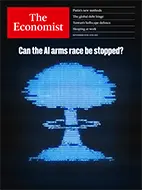
Can the AI arms race be stopped?
- America will struggle to make AI safe while keeping ahead of China: leader, page 9.
- As fears about dangers mount, superpower talks will do little to help, page 35.
- Making AI safer is not impossible, but agreeing to do so may be, page 54.
- The AI debate has taken over Washington, page 19.
- Anthropic’s boss wants to slow down. What about that $2trn IPO? Page 57.
Putin’s new methods
- Western democracies should do more to speed up, and scale, Ukraine’s defences against Russia’s attacks on civilians: leader, page 10.
- Russia has entered a new phase of total war. Ukraine is feeling the heat: briefing, page 16.
The global debt binge
- Markets are waking up to the rich world’s reckless borrowing: leader, page 10.
- Soaring bond yields, gaping deficits and towering debts: what could go wrong? Page 65.
Taiwan’s hellscape defence
- What drones and AI can do, page 31.
Sleeping at work
- One firm’s attempt to create a more rested workforce: Bartleby, page 61
The world this week Politics
- Ursula von der Leyen, the European Commission’s -president, invited Canada to become the European Union’s first associate member. In the EU’s state-of-the-union address she told Canadian prime minister Mark Carney that the partnership would be “for our common strength”. Canada has sought closer ties to the bloc as its trade war with America worsens. Donald Trump called the proposal “laughable” and threatened the EU with “serious tariffs”.
- Russian drones hit a stationary Ukrainian locomotive and a petrol station near the Polish border approximately an hour after a train carrying top Western officials passed through the area. Andrii Sybiha, Ukraine’s foreign minister, called the strike “Putin’s terror knocking…on the doors of the EU and NATO”.
- Magdalena Andersson, the leader of Sweden’s Social Democrats, looked likely to become the country’s next prime minister after an agonisingly close election on September 13th. Ms Andersson’s leftwing bloc—which includes small-state centrists, environmentalists and leftist-popu-lists—was set to take 176 seats, compared with 173 for the government and its allies. The populist-right Sweden Democrats, who have supported the centre-right government since 2022, lost support for the first time since they entered parliament in 2010.
- A pair of record-breaking donations to Reform UK prompted calls for an overhaul of funding in British politics.
- Christopher Harborne and Ben Delo, British crypto billionaires who used to live in Asia, said they would each give £36m ($48m) to the populistright party led by Nigel Farage. Politicians from other parties now want to tighten the rules, perhaps even rendering Reform UK’s windfall illegal.
- Binyamin Netanyahu, Israel’s prime minister, said that he would sue Haaretz, a liberal Israeli newspaper, for publishing claims that days before October 7th 2023 the leader of the United Arab Emirates warned him in a phone call that Hamas, the Islamists in Gaza, were preparing to attack. Mr Netanyahu’s office said that the reports were part of a “sinister plot” and that the prime minister had received no such warning.
- The Houthis, Iran-backed rebels in Yemen, advanced down the country’s western coast. They captured Mokha, a port city, and seized Perim island, a rocky outcrop in the middle of Bab al-Mandab, the strait that links the Red Sea to the Indian Ocean. In July the Houthis announced a blockade on Saudi shipping through the Red Sea.
- Meanwhile, drones hit Saudi Arabia’s east-west pipeline which can carry up to 7m barrels per day to the kingdom’s Red Sea ports. It was shut down “as a precautionary measure”. The Saudi foreign ministry blamed the attack on militias in Iraq.
- The closure saw the price of Brent crude, the international oil benchmark, rise above $109 a barrel. Saudi Arabia said it shot down a Houthi drone south of the holy city of Mecca.
- China accused American tech bosses of “fearmongering” over their calls to limit its ability to develop AI. Dario Amodei, the chief executive of Anthropic, called for a slowdown in AI development. He warned that a Chinese lead “would pose grave danger” for America and the world. China’s foreign ministry said such comments were counterproductive and would limit options for global AI governance.
The winner takes it all
- Donald Trump said America must remain ahead of China in AI as he rejected a chorus of calls for a slowdown and greater regulation. Steve Bannon, a former Trump adviser, and Bernie Sanders, a socialist Democrat, united in a speech to warn of the need for greater oversight of the technology. Mr Trump has said “whoever wins AI wins” and dismissed concerns that it poses a risk to humanity as “a hoax”.
- Mr Trump hit out at America’s Supreme Court for rejecting his attempt to restrict postal voting ahead of November’s midterms. The president wrote on Truth Social, his socialmedia platform, that the court was “bullied and cajoled by the Radical Left”. He has repeated claims, without evidence, that postal voting is prone to fraud.
- America’s Environmental Protection Agency (EPA) will scrap limits on greenhouse-gas emissions from coal- and gas-fired power plants. The head of the EPA said that reversing the Biden-administration requirements that plants reduce pollution by using technologies like carbon capture and storage would save Americans $310bn. Power plants are America’s second-biggest source of CO2 emissions.
- America paid $725m in dues to the United Nations, averting the possibility that it could lose its vote in the UN General Assembly for skipping two-years’ worth of membership fees. The payment, made for the 2025 budget, was overdue. The Trump administration had halted contributions to push for changes to some UN agencies and priorities.
- Police in the Philippines said it could take months to identify victims from a ferry fire that killed at least 76 people. The MV June Aster was travelling from Manila to Coron, a popular tourist destination, when the fire broke out. The cause of the blaze has not yet been identified.
- China’s president Xi Jinping attended the BRICS summit in New Delhi on his first trip to India for seven years. Mr Xi met Indian prime minister Narendra Modi on the sidelines of the event in a further warming of relations between the countries following a border dispute in 2020.
Third time lucky
- Prabowo Subianto, Indonesia’s president, appointed his third finance minister in two years. Mr Prabowo replaced Purbaya Yudhi Sadewa with his deputy, Suahasil Nazara, in a bid to restore economic credibility. Mr Purbaya, who was in office for a year, spooked investors by calling the IMF “stupid”and with his comments about the effects of rising oil prices on the global economy.
- The UN Security Council voted unanimously to extend the arms embargo on Sudan’s western Darfur region for another month. America backed away from forcing a vote to extend the embargo to the whole country, but said it would not “rubber-stamp” a further extension to a Darfur-only embargo. The United Arab Emirates, which is accused of sending weapons to the Rapid Support Forces in Darfur in violation of the restrictions, has been lobbying to extend the ban across the whole country.
The world this week Business
- The Federal Reserve raised its benchmark interest rate by 0.25 percentage points, to 3.75-4%. It was the first increase since July 2023. All 12 rate-setters backed the move. Inflation remains stubbornly high, fuelled by tariffs and soaring energy prices. The decision is Kevin Warsh’s first change in monetary policy since becoming chairman in May. An angry Donald Trump responded by demanding that the Fed cut rates to 1%.
- Bond yields rose after the Fed signalled that most policymakers expect more interest-rate increases this year. Yields had already been climbing as higher oil prices stoked fears of persistent inflation; earlier the yield on ten-year Treasuries reached its highest level since 2007.
- Sam Altman of OpenAI, Elon Musk of xAI and Dario Amodei of Anthropic called for a slowdown in the race to build superhuman artificial intelligence, amid fears that models could escape human control. The unusual show of unity comes as Anthropic prepares an IPO that could value the company at $2trn. The safety scare could delay the listing or dent its valuation; Mr Altman said OpenAI would not go public this year. Mr Trump dismissed the warnings, arguing that beating China in AI mattered most.
- Meanwhile, Microsoft published a draft “code of conduct” designed to keep its AI models under human control. The document—which states that “people matter more than AI”—says the technology should not imitate consciousness, nor assist with the development of weapons.
- America’s Senate blocked legislation to establish clearer rules for cryptocurrencies. The Clarity Act would have written the Trump administration’s crypto-friendly policies into law, making it harder for a future administration to impose tougher rules. Democrats opposed the bill over concerns about Mr Trump’s own crypto interests.
Building trouble
- China’s property slump dragged on in August. Prices of new homes fell by 0.1% from July, the 16th consecutive monthly decline, and by 3% from a year earlier. Prices in the wealthiest cities rose slightly, while those in the rest continued to fall. The prolonged housing bust is depressing household confidence and consumption, leaving China reliant on exports to sustain economic growth.
- India’s trade deficit narrowed unexpectedly in August, from $32bn to $27bn. Exports surged by 26% year on year, because of strong demand from America and Europe, while imports rose by 14%. The smaller gap may offer some relief to the rupee, one of Asia’s worst-performing currencies this year. But soaring oil prices pose a threat: India imports nearly 90% of its crude.
- Accenture agreed to pay $25m to settle allegations by America’s government that it discriminated in hiring and promotions by considering applicants’ race and sex to meet diversity targets. The consultancy denied wrongdoing. Mr Trump has sought to stamp out diversity, equity and inclusion programmes. Deloitte and IBM have paid $21.5m and $17m respectively to settle similar investigations this year.
- Aliko Dangote, Africa’s richest man, listed his refinery business on Nigeria’s stock exchange in what is expected to be Africa’s biggest-ever IPO. Valued at around $49bn, the company hopes to raise $1.6bn by October. With a minimum purchase of just ten shares, it is targeting 10m retail investors; Mr Dangote has dubbed it “the people’s IPO”.
- L’Oréal overtook LVMH to become France’s most valuable listed company, the first time since 2017 that a non-luxury firm has held the crown. The cosmetics giant is worth €203bn ($233bn), against LVMH’s €201bn. Its rise reflects the “lipstick effect”: cashstrapped consumers can still afford small indulgences, even as they shun pricey handbags.
- Carlos Ghosn, a former boss of Renault-Nissan, in exile in Lebanon after fleeing charges of financial misconduct in Japan, went on trial for corruption in Paris. Prosecutors allege that a €300,000-a-year contract for legal advice he awarded Rachida Dati, a former French culture minister and then member of the European Parliament, concealed payments for lobbying. Both deny wrongdoing.
High steaks
- Mr Trump’s efforts to make burgers cheaper before the midterms are not going to plan. Ground-beef prices hit a record-high in August, up 8% year on year. Mr Trump has blamed meatpackers and tried to beef up supply by easing tariffs on imports. But years of drought and high feed costs have shrunk America’s cattle herd by nearly a tenth since 2020, pushing up prices.
скачать журнал: The Economist September 19th 2026
|