|
Год выпуска: ноябрь 2026
Автор: The Economist Newspaper and The Economist Group
Жанр: Экономика/Политика
Издательство: «The Economist Newspaper Ltd»
Формат: PDF (журнал на английском языке)
Качество: OCR
Количество страниц: 84
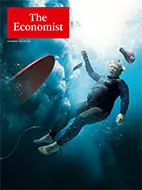
Wipeout
Voters have castigated Donald Trump. That has given Washington a rare opportunity
SURFERS CALL it the washing machine. When a giant wave throws you off your board and plunges you underwater, you lose all sense of where you are. That is what befell Donald Trump and his party on November 3rd, as they were slammed by tens of millions of American voters. They have still to grasp just how much their country has changed.
Already it is clear this was not a normal midterm swing against a sitting president, but the biggest wave-election since the aftermath of Watergate more than 50 years ago. Democrats won control of both chambers of Congress, flipping seats deep into once-safe red waters, from South Carolina to Texas.
The coming days will spell out two further lessons. One is that this is not just a triumph for Democrats, but also for American democracy. Voters cannot be taken for granted. If they are angry, they will turn against parties they have long supported. The other lesson, which follows from this, is that both parties now need to find a new way of doing politics—one that spends less time riling up their constituents and more getting things done on their behalf.
The wave has swept across America. With some races still uncalled, the Democrats have 54 Senate seats (including two independents) and around 260 in the House, up from 47 and 214. They are set to win the popular vote for the House by 13 points. They have also taken at least five more governors’ mansions. Kansas has its first Democratic senator since the New Deal. In Texas Democrats won their first Senate seat in almost 40 years and kicked out a three-term governor (see United States section).
It turns out that voters do not much like a president who is elected on a promise to lower prices and stay out of wars, but who then goes on to launch a tariff crusade and attack Iran—thereby driving up prices. And they hate it if that president’s relentless selfglorification and enrichment of his family and friends mocks their own hardship. In Mr Trump’s America, Gallup finds, nine in ten adults complain that corruption in their government is widespread—about as many as in Nigeria.
The vote was thus a verdict on the president. But politicians from both parties should also reflect on voters’ rejection of the ugly mechanics of modern partisanship. Republicans gerrymandered seats, but failed to make gains. Elon Musk, a multibillionaire, poured more than $150m into a race in Texas, but his candidate was trounced. Republican candidates stoked fears over Muslims and transgender people, and lost. One in Ohio backed an ad in which a mother damned his opponent: her own abused daughter. It sealed his defeat.
The message from this is clear and it is hopeful. It has often seemed as if polarisation was stronger than the electoral feedback that ensures democratic accountability. Not this time. Voters demanded that politicians put the nation’s prosperity above the grubby pursuit of power. Just before the election, polls say, 80% of Americans called for “substantial change” or “complete and total upheaval” in how America is run.
Voters have done their job. Politicians must now do theirs.
The immediate task falls to the Republicans. When Mr Trump took control of the party, he ditched its values. Most old-guard Republican politicians were either forced out of office or traded their principles for political survival. With their call for change, voters have given Republicans a second chance. Some may stick with the president, risking further drubbings in future elections. Braver souls will breathe new life into their party, even if that courts Mr Trump’s vengeance. He is more feared than loved. They may discover that, once the old king’s power begins to ebb, it drains away surprisingly fast.
Plenty could go wrong—including with Democrats flushed by success. Their party is only a bit more popular than Mr Trump. Their campaign succeeded by pairing a promise to lower costs with one to crack down on corruption and incompetence. Both are vital, but the balance will be hard to strike.
If Democrats ignore the rot, they will only deepen voters’ cynicism and despair at the federal government in Washington. But if subpoenas and impeachments consume all of their efforts and they fail to improve people’s lives, voters will feel that they have been hoodwinked once again. A running fight with the administration will also make it harder to pass legislation that would, say, restore funding for health care.
Above it all will loom the legacy-obsessed figure of Mr Trump. Some hold out hope that he will spend the rest of his presidency pottering about the White House, gilding golf balls and opining on granite. That underestimates the president’s capacity, for good and ill.
At home Mr Trump may focus on pardoning his friends and punishing his enemies. With only two years left, he and his cronies and ideologues may try to wring what more they can from their time in power, be that through lucrative state-supported mining ventures or more deportations.
The president also retains enormous authority over foreign policy. He may yet pursue further strikes on Iran, try to bully Ukraine into abad deal with Russia, or invade Cuba (see Briefing). As the White House’s more talented staff eye the exits, a depleted executive branch may find itself even more subject to the president’s whims. It will be ill-prepared for a crisis.
Coming up for air
There is a glimmer of a possibility, however, that politicians will take their responsibility seriously. Republicans in Congress may consider working with Democrats, and vice versa (imagine that). They could pursue egregious corruption or even impeach the administration’s most reckless cabinet members, including Pete Hegseth, the secretary of war. They could develop rules for artificial intelligence that guard against disastrous outcomes without crippling innovation.
Mr Trump is not a man who enjoys being left out. He may judge that he could improve his legacy by working with Congress, rather than trampling on it. That is not the likeliest scenario, we admit. But, as the voters have shown, politicians who ignore them risk ending up in very deep water.
- Voters have castigated Donald Trump. That has given America a rare opportunity: leader, page 9.
- How Democrats won Congress, page 24.
- What will they do with control of Texas? Page 26.
- Lame-duck foreign policy: briefing, page 19.
- Republicans face a brutal presidential contest, while Democrats glimpse a unifying agenda: Lexington, page 28.
- Divided government and spending: By Invitation, page 18.
China’s autonomous labs
- With an eye on America, China is beefing up AI-controlled science, page 37.
- Al-powered hackers Stopping cyber-disasters means making sure defenders have better models than attackers do: leader, page 10.
- Firms are racing to protect themselves from the new threats, page 57.
The longevity business
- People will pay a lot in the search for immortality, page 62.
- Patients are acting more like consumers. Good: leader, page 11.
Is childlessness contagious?
- A new book looks into the birth dearth, page 76.
- The cost of intensive parenting, page 67.
The world this week Politics
- The Democratic Party won a landslide in America’s midterm elections, gaining majorities in both houses of Congress. In the Senate the party captured seven seats, giving it at least 54 (although Senate races in Alaska and Mississippi are too close to call). Democrats took control of the House of Representatives with the biggest popular-vote margin since 1976.
- Donald Trump tried to distance himself from the defeat, claiming that the Republican Party “would have won in a landslide” had he been on the ballot. But Americans were angry at the president’s war in Iran, which has pushed up prices, and corruption. Republicans turned to infighting. J.D. Vance, the vice-president, offered his diagnosis: “The reason we lost is the war.”
- The Democrats gained Senate seats in Republican strongholds. James Talarico became the first Democratic senator elected in Texas in 38 years, beating the Republican candidate, Ken Paxton, by 12 points. Adam Hamilton took the party’s first seat in Kansas since 1932. Annie Andrews won in South Carolina, which had voted for Mr Trump by 18 points in 2024. The Democrats regained support among Hispanic voters, who had swung sharply towards Mr Trump in 2024. This helped negate Republican gerrymandering in House districts in the South.
- A day before the election American forces bombed Qeshm Island in the Strait of Hormuz. The Iranian island hosts several military bases.
- American officials described the strikes as “defensive”. Mr Trump said that he is not planning to restart the war in Iran, even as he hinted that American forces are ready to launch strikes on the country.
- Mr Trump said that America would stop providing around $4bn a year in aid to Israel at the end of 2026. The funding is not due to expire until 2028. Mr Trump said Democrats had used his administration’s support for Israel as a “bad talkingpoint” during the midterms. Binyamin Netanyahu, Israel’s prime minister, has repeatedly said that he wants to wean Israel off American aid.
- Joshua Wong, a pro-democracy activist in Hong Kong, was sentenced to ten years in jail. Mr Wong was already serving a shorter sentence under the territory’s national-security law. Meanwhile John Lee, Hong Kong’s leader, apologised after an inquiry exposed regulatory failures and corruption behind a fire in a housing estate last year. The blaze killed 168 people.
- Indonesia deployed 20,000 troops to Jakarta, the capital, after the authorities accused several people of snooping on the communications of Prabowo Subianto, the president. Mr Prabowo’s chief of staff and two senior police officers were arrested. An ally of Mr Prabowo said the wiretapping scandal could amount to an attempt to overthrow the government.
Quaking in their boots
- Japan’s government created the National Disaster Management Agency, which will oversee its preparation and response to calamities such as earthquakes, tsunamis and volcanic eruptions. The agency, which has roughly 350 staff, will co-ordinate between different departments.
- Early results in South Africa’s local elections pointed to a bad outcome for the African National Congress. The oncehegemonic party was on course to win about 32% of the vote, its lowest-ever share in a nationwide election. The second-largest party, the Democratic Alliance, was set to win the most votes in Johannesburg, the commercial capital. Whether its candidate, Helen Zille, becomes mayor will depend on coalition talks.
- America said it would exclude South Africa and Rwanda from the African Growth and Opportunity Act (AGOA) from next year. The law, passed in 2000, allowed them to export certain goods to America duty-free. The Trump administration is annoyed about South Africa’s refusal to change race-based laws and Rwanda’s warmongering in the Democratic Republic of Congo. But since just a fraction of their exports to America were covered by AGOA, the economic impact will be limited.
- King Charles attended the Commonwealth Summit in Antigua & Barbuda, alongside Britain’s prime minister, Andy Burnham. Some Caribbean leaders and activists demanded an apology and reparations for Britain’s role in the slave trade. Mr Burnham said he was open to discussing a formal apology, but ruled out paying reparations directly.
- Donald Tusk, Poland’s prime minister, defended his efforts to overhaul the country’s Constitutional Tribunal. On October 30th judges appointed by Mr Tusk’s government took their seats on the court. Karol Nawrocki, the nationalist president, had refused to swear them in. One of the new judges suspended the court’s president, an ally of Mr Nawrocki’s Law and Justice (PiS) party. Mr Tusk said the move was necessary to restore the rule of law, which was undermined by PiS when it was in power in 2015-23. PiS accused Mr Tusk of a “coup”.
- Bulgaria elected Iliana Yotova as its first female president. Ms Yotova describes herself as a “president of peace” and favours negotiations with Russia to end the war in Ukraine.
- Bulgaria’s presidency is a largely ceremonial role. But the election cements Bulgaria’s Russia-friendly tilt under its prime minister, Rumen Radev.
Cold war
- Dozens of supermarkets in Europe lost food after hackers meddled with the temperature settings of their fridges and freezers. Millions of euros’ worth of food was spoiled. Danfoss, a Danish company whose systems were targeted in the cyber-attacks, urged shopkeepers to update their software. Nobody has claimed responsibility for the attacks, though similar incidents earlier this year were linked to proRussian hackers.
- Alexander Dobrindt, Germany’s interior minister, said there would be “severe penalties” after riots in Frankfurt. More than 100 police officers were injured. The violence followed protests against education-spending cuts and high living costs. Mr Dobrindt blamed “violent left-wing groups and troublemakers from migrant communities”.
- Britain and the European Union agreed to a draft deal to remove border checks on food and agricultural goods. The agreement is a boon to British farmers, whose exports to the EU have fallen by a third since Britain left the bloc. It is one of several “mini-deals” (over students, electricity trading and other issues) that the two sides hope to seal before a summit on November 20th.
The world this week Business
- American stock markets rose a little following the Democrats’ landslide victory in the midterms. The S&P 500, an index of big American companies, rose by 1.6% the day after the vote, while the tech-heavy NASDAQ rose by nearly 1.5%. Health-care and renewableenergy stocks rallied. Bond yields fell slightly and the dollar weakened.
- Some artificial-intelligence stocks fell amid worries that local Democratic lawmakers could curtail the construction of data centres. Share prices of Nvidia, the world’s most valuable chipmaker, fell by more than 3%. Those of CoreWeave, a data-centre operator, fell by around 10%. Companies owned by Elon Musk, a big Republican Party donor, took a beating. Shares in SpaceX, his rocketry-cum-AI firm, fell by nearly 4%.
- Brent crude, the global oilprice benchmark, fell by 8% to around $95 a barrel—its lowest level since September. Prices had risen in recent weeks over fears that Donald Trump might resume the war with Iran, causing fresh disruption to oil supplies from the Gulf. But after the Republicans’ poor showing in the midterms, traders are betting that the president may be reluctant to restart the unpopular war.
- Anthropic committed to spending $895bn on AI infrastructure and computing power, according to a regulatory filing ahead of its planned IPO. The model-maker reported revenues of almost $17bn in the third quarter, up from $1.4bn in the same period a year ago. But computing costs led to operating losses of $567m. Its IPO will be one of the largest ever.
- Apple reported its first quarterly results since John Ternus, its new boss, took over in September. The tech giant’s revenue reached $114bn, an increase of 12% year on year. But Mr Ternus warned of a sharp rise in the cost of memory chips, which would squeeze its margins. Shares in the firm briefly fell.
Tokens of depreciation
- Hackers stole some $6.3bn-worth of tokens from Binance, the world’s largest cryptocurrency exchange. The firm worked with other companies to freeze $3bn-worth of crypto. It promised to cover all losses. TRM Labs, a blockchain-intelligence company, said it suspected that North Korean hackers were responsible. Bitcoin fell by around 5% following the attack, though it has since recovered to its earlier level of around $80,000.
- Inflation in the euro zone rose to 4% year on year in October, the highest level since 2023. Energy prices, which have been pushed higher by the war in the Middle East, rose by nearly 21%, driving the increase. Core inflation, which excludes energy and food, was 2.5%. The European Central Bank is now expected to raise its main interest rate by a quarter of a percentage point, to 2.75%, in December.
- America’s economy grew at an annualised rate of 3.4% in the third quarter, the fastest expansion in a year and above economists’ predictions. The personal-consumption-expenditures price index, the Federal Reserve’s preferred measure of inflation, came in at 3.6% year on year in September.
- South Korea’s exports reached $115bn in October, up 94% from a year earlier. Semiconductors performed especially well, as AI firms gobbled up the memory chips produced by Samsung Electronics and SK Hynix. South Korea has exported $930bn-worth of goods in 2026 so far, putting it within reach of $1trn for a single year.
- Chinese stocks found a floor this week after entering a bear market in October. The country’s market regulators announced a rescue plan to support stock buybacks and help investors access collateral for equity purchases. Officials have also quietly paused initial public offerings. China’s markets have been a global outlier this year. The CSI 300 is down by 13%, while most other markets have risen.
- Saudi Aramco, the world’s biggest oil company, reported profits of $31.2bn in the third quarter, up 9% from a year earlier. High oil prices caused by the Iran war have created a windfall for oil firms. Saudi Arabia’s state oil concern has been more exposed than many. Attacks on shipping in the Strait of Hormuz have disrupted its exports and Yemeni rebels have bombed its facilities. But last month the firm managed to supply around 7m barrels of oil a day, roughly the same as before the war.
In a foxhole
- Fox News revealed that viewership had fallen by 27% ahead of the midterms. Last October an average of 2.3m people tuned in to the news channel during prime time. This year 1.7m did. Lachlan Murdoch, the cabletelevision network’s boss, blamed “viewer fatigue”. Mr Trump said Fox owed its poor ratings to “spending too much time covering the Trump Deranged Dumocrats”.
скачать журнал: The Economist November 7th 2026
|