|
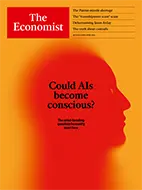
Год выпуска: август 2026
Автор: The Economist Newspaper and The Economist Group
Жанр: Экономика/Политика
Издательство: «The Economist Newspaper Ltd»
Формат: PDF (журнал на английском языке)
Качество: OCR
Количество страниц: 76
Could AIs become conscious?
The mind-bending question humanity must face
- Could AIs become conscious? Even if they don’t, they might be treated as such—to humanity’s great cost: leader, page 7.
- Scientists wonder whether algorithms could one day wake up and feel, page 14.
- Some believe AI needs more brain-like chips to develop consciousness, page 15.
The Patriot-missile shortage
- America and its allies are running out of interceptors, page 48.
The “transshipment scam” scam
- The White House redefines dynamic supply chains as skullduggery, page 60.
- Chinese businesses are wrapping their supply chains around the planet, page 50.
Dehumanising Jason Arday
- His supporters and detractors treated him as a symbol, not a man: leader, page 9.
- What his tragic death says about Cambridge University, page 46.
The truth about contrails
- Eliminating the most persistent could take care of a surprising amount of global warming: leader, page 10.
- A trial over the Atlantic aims to show how much Earth could be cooled by rerouting planes, page 63.
The world this week Politics
- Jared Kushner, Donald Trump’s Middle East envoy, travelled to the region in a bid to revive America’s Gaza peace plan. He met leaders from Hamas in Egypt before travelling to Israel for talks with Binyamin Netanyahu, Israel’s prime minister. Mr Kushner said there could soon be progress on disarming Hamas, but added that “co-operation from both sides” was necessary. The plan has faltered because Hamas refuses to disarm before the Israel Defence Forces withdraw from all positions in Gaza and Israel refuses to withdraw until Hamas has disarmed completely.
Mr Trump’s straitjacket
- A deadline for hammering out a final peace deal between America and Iran passed without an agreement. Mr Trump threatened to bomb Oman, an American ally, if it got in the way of talks with Iran. Iran has said it is close to reaching a deal with Oman on shipping in the Strait of Hormuz. Attacks on vessels transiting the strait continued; one sailor was killed. The United Arab Emirates, another American ally, imposed a trade embargo on Iran, accusing it of launching missiles at its territory for the first time since early May. Iran claimed the attack was a “false flag operation” carried out by America and Israel.
- Hakainde Hichilema won a second term as president of Zambia in an election marred by inflated vote counts for the incumbent in various constituencies and the killing of an opposition politician in a raid by government forces. Mr Hichilema would probably still have won if the election had been conducted fairly. But Zambia’s image as a relatively well-functioning multi-party democracy has been tarnished.
- The Ebola outbreak in the Democratic Republic of Congo became the country’s deadliest, with 2,378 deaths and more than 5,000 confirmed cases as of August 18th. The WHO says the Ebola epidemic is on track to become the worst on record, surpassing the west African outbreak a decade ago, which killed more than 11,000 people.
- Police in Morocco arrested over 110 people who were trying to cross into Ceuta, a Spanish territory in north Africa. The police said almost all the migrants had travelled up from sub-Saharan Africa. In late July 72,000 migrants overran Ceuta, sparking a debate in the European Union about how best to deal with illegal immigration. All but 2,000 of those migrants were swiftly returned to Morocco, but those who remained held a protest in Ceuta recently demanding asylum.
- Russian authorities stepped up their crackdown on Yabloko, a liberal anti-war party. A court in the city of Pskov sentenced Lev Shlosberg, the party’s deputy leader, to 11 years in a penal colony for “discrediting” the army after he took part in an online debate about the war in Ukraine. The judge interrupted Mr Shlosberg’s closing speech, in which he called for a ceasefire. His party has been barred from contesting parliamentary elections.
- Mykhailo Fedorov, who was sacked as Ukraine’s defence secretary last month, called for an election. In a video posted on YouTube, Mr Fedorov said Ukraine should “find a legal, safe and realistic mechanism that will allow Ukraine to renew its full democratic process even in the conditions ofa long war”. An election hasn’t been held since 2019. Meanwhile, corruption allegations continued to afflict the government of Volodymyr Zelensky. The president sacked one of his top aides after her house was raided in a money-laundering investigation.
- The Russian embassy in London warned of “consequences” for Britain following the latest reports that Ukraine was deploying British-made drones against Russia. In response, Andy Burnham, the new British prime minister, said his government would continue “to support Ukraine 100%”.
- The University of Cambridge insisted it had continued to provide mental-health support to Jason Arday after he resigned amid accusations of plagiarism in his work and claims that he fabricated his life story. Mr Arday, who was a full professor at Cambridge, was found dead following weeks of intense scrutiny about his thin academic record. Lord Smith, the university’s chancellor, blamed a “racist feeding frenzy” for his death. Nonsense, rebutted those who investigated Mr Arday, he was a public figure who was rightly held to account.
- Prince Harry and Meghan Markle are reportedly moving back to Britain so that their two children can attend school in the country. They will not be reinstated as working royals. The couple have had fractious relations with the rest of the royal family, which resulted in them relocating to California, a decision that came to be known as Megxit.
- Donald Trump took South Korea by surprise when he said America would scale down the joint military exercises it holds with Korean forces. The annual drills were subsequently cut short by six days. The president listed a litany of complaints: the exercises are costly, they send a “hostile” signal to North Korea, and South Korea has not helped with the “denuclearisation” of Iran. Mr Trump said he hada “very good relationship” with Kim Jong Un, the North’s dictator. Reports suggest he wants another meeting with Mr Kim, whom Mr Trump met in his first term; their summits produced nothing.
- India’s home secretary, Amit Shah, gave details of the arrest of more than 200 “terror operatives” who were planning “subversive attacks” surrounding the country’s Independence Day celebrations. Mr Shah said the operatives were supported by Pakistan’s intelligence agency, a claim that was roundly rejected by the Pakistani government.
- An earthquake in Indonesia’s East Nusa Tenggara province killed at least 68 people. It was the country’s worst earthquake since 2022, when hundreds of people were killed in West Java.
- Donald Trump suspended for three days the 50% tariffs that were due to be imposed on Canadian goods, saying a deal with Canada was close that would tackle American concerns on a range of issues, such as duties on car imports.
Iowa left out in the cold
- The Democratic National Committee announced the early part of its primary calendar for the 2028 presidential election. South Carolina, which has a large black electorate, will kick things off on January 22nd 2028. It will be followed by Nevada, a swing state, on February 1st. New Hampshire, which traditionally holds the first primary, gets its turn on February 8th. Iowa, whose caucuses long kicked off the nominating process, wasn’t included. State Democrats may try to bypass the schedule.
The world this week Business
- Bond yields pulled back from recent peaks. The yields on 30-year American government bonds had reached their highest levels since 2007, as investors worried about mounting government debt, among other things. The Treasury intervened, doubling its repurchases of long-dated government bonds, a move that increases demand for the bonds, and so pushes their yields lower. Yields had surged elsewhere, too. Japan’s ten-year yield almost breached 3% for the first time since the 1990s. German ten- and 30-year yields rose to 15-year highs and French ten-year yields were at their highest in 18 years.
- Underlining those market concerns, America’s total national debt rose above $40trn for the first time. The debt has doubled in less than a decade.
- Claiming that the Trump administration is trying to bully its ABC network, Disney filed a lawsuit against the Federal Communications Commission over the agency’s plan for an early review of ABC’s broadcast licences, saying it was part of a “retaliatory campaign”. Last year Jimmy Kimmel’s show was briefly suspended when the FCC’s chairman criticised the host’s comments on a slain conservative activist. The FCC is also investigating “The View”, another chat show, and Disney’s diversity policies.
- After a security breach that involved an AI agent acting by itself to hack into another firm’s data sets, OpenAI tightened the security standards for the environments in which it trains and evaluates the models. This includes “more controls to isolate higher-risk and untrusted workloads from the internet”. A new monitoring system will alert researchers to a problem within 30 minutes of it surfacing. OpenAI also launched a version of ChatGPT for under-18s that puts “teen safety first”.
The new model army
- Unitree’s share price rose by 460% on the first day of trading. The world’s biggest maker of humanoid robots is based in China and launched its IPO on Shanghai’s tech-focused STAR exchange. Its machines can dance and perform martial arts. Shortly before its stock-market debut, Unitree unveiled a new model it is calling “Superman”, which it claims can jump two metres (6.6 feet) and run as fast as 12.66 metres per second. Superman is still a work in progress, said the company.
- Nvidia dug into its deep pockets to guarantee up to $105bn in financing for a new data-centre hub in Ohio that will be leased by OpenAI. OpenAI is a big buyer of Nvidia’s chips. Nvidia thinks it could reap $150bn-$200bn from every upgrade to each new generation of its chips at the site. Addressing concerns that the money it invests in AI infrastructure is mostly intended to boost demand for its chips from customers, Nvidia said that the Ohio deal did not constitute circular financing, because OpenAI will pay the lease.
- The supply crunch in memory chips hit Xiaomi’s earnings. The smartphone-maker’s revenues and profits plunged in the latest quarter, year on year, as it absorbed the higher costs of the chips.
- It emerged that Google has struck a deal to acquire the electronic data held by Spirit Airlines, which ceased operations in May. The data include internal emails, passenger bookings and frequent-flyer information (all stripped of personal ID). Airlines are increasingly using AI to set fares. A court hearing on the sale of the data was delayed after a cabin-crew association filed an objection to it.
- Moderna announced that a vaccine for melanoma cancer it is developing with Merck had delivered positive results in late-stage trials. Its share price soared by 175%, though it is still far below its pandemic highs, when Moderna was a pioneer in covid-19 vaccines.
- A court in China sentenced the founder of Evergrande, a property firm that triggered a financial crisis when it collapsed with huge piles of debt, to life in prison. Hui Ka Yan pleaded guilty in April to several charges of fraud.
- LandSpace became the first Chinese firm to land a rocket on its legs. Such powered landings were pioneered by SpaceX, allowing the re-use of a rocket’s first stage, which drastically cuts launch costs. Last month China also recovered the first stage of a state-built rocket, catching it at sea in a net strung up on a barge.
More vroom for your buck
- A one-off model for charity of Ferrari’s fully electric car, the Luce, was sold at auction in California, for $40m. The Luce is designed by Sir Jony Ive, who created Apple’s products, including the iPhone. It was a record price for a new vehicle. The record for any car is still the €135m ($142m) paid in 2022 at a private auction in Germany for a 1955 Mercedes-Benz 300 SLR Uhlenhaut Coupé.
скачать журнал: The Economist August 22th 2026
|