|
Год выпуска: октябрь 2026
Автор: The Economist Newspaper and The Economist Group
Жанр: Экономика/Политика
Издательство: «The Economist Newspaper Ltd»
Формат: PDF (журнал на английском языке)
Качество: OCR
Количество страниц: 80
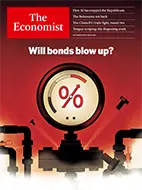
Will bonds blow up?
- A government-debt crisis is looming because of politicians’ fiscal folly: leader, page 9.
- Which countries are most at risk? Briefing, page 18.
- The sell-off is helping the dollar, page 63.
How AI has trapped the Republicans
- A no-rules approach to regulating AI is mad politics and worse policy: leader, page 11.
- Donald Trump’s desire to unleash the technology is running into political reality, page 21.
- Don’t depend on liability law to tame the bots, page 22.
- Silicon Valley likes to listen to itself. To much of the world, the sound is jarring, page 71.
The Bolsonaros are back
- The clan and their allies have swept Brazil’s general election, page 26.
The China-EU trade fight, round two
- How Europe should deal with another China shock: leader, page 10.
- A bold letter from France and Germany augurs confrontation, page 43.
Tongue scraping: the disgusting truth
- People have been using scrapers since Roman times or before. But do they work? Well Informed, page 70.
The world this week Politics
- At least 250,000 demonstrators in France marched through Paris, Marseille, Lyon, Rennes, Toulouse and other cities, mainly to protest against a lack of investment in education. The protests, led by school pupils but joined by parents, teachers and unions as well as elements of the populist-left, have been building since midSeptember, and are often accompanied by arson and vandalism. The police have responded with tear-gas and baton charges. Sébastien Lecornu, the prime minister, accused the populist-left of fuelling the violence. The protesters’ calls for more public investment come amid efforts by the government to control the budget deficit, and as bond markets punish France for its fiscal irresponsibility.
One eviction, one election
- Spain has also seen significant protests, over housing, which were triggered by the eviction ofan 87-year-old woman from her home by an investment fund, underscoring the high cost of renting in Spain. The woman has since died. The Socialist prime minister, Pedro Sánchez, has used the protests as a pretext to call a snap general election for November 29th. Mr Sánchez is seeking a progressive majority, but the left trails behind the conservatives in the opinion polls.
- A former head of the BND, Germany’s foreign-intelligence service, was arrested for treason. August Hanning led the BND from 1998 to 2005 and was a security consultant after that. He is accused of collecting classified material, some of which was passed to an unnamed foreign power. Press reports say it was Azerbaijan; the country denies it. A former aide was charged with gathering the documents.
- Rahul Gandhi, the leader of the opposition in India, was briefly detained during protests demanding the resignation of the head of the Election Commission. The commission is embroiled in a political scandal after tens of millions of voters were deleted from the electoral rolls, reportedly to the advantage of the ruling Bharatiya Janata Party. The commission says it merely removed duplicate or ineligible names.
- In Japan the prime minister, Takaichi Sanae, lodged a complaint with the American government over the alleged murder of a Japanese woman in Okinawa by an American marine, which the marine denies. The American embassy said it was co-operating; marines have been put on a one-month curfew and banned from drinking alcohol for 48 hours. The presence of American troops in Okinawa has caused friction with locals in the past. In 1995 the rape ofa 12-year-old girl by three marines led to angry protests calling for the troops to leave.
- Min Aung Hlaing, who led a military coup against Myanmar’s elected government in 2021 and earlier this year had himself named president, visited Malaysia. Malaysia had previously been among the most vocal critics of the putsch. But Anwar Ibrahim, Malaysia’s prime minister, needs Min Aung Hlaing’s support to deport Myanmar refugees ahead of elections expected in Malaysia next year.
- Pro-government forces in Yemen began a big offensive against the Houthi rebels, who are backed by Iran. They said they had “secured” Bab al-Mandab, a crucial waterway in the Red Sea, and captured the city of Mokha, with the support of Saudi air strikes. The Houthis denied losing control of the strait or Mokha and launched strikes on the airport in Riyadh, the Saudi capital, and elsewhere in the kingdom, killing at least three people. Turkey and Pakistan, which have signed a defence pact with a mutual-defence clause with the Saudis, agreed to deploy forces to Saudi Arabia.
- An investigation led by the United Arab Emirates got under way into the co-pilot of a Flydubai plane who is suspected of trying to hijack it in order to carry out a terrorist attack against Israel. The co-pilot, said to be a citizen of Oman, is also being investigated in Australia, where he reportedly visited radical mosques while studying in the country, and New Zealand, where he spent some time in flight training.
- America withdrew all its B-1 bombers from Fairford airforce base in Britain, amid warnings of a potential terrorist attack on the facility. Reports suggest that Iran was using operatives in Britain to carry out a drone strike that would destroy the fleet of bombers, which America deploys from Fairford to target installations in Iran. British police have arrested several men, though the details of any actual plot remain murky.
- Kenya confirmed its first death from Ebola. The patient had travelled to Kenya via Uganda from the Democratic Republic of Congo, the centre of the latest outbreak. Kenyan authorities said they had traced several dozen of the patient’s contacts and quarantined ten. More than 4,000 people have died of Ebola since Congo declared an epidemic in May.
- The Ethiopian army captured Mekelle, the capital of the northern Tigray region, from forces loyal to the Tigray People’s Liberation Front, which governs the region, and expelled the group’s leaders. Fighting in Tigray, which erupted on September 23rd, may evolve into a wider regional war. Ethiopia and Eritrea have cut diplomatic relations and Eritrean forces are reported to have entered Tigray.
- Confounding the pollsters who had him trailing in the polls for months, Flávio Bolsonaro took 47% of the vote in Brazil’s presidential election, ahead of Luiz Inácio Lula da Silva (or Lula), the left-wing incumbent, who took 45%. A run-off ballot will be held on October 25th. Mr Bolsonaro is in a strong position to win; other conservative candidates in the first round have endorsed him.
- In Canada the separatist Parti Québécois won its first provincial election since 2012. With just 28% of the vote, the party took 59 seats in Quebec’s legislature, five short ofa majority, and will form a minority administration. Paul St-Pierre Plamondon, the probable new premier, reiterated his commitment to hold a referendum seeking independence from Canada. He has also pledged to abolish the constitutional role of the British monarch in Quebec.
They think it’s all over
- Lionel Messi, one of the greatest-ever footballers, played his last international match for Argentina, scoring a penalty in a3-0 win against Benin. Mr Messi has been awarded the Ballon d'Or, the game’s most prestigious award, a record eight times and was on the World Cup winning Argentine team in 2022. At 39 most footballers would be long retired, but Mr Messi may be delighting fans for a few years yet, just not on the international stage.
The world this week Business
- The sell-off in global bond markets continued, and was particularly acute for French government debt. Worries that the government may not be able to control the budget deficit for 2027 coupled with the dimming prospect for fiscal consolidation ahead of next year’s presidential election have pushed up the yield on ten-year bonds. The spread between French and German borrowing costs recently hit their highest level for 14 years. The fiscal uncertainty has weighed on the euro, which dropped to a 17-month low against the dollar, below $1.12.
“Ongoing market pressures”
- The countries of the G7 announced that they would release 100m barrels of diesel and crude oil from their emergency reserves over four months. Donald Trump had threatened to withhold American diesel exports unless the European Union released some of its stocks. He has now backed away from that threat and has announced other ways to curb the price of diesel in America, abig issue in next month’s midterm elections.
- Persistently higher energy prices and crippling public debt are proving to be a real threat to the global economy, said Kristalina Georgieva, the head of the IMF. Inflation is also being fuelled by the AI-building boom, by adding to the demand for energy. The IMF estimates that AI hardware and related tech products now account for more than 10% of the world’s trade in goods.
- Battling inflationary pressures that have been building all year, India’s central bank raised interest rates for the first time since February 2023, lifting its benchmark rate by a quarter of a percentage point to 5.5%. Markets think the Reserve Bank of India will increase rates again over the coming months.
- The African Union launched the first pan-African creditrating agency. This is part of a wider push to change how international investors price the risk of putting money into Africa, challenging what African leaders say is an unfair “Africa premium”. Only three African countries have investment-grade ratings, one reason Africa’s sovereign debt is so expensive to service.
- SpaceX’s share price jumped to its highest level since the days following its IPO in June. The stock hit a low point in early August but has gradually risen since then in part because of bullish bets on the company’s future AI business, which develops the Grok series of large language models. Elon Musk said that SpaceXAI isto be rebranded as SpaceXSI; Donald Trump has called for the technology be renamed “super intelligence”.
- Meanwhile, SpaceX was reportedly trying to raise $40bn through bonds and loans to buy more chips from Nvidia, which in August announced that it was working with Wall Street firms, such as Apollo, to assemble a $500bn financing fund for its customers. The news helped push Nvidia’s share price to another record; the company’s market value is now more than $5.7trn. Nvidia’s gains in turn spurred the S&P 500 and NASDAQ Composite to new highs.
- The demand for Samsung’s memory chips is expected to result in a 780% rise in operating profit for the second quarter, year on year, to 107.4trn won ($80bn). The chips are integral to AI data centres, but there is a global shortage of them. Samsung’s share price has doubled this year.
- Schneider Electric, a French engineering group, struck a deal to acquire PTC, an American software company specialising in complex industrial product design, engineering and data management, for $22.6bn. Schneider supplies essential units to data centres, such as cooling units and server racks. It says its acquisition will bridge the physical and digital worlds for the next generation of industrial AI.
- The holding company for investments made by Canada’s billionaire Weston family agreed to buy Boots, a British high-street chemist and beauty chain that was founded in 1849, for £6.7bn ($8.9bn). It is the second change of ownership in a year for Boots, which was previously sold to a privateequity firm in August 2025.
Trying to figure it all out
- A month after announcing that one of its frontier models had solved the Navier-Stokes equation, one of the hardest problems in mathematics, OpenAI said the same model had resolved or made substantial progress in more than 370 other puzzles. OpenAI shared the model’s deliberations en masse on GitHub, in an apparent effort to counter criticisms from mathematicians that it is solving problems without consideration for their effect on the field. An independent advisory board based at Princeton University described OpenAI’s new transparency as “the beginning, not the completion” of incorporating AI into mathematical knowledge.
скачать журнал: The Economist October 10th 2026
|