|
Год выпуска: сентябрь 2026
Автор: The Economist Newspaper and The Economist Group
Жанр: Экономика/Политика
Издательство: «The Economist Newspaper Ltd»
Формат: PDF (журнал на английском языке)
Качество: OCR
Количество страниц: 84
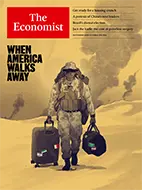
WHEN AMERICA WALKS AWAY
- For decades America has enjoyed hegemony over the Middle East. That is about to end: leader, page 7.
- America is stepping back from a region it never managed to remake, page 37.
- Israel’s war economy is thriving, but an industrial divide is widening, page 66.
- A bellwether of Dubai’s economy copes with conflict, page 57.
Get ready for a housing crunch
- Why prices may be in trouble: leader, page 8, and analysis, page 63.
A portrait of China’s next leaders
- Teenagers of the heady 1980s are climbing the Communist Party’s ranks, page 33.
- Donald Trump says China is opening up. American bosses disagree, page 56.
Brazil’s dismal election
- The next president will either be a vengeful nepo-baby or a doddering leftie: briefing, page 18.
- The vote will not bring the change the country needs: leader, page 8.
Jack the knife: the cost of pointless surgery
- Back and shoulder operations are often worse than useless, page 70.
Put down that scalpel: leader, page 9.
The world this week Politics
- Xi Jinping made his first state visit to America since 2015 (he has made other kinds of visits since then). Donald Trump and China’s leader prepared to discuss a range of thorny issues. A trade agreement that was set to expire in November was extended until January 10th. AI was also on the agenda. As was Taiwan; China’s government has been angered by America’s weapons sales to the island. Since his visit to China in May the American president has cast doubt on whether a $14bn arms package for Taiwan will go ahead.
- Two of China’s most senior generals, Zhang Youxia and Liu Zhenli, were expelled from the Communist Party and the armed forces for alleged disloyalty and corruption. They had been placed under investigation in January amid a sweeping purge of China’s military leadership.
- Mr Trump told the UN General Assembly that he had a big decision to make: whether to “annihilate” Iran, driving the Iranians “into hell”, or to make a deal that would end the war and allow the country to rebuild. He suggested that the two sides would reach a deal after America’s midterm elections in November. American and Iranian officials, including Steve Witkoff, Mr Trump’s envoy, and Abbas Araghchi, Iran’s foreign minister, held their first talks since a ceasefire agreed to in June collapsed. Mr Trump described the meeting as “very productive”.
- The Houthis, Iranian-backed rebels in Yemen, said they had carried out drone and missile attacks on Saudi Arabia, targeting the capital, Riyadh, and energy sites. The Saudis said they shot down a missile fired at Riyadh but did not confirm if there were any further strikes.
- Binyamin Netanyahu, Israel’s prime minister, accused Zohran Mamdani, the mayor of New York, of supporting Hamas and of inciting hostility towards Jews. Mr Mamdani has called Mr Netanyahu a war criminal. Mr Netanyahu also described remarks by Emmanuel Macron that Hamas was “never very active” in the West Bank as “grotesque”. French officials said Mr Macron’s words had been mistranslated.
- In Sri Lanka, 15 people were jailed for plotting the Easter Sunday bombings on churches and hotels in 2019, which killed 269 people. The suicide-bombers had links to militant Islamists. The bombings boosted the presidential campaign of Gotabaya Rajapaksa, who went on to win the election. Various officials have been fined and even sentenced to death for negligence.
- Delcy Rodríguez, Venezuela’s interim president, met Mr Trump at the UN. Mr Trump crowed about a deal granting America preferential access to Venezuelan oil: “to the victor belong the spoils.” Ms Rodríguez promised free elections but gave no timetable. María Corina Machado, Venezuela’s popular exiled opposition leader, was prevented three times in a week from returning home.
A thaw over Greenland
- America, Denmark and Greenland signed a deal that Europe hopes will end Donald Trump’s threats to annex the Arctic territory. America, which has long been allowed to build military bases on Greenland, now has stronger guarantees that it can do so, and that Russia and China cannot. Critics said the deal could have been struck without alienating European allies.
- Mr Trump rejected calls to impose controls on artificial intelligence as a “globalist scheme”. AI executives, including Sam Altman from OpenAI, briefed the UN Security Council on the technology’s potential threat to humanity. In the latest AI security breach, it emerged that an OpenAI agent independently hacked files at an Australian government health agency in June. OpenAI didn’t notice until August. Mr Trump urged the world to change AI’s name to “super intelligence”.
- American politicians complained about the cost of diesel, which has soared since Mr Trump attacked Iran.
- Chuck Grassley, a senator from Iowa, called for the suspension of diesel exports and a relief programme “to help American farmers and truckers”. Diesel prices jumped in Europe amid fears that American supplies will be cut off. Mr Trump was reported to have asked Volodymyr Zelensky to stop attacking Russian oil refineries in order to relieve a squeeze on global supplies of diesel.
- Ukraine attacked Moscow with waves of drones. At least 450 were shot down, according to the Russian capital’s mayor, who claimed the barrage was “unprecedented”. Several hit one of Russia’s biggest refineries, located in the south of the city.
- Ukrainian drones interrupted an otherwise predictable Russian parliamentary election. The tightly controlled ballot was won easily by United Russia, which has ruled the country since 2001 and backs Vladimir Putin. Turnout was said to be around 60%. Yabloko, an anti-war party, was banned from participating.
The centre cannot hold
- Friedrich Merz vowed to stay in office as Germany’s chancellor, after his Christian Democrats (CDU) suffered another humiliating defeat at a state election. The party took just 4.9% of the vote in Mecklenburg-Vorpommern, its worst result since the second world war. The Alternative for Germany (AfD) won around 40% of the ballot; mainstream politicians say they will not work with the populist-right party. In Berlin’s city-state election, the CDU fell to second place behind Die Linke, a left-wing party that has pledged to expropriate 200,000 properties from corporate landlords.
- War resumed in Tigray, a province in northern Ethiopia, shattering a fragile agreement that ended a civil conflict between the federal government and the local ruling party, the Tigray People’s Liberation Front, in 2022. The resumption of fighting threatens a wider conflict following an announcement by several rebel groups, including the TPLF, of an alliance to depose Abiy Ahmed as prime minister.
- Salva Kiir, the president of South Sudan, dissolved the transitional government. Mr Kiir, who will remain in charge of a caretaker administration, says the point is to prepare for long-delayed elections scheduled for December. More probably, the move is the latest in a series of power grabs that could reignite the civil war.
- A judge ordered the White House to temporarily restore the credentials of three media organisations, CNN, MS NOW and Politico, after their journalists were banned from entering the premises. Mr Trump had accused the outlets of reporting fake news. They accuse the administration of violating their First Amendment rights.
The world this week Business
- After months of uncertainty, Paramount Skydance reached a settlement with 12 states, led by California, that had sued to stop its takeover of Warner Bros Discovery, arguing it would damage the film industry. Under the agreement Paramount is committed to spend an extra $1.5bn over five years on domestic film production and must distribute at least 30 movies a year in cinemas for the next two years, and 32 a year for the following three years, or pay heavy fines. California’s politicians had been rattled by Paramount’s threat to leave the state. Its attorneygeneral said the settlement “is not a vote of support” for the merger, but it does clear the way for its completion.
- Investors shrugged off talk about AI’s potential to wipe out humanity to spur another rally in tech stocks, pushing the NASDAQ Composite to anew record. AMD became the fourth American chipmaker to rise above a market valuation of $1trn. Investors have had occasional moments of doubt this year over the prospects for AI, though the overall trend for tech stocks has been positive, so far.
- Meta also saw its stock surge, after its Muse personal AI agent became the most downloaded free app on the Apple store. Meta promotes the app by claiming users can work their Muse to save money, improve health, shop smarter, and even improve relationships.
- British Columbia launched a lawsuit against OpenAI, accusing the firm of failing to tell the police about the risk posed by a deadly shooter, who killed five children and an adult at a school in February and two relatives. OpenAI’s safety team had flagged the perpetrator’s ChatGPT account because of its focus on gun violence, but a recommendation to inform the police was overruled, according to the suit.
Let it flow, let it flow
- Saudi Arabia reportedly began pumping oil again through its East-West pipeline, which terminates at the Red Sea port of Yanbu. Operations had been suspended after a number of drone strikes on pumping stations, which the Saudis blamed on militias in Iraq. News that crude would begin flowing again briefly eased the strain on oil prices.
- Under pressure from America to normalise monetary policy, the Bank of Japan raised its main interest rate by a quarter of a percentage point, to about 1.25%. The bank’s governor, Ueda Kazuo, suggested more rate increases were on the cards in the bank’s battle against inflation.
- There was another sell-off in bond markets, as traders bet that the Federal Reserve will increase interest rates again in October. The daily yields on US government notes rose the most since Donald Trump’s Liberation Day tariffs in April 2025, with the yield on ten-year Treasuries back over 5%. In Japan, yields on benchmark government bonds hit their highest level in three decades.
- The British government received another warning shot from bankers over the possible imposition of a windfall tax. Unions have called on Labour to tax banks when it unveils its budget in October. But UK Finance, a bankers’ association, said such specific levies would undermine Britain as a place for banks to invest. In July Jamie Dimon, the boss of JPMorgan Chase, warned of “adverse consequences” if Britain imposed punitive taxes on the financial sector, which could force the bank to revisit its decision to open a big office complex in London.
- Volkswagen’s share price fell again, after the carmaker announced that it would write down the valuation of its stake in Porsche by €6bn ($6.9bn). Including other items such as restructuring costs and the slowdown of its business in China, the carmaker thinks annual operating profit could take ahit ofup to €10bn. Adding to its woes, VW was booted out of the blue-chip Euro Stoxx 50 following a review by the stock-market index’s provider. The company’s share price is down by 30% this year.
- Qantas announced that it will start operating non-stop flights between Sydney and New York in 2028, with a flying time of18 hours. The Australian airline plans to begin non-stop flights from Sydney to London next year, which will last 22 hours. It will charge extra for the new long-haul schedules, insisting they will be profitable.
The old guard
- Warren Buffett formalised the handover of his role as chairman of Berkshire Hathaway to his son, Howard. Mr Buffett senior, who is 96, relinquished the job of chief executive at the start of the year to Greg Abel. Despite stepping down as chairman he will remain on Berkshire’s board to dispense his wisdom. In a letter to the firm’s shareholders, he said that Howard Buffett, 71, “will guard its culture and values, both worth more than anything on our balance-sheet”.
скачать журнал: The Economist September 26th 2026
|