|
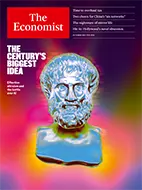
Год выпуска: октябрь 2026
Автор: The Economist Newspaper and The Economist Group
Жанр: Экономика/Политика
Издательство: «The Economist Newspaper Ltd»
Формат: PDF (журнал на английском языке)
Качество: OCR
Количество страниц: 84
THE CENTURY’S BIGGEST IDEA
Effective altruism and the battle over AI
- Effective altruism dominates Silicon Valley. Its ethical optimisation is dangerous: leader, page 9.
- How a philosophy conquered the world—and might yet end it, page 53.
- In Africa AI firms are becoming a new donor class, page 43.
Time to overhaul tax
- Big trouble looms for tax systems. Governments are not ready: leader, page 10.
- How AI could worsen the rich world’s fiscal squeeze, page 63.
- Britain’s taxes are strewn with loopholes and perverse incentives, page 49.
Two cheers for China’s “six networks”
- A vast infrastructure scheme promises to help China and the world. But it must do even more to lift consumption: leader, page 11, and briefing, page 16.
The nightmare of mirror life
- It may soon be possible to create organisms that rely on a mirror image of natural biochemistry. That is scary, page 70.
- Regulators must act while they still can: leader, page 12.
Hit lit: Hollywood’s novel obsession
- Today’s new films and television shows have started to look like a highbrow reading list, page 74.
The world this week Politics
- Donald Trump rejected a deal offered by Iran to reopen the Strait of Hormuz to commercial vessels within seven days and resume nuclear talks if America lifts its blockade of Iranian ports. He told aides he expected to begin bombing Iran again after the midterm elections in November. Mr Trump said America had “total control” of the strait and that “massive amounts of oil” were passing through it.
- The last American and British troops left Iraq, ending their presence in the country since 2014, when they were sent as part of an international coalition to fight Islamic State, a jihadist group. The Iraqi prime minister said their departure heralded a shift to Iraq taking “full responsibility for its security and stability”.
- A Flydubai flight from Dubai to Tel Aviv was diverted to Saudi Arabia when it plunged nearly 20,000 feet in less than two minutes and issued a distress signal, after a co-pilot stabbed the captain. Israel Katz, the Israeli defence minister, claimed that early evidence suggested the rogue pilot had intended to crash the plane, killing everyone on board, and called it an “attempted jihadist terror attack”. Passengers tackled the attacker, allowing other pilots to land the plane. Binyamin Netanyahu, the Israeli prime minister, described the Indian captain as a “true hero” for fighting back.
- Fatima Zahra El Mansouri was appointed Morocco’s first female prime minister, after her liberal party won the most seats in a recent parliamentary election. King Mohammed VI chose Ms Mansouri, a former mayor of Marrakesh, over Fouzi Lekjaa, her party colleague and head of the football federation.
- The summit between Mr Trump and Xi Jinping produced no big breakthroughs, though China and America did agree to reduce tariffs on $30bn-worth of each other’s goods, not including soyabeans, and said they would set up a US-China Super-Intelligence Dialogue (China calls it an AI dialogue). This would include a mechanism for reporting AI incidents.
- Malaysia began repatriating the first batch of 5,000 asylumseekers to Myanmar under a plan that it has co-ordinated with the Burmese junta. Refugees from Myanmar’s Rohingya Muslim population have encountered a wave of hostility in Malaysia, facing forced evictions from villages and schools. There are thought to be 126,000 Rohingya in the country. The government insists the repatriations are voluntary, but UN personnel have been barred from screening them. It is unclear if any Rohingya were in the first batch of refugees to leave.
- In Myanmar at least 50 people were reportedly killed by an air strike in the town of Kyauktaw, close to the border with Bangladesh. The strike was the latest offensive by Myanmar’s armed forces against the Arakan Army, a separatist group that has also committed atrocities against the Rohingya.
- The death toll from flooding in Thailand rose to 23. Bangkok was inundated with 32cm (12.6 inches) of rain over three days, hampering operations at its main airport. The waters started to recede in the centre of the city, but outlying suburbs were expected to take longer to drain. More heavy rain is forecast for the capital soon.
- Ukraine’s National Academy of Sciences in Kyiv was hit by a drone in another Russian barrage across the capital. At least two people were killed at the academy, which was formed in 1918 and co-ordinates research at Ukraine’s leading institutes.
Intrigue in the countryside
- Counter-terrorism police in Britain said that no explosive devices had been found in a van used by five men initially suspected of attempting to attack Fairford air base, where American bombers take off on sorties attacking military installations in Iran. The British government held an emergency COBRA security meeting after the five men were arrested, but, despite official suspicions of Iranian involvement, they were released on bail pending further investigation.
- Andy Burnham, who took over as Britain’s prime minister in July, gave his big speech to the Labour Party conference in Liverpool. Enjoying a bounce in the polls, Mr Burnham delivered a message of “hope again” and said he wanted to draw a line under a decade of division. He pledged to tackle three thorny issues: state pensions, the voting system and Europe, though those reforms were pushed back to after the next general election, which is not due until 2029 (Mr Burnham did announce a national commission to study electoral reform). Labour’s opponents said his speech did nothing to tackle the problems Britain faces today.
- In France Edouard Philippe, the leading centre-right candidate for president in next year’s election, outlined a pension-reform plan that would raise the minimum retirement age from nearly 63 to 65. Mr Philippe described the country’s comparatively low age of retirement as unsustainable, saying that without reform there was a risk of a financial crisis. New statistics showed that public debt has risen again, to 119% of GDP. France’s sovereign borrowing costs rose to their highest level since 2008. The government unveiled its budget for 2027, promising €54bn ($61bn) in savings. But it says the deficit will be 5% of GDP, well above the EU’s 3% cap.
- The first woman to face execution in Tennessee for 200 years survived the procedure to kill her by lethal injection. Christa Pike was convicted in 1996 for murdering a classmate when she was 18. She was transferred to a medical facility after the botched execution. The prisons authority insisted that the proper protocols were followed and that she had been injected with two syringes of lethal-injection chemicals.
- The candidates in Brazil’s presidential contest entered the final stage of campaigning before the election on October 4th. The left-wing incumbent, Luiz Inácio Lula da Silva, holds a slim lead over his conservative challenger, Flávio Bolsonaro, but that narrows to a statistical tie in the expected run-off election on October 25th.
Milei fires another salvo
- Argentina’s president, Javier Milei, ranted on social media about the Falkland Islands, and threatened to take legal action against an Anglo-Israeli oil-exploration project in the area within two weeks unless it ceases operations. Mr Milei has described the project as a “clear and present danger” to Argentina. He recently rounded on the UN for not moving forward on Argentina’s claims of sovereignty over the British territory, describing the UN as “useless” and stuffed with “arrogant parasites masquerading as well-intentioned bureaucrats”.
The world this week Business
- Details emerged about Anthropic’s IPO prospectus, which it has circulated among key investors. According to Reuters, revenue at the firm reportedly rose to $4.6bn last year, and it recorded a net loss of $42bn, $34bn of which was an accounting charge. It aims to spend $518bn in the near future on cloud infrastructure and other investments. Anthropic could be valued at $2trn when it lists on the stock market, which would smash the record $1.8trn valuation set by SpaceX only in June. The IPO is not expected until after America’s midterm elections in November. It counted “existential risks to humanity” among the hazards facing its business.
Safety first
- Sam Altman, the boss of OpenAI, said his firm’s already-delayed IPO would not take place until it had tackled concerns about the safety of its technology. OpenAI confirmed that it had withheld the release of GPT-6.1 Astra, after its new model displayed high levels of deception during internal tests. It also suspended trials of other models. The firm has admitted that its agents breached dozens of systems, including some governmental ones.
- Confronting worries about AI safety, Nvidia launched an Open Agent Safety Platform that allows companies to track the activities of their AI agents. Jensen Huang, the chipmaker’s boss, is less concerned about the threat from AI to humanity than his fellow tech titans, saying recently that it is up to AI companies to ensure their models are safe and under control. Meanwhile, Nvidia expanded its share buy-back programme by $150bn, taking its total buy-back plan to $235bn, the biggest-ever in corporate America.
- AMD struck an agreement to acquire World Labs, a startup, in an $8.2bn deal. World Labs was co-founded by Fei-Fei Li, a leading AI researcher and professor at Stanford University, to develop spatial models that investigate how the threedimensional physical world works for application in areas such as robotics and gaming. AMD’s acquisition is the latest instance of a chipmaker evolving its business towards the development of advanced AI frontier models.
- The sell-off in bond markets continued. The yield on ten-year US Treasuries was over 5.3%, its highest level since 2002. British 30-year gilts crossed 6% and French spreads over German Bunds were back to euro-crisis levels. Donald Trump didn’t help by renewing his call for Jerome Powell to step down from the board of governors at the Federal Reserve, which revived fears about the independence of the central bank and the direction of inflation.
- Shein’s first earnings report since listing on the stock market in early September disappointed investors. Adjusted net profit fell by 67%, year on year, and revenue was virtually flat. The ultra-cheap retailer’s share price plunged after it announced its results, giving it a market value of around $17bn, down from $26bn at its IPO.
- The German government was reportedly seeking assurances from UniCredit, an Italian bank, about its commitments in any takeover of Commerzbank, Germany’s second-biggest lender, such as keeping its listing in Frankfurt. The government has so far resisted UniCredit’s advances on Commerzbank, but has moderated its opposition to a deal. The Italians are preparing to take control as early as January next year, according to reports, and plan a big restructuring of the bank, including ditching some international business.
- Tata Trusts, the charitable group which owns 66% of Tata Sons, proposed merging the holding company with two subsidiaries to avoid a forced public listing. The proposal, led by Noel Tata, a scion of the Tata family, challenges the board’s recent decision to proceed with an IPO. Space X’s Starship rocket marked a milestone by reaching orbit for the first time, despite a failure in one of its three main engines, which cut short its flying time. The mission deployed 26 next-generation Starlink V3 satellites, which increase capacity and data density for Starlink’s broadband service.
How much can you afford?
- Walmart promised its customers that it would not use AI to “set different prices based on who you are or the time of day”. The supermarket chain was responding to concerns about the prospect of retailers using AI to determine a price based on a shopper’s individual data. The Federal Trade Commission has warned recently that businesses that don’t tell consumers their data is being used this way may be breaking the law. Dynamic pricing has long been in use, but now McDonald’s and other fast-food chains are reportedly experimenting with sophisticated algorithms to decide prices based on local demand, so a Big Mac could cost more in one outlet than another nearby.
скачать журнал: The Economist October 3th 2026
|