|
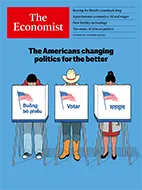
Год выпуска: октябрь 2026
Автор: The Economist Newspaper and The Economist Group
Жанр: Экономика/Политика
Издательство: «The Economist Newspaper Ltd»
Формат: PDF (журнал на английском языке)
Качество: OCR
Количество страниц: 84
The Americans changing politics for the better
- Hispanics and Asians have become their country’s most dynamic voters: leader, page 11.
- The midterms could reshape politics far beyond Congress, page 28.
- Some Democrats are rediscovering, in Iowa and elsewhere, an appealing politics of progress: Lexington, page 30.
- Ahead of the midterms, American business is hastily trying to win favour with the Democrats, page 59.
Bracing for Brazil’s comeback king
- The pressure is on the re-elected president to avoid an economic slump: leader, page 14.
- Lula pulls offa historic victory—and his rival flees to the United States, page 31.
Apprehension economics: AI and wages
- Fear of a technological revolution may be suppressing wages: Free Exchange, page 71.
New fertility technology
- Treatments for age-related infertility are coming at last, page 72.
The music of African politics
- Artists have captured a continental spirit of revolt, page 56.
The world this week Politics
- No clear winner emerged from Israel’s election. With more than 90% of the vote counted, Binyamin Netanyahu’s bloc won 53 of the 120 seats in the Knesset. The opposition parties took 67 seats, enough to command a majority. But 19 of those seats went to Arab parties, a historic high, and most of the Jewish opposition parties have refused to include them in a coalition. Once the results are finalised, coalition talks will begin. Before the election Mr Netanyahu ordered Israeli troops into Hebron, a city in the occupied West Bank, after Palestinian gunmen attacked a military checkpoint, killing two soldiers. Thousands of Palestinians were forced to leave their homes or had their homes demolished.
- Officials from Pakistan, Saudi Arabia and Turkey, the three signatories to the new Mecca pact, travelled to Tehran to meet Iran’s security chief and president. The meeting took place amid more attacks by the Houthis, Iranian-backed rebels in Yemen, on Saudi infrastructure and the growing threat of further American and Israeli strikes on Iran. No breakthroughs were announced.
- Nine people were shot dead at a Christian funeral in Jordan. The country’s air force struck back at “terrorist organisations” in Syria.
Unrelenting carnage
- At least 100 people were killed and dozens more injured in an army drone strike on a market in Nyala, in Sudan’s Darfur region, which is controlled by the rebel Rapid Support Forces. According to the UN drone strikes killed over 300 people and injured hundreds more in the first three weeks of October. Separately, drone strikes by the RSF knocked out several power plants in army-controlled areas, causing widespread power cuts.
- Dozens of African delegations travelled to Moscow for a summit with Vladimir Putin. Mr Putin is trying to pitch Russia as a more reliable partner for African countries than the “colonial” West.
- Kim Jong Un, North Korea’s dictator, made a surprise visit to Dandong in China. Mr Kim was driven over a bridge crossing the Yalu river to the border city. The official reason for his trip was to commemorate China’s support for North Korea during the Korean war. Speculation swirled that he was also consulting with the Chinese ahead of a possible meeting with Donald Trump.
- At least 68 people were killed when two high-speed trains collided on the line between Madrid and Seville in Spain. One train was stationary, reportedly because of a computer-system failure. The crash has raised more concerns about maintenance of the country’s railways. In January 46 people died when one train derailed and another smashed into its carriages in southern Spain.
- More than 1,400 people were arrested across France in another day of protests that were accompanied by vandalism and looting, but less so than over the previous weekend. The day before the demonstrations a black man was shot dead near Paris and seven people injured, including a child, when a 39-year-old man opened fire from his car. Emmanuel Macron called it a “racist, terrorist attack”.
- Marine Le Pen, the populistright front-runner in next year’s presidential election, officially launched her campaign. She made her first campaign speech in Orléans, a city closely associated with Joan of Arc. At its party congress the same weekend, her National Rally re-elected Jordan Bardella as its president. Ms Le Pen confirmed that she will appoint him prime minister if the party takes power.
- In Ukraine a six-day ceasefire came into force to allow humanitarian aid into the Russian-occupied city of Oleshky. The ceasefire was reportedly extended across the Kherson region. Meanwhile, Vladimir Putin spoke by phone to the leaders of Finland and Norway ahead of forthcoming trilateral talks between Russia, Ukraine and America that will take place in Abu Dhabi.
Students get top marks
- Aleksandar Vucic, who has served as either prime minister or president of Serbia since 2014, conceded defeat in a parliamentary election. Mr Vucic had called the snap poll after two years of student-led protests against corruption and abuses of government power. Tens of thousands of people took to the streets to celebrate the Student List’s stunning victory. The list was composed of candidates selected by student bodies; the students ruled themselves out from standing. Russia has now lost two key allies in Europe: Mr Vucic in Serbia and Viktor Orban in Hungary.
- Luiz Inácio Lula da Silva was re-elected as Brazil’s president in a run-off election, winning 52% of the vote. It was the first time a candidate who had finished second in the first round went on to win the runoff. Flávio Bolsonaro, his conservative challenger and the first-round winner, described the outcome as “inexplicable” and suggested foul play, but his party accepted the result. After the election, Mr Bolsonaro left Brazil for Miami, defying a judge who ordered him to stay in the country while a preexisting criminal investigation continues. In a social-media post he said the election had been stolen by “criminals” who have “established a tyranny”.
- María Corina Machado returned to Venezuela. The opposition leader left the country ten months ago to collect a Nobel peace prize. She had tried to return several times since January, when American special forces arrested Nicolás Maduro. Ms Machado has called for fresh elections, though her party has been excluded from talks brokered by the Trump administration on a future electoral process. Marco Rubio, America’s secretary of state, says the talks are making progress and that no one should try to “derail that process”.
- In Canada the opposition Conservative Party won its first election in British Columbia in nearly 100 years. The province had been governed by the left-wing New Democratic Party since 2017. The Conservatives have pledged to slash red tape and remove limits on greenhouse-gas emissions. They also promise to increase British Columbia’s output of liquefied natural gas and support a new oil pipeline from Alberta to the west coast. The party’s pro-energy agenda is bound to face legal challenges.
- King Charles began a tour of the Caribbean amid calls from some countries in the region for Britain to pay reparations for slavery. Several governments want the issue placed high on the agenda at the summit of Commonwealth governments that the king will attend in Antigua and Barbuda.
The world this week Business
- Anthropic released the long-awaited prospectus for its IPO, which promises to be one of the largest ever, if not the largest. Revenue soared from $787m in the second quarter of 2025 to $11.6bn in the same quarter this year. Its spending on personnel, including stockbased compensation, rose from $320m to nearly $1.9bn. Anthropic reported a net loss of $66.3bn for the quarter, mostly because of an accounting charge related to the reassessment of the fair value of debt that could be converted into shares. It actually made an operating profit of $974m in the second quarter, compared with an operating loss of almost $1.7bn in the preceding three months. Anthropic’s stock-market debut could happen in November.
- More funding deals were announced in AI. With tech companies increasingly turn to Wall Street and capital markets to fund their investments, Broadcom is setting up a $63bn special-purpose vehicle with Bank of America and other financial firms. The SPV will buy Broadcom’s chips and networking equipment and lease them to Anthropic. Meta is raising $37.5bn through stock offerings. It also plans to raise up to $60bn through periodic sales of newly issued shares, starting next year.
- Alphabet’s share price sank, after it emerged that the rate at which it is burning through cash was much higher than markets had expected. Microsoft’s stock fared better, after it reported lower capital expenditures than Wall Street had forecast, mostly because of delays in building new data centres. Seeking to keep costs under control, Microsoft wants to shed 60,000 employees, a quarter of its global workforce, through a “voluntary exit offer” that will give staff “who may be considering a future outside the company a new choice to make that transition”.
- Skydance also offered a “voluntary buy-out” plan to staff as part of its effort to cut costs following its takeover of Warner Bros. It told remaining employees that from now on they would have to work in the office five days a week, because “in a creative company like ours, the best ideas come from people in the same room”.
Taxing questions
- The British government unveiled its budget, the first under Andy Burnham as prime minister and John Healey as chancellor. Among the measures, the budget raised the bank corporation-tax surcharge from 3% to 6% for 15 months to help pay for household-energy relief. Businesses will benefit from a freeze or cut in property taxes, meaning that half of all retail, hospitality and leisure properties will pay no property tax at all. From 2028, mayors and local authorities will have the power to impose a tourist tax. The government also committed to a target to spend 3% of GDP on defence by 2030, but left the details of how this would be funded to a spending review next year.
- The Federal Reserve kept interest rates on hold at its latest meeting, leaving its benchmark rate in the 3.75-4% range. Kevin Warsh, the Fed’s chairman, promised to continue dispensing “new monetary medicine” to bring inflation under control. Markets think the Fed will raise rates over the coming months.
- The IPO of JIO Platforms was a success, raising $3.1bn. The share price of the Indian telecoms company rose by 27% on the first day of trading, leaving it with a market capitalisation of $137bn. Jio will use the proceeds to pay debt accrued as it furthers its ambitions in AI and satellite broadband.
- Boeing’s stock took a dive, after the company confirmed it would miss production and delivery targets for its 737 aircraft this year. Its commercial-airline division reported a quarterly operating loss of $697m, more than analysts had expected, but profits from defence, space and security surged to $492m.
- Audi announced that it will build a $4bn factory in Georgia, its first plant in America. The factory will produce 200,000 sport-utility vehicles a year, creating 4,500 jobs, even as Audi’s parent company, Volkswagen, slashes 100,000 jobs. Gernot Döllner, Audi’s boss, made the announcement with Donald Trump at a campaign rally in Georgia. The president said Audi’s decision would not have happened “without tariffs”: European cars that are made in America are exempt from the duties.
Taking the high-tech road
- The carmaking industry’s evolution to a focus on high tech was underscored by the decision of General Motors to switch its share listing from the New York Stock Exchange to the Nasdaq. The Nasdaq is a natural home for our “technology-driven strategy”, GM said. The company recently highlighted how it is “using frontier AI and machine-learning breakthroughs to accelerate development” in autonomous driving.
скачать журнал: The Economist October 31th 2026
|