|
Год выпуска: август 2026
Автор: The Economist Newspaper and The Economist Group
Жанр: Экономика/Политика
Издательство: «The Economist Newspaper Ltd»
Формат: PDF (журнал на английском языке)
Качество: OCR
Количество страниц: 80
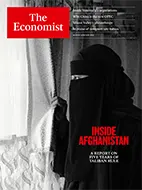
INSIDE AFGHANISTAN
А report on five years of taliban rule
- The Afghan regime is vile. Democracies should engage with it anyway: leader, page 7.
- Afghanistan is a much safer place than it has been for half a century. But its people are suffering and increasingly isolated: briefing, page 16.
Inside Venezuela’s negotiations
- America’s efforts to restore Venezuelan democracy are off to an unexpectedly good start: leader, page 8.
- The real talks begin, page 25.
Why China is the new OPEC
- By releasing stocks, restricting exports and managing demand, it has curtailed imports and wrested control of oil markets: leader, page 9, and analysis, page 61.
Silicon Valley’s philanthropy
- AI founders pledge to give away hundreds of billions of dollars. How will they be spent? Page 50.
In praise of designer(-ish) babies
- Couples should be allowed to select embryos on the basis of both disease resistance and IQ: leader, page 10.
- Silicon Valley wants to reshape the way humans are made, page 53.
The world this week Politics
- Iranian-backed Houthi rebels stepped up their attacks on shipping trying to traverse the Red Sea. The Houthis struck an Egyptian-owned cargo vessel, killing six people, the first deaths from a Houthi assault on shipping since the war with Iran started in February. The Houthis are fighting Saudi Arabia in Yemen and are trying to impose a blockade on Saudi ships; they also attacked a Saudi oil refinery at the port of Jazan. America fired missiles at a vessel in the Gulf of Oman that was heading for an Iranian port. There was little progress towards a peace deal between America and Iran.
Brothers in arms
- Pakistan, Turkey and Saudi Arabia signed a defence cooperation agreement, which was described as similar to NATO’s Article 5, when an attack on one member of the alliance triggers a collective response. The pact builds on an existing accord between Pakistan and Saudi Arabia; Pakistan has deployed fighter jets to Saudi Arabia to defend it from Iranian attacks. The Saudis were keen to stress that the new pact did not represent a Sunni “military axis”, and that other countries could join.
- Details emerged of a ploy to thwart an Iranian threat to assassinate Donald Trump. As he was leaving last month’s NATO summit in Turkey, the president was secretly transferred to a military jet that then flew to Britain. The media reported at the time that Mr Trump left Turkey on an older version of Air Force One. He did board that plane, but was then squirrelled out through a side exit into a catering van and onto the waiting jet, out of the view of journalists.
- Bashar al-Assad, who was overthrown as Syria’s president in 2024 following a 14-year civil war, was sentenced to death in absentia for killings and torture committed under his regime. Mr Assad and his family live in Russia. Death sentences were also handed down to other regime officials, including Atef Najib, the security chief of Deraa, in southern Syria. Concerns have been raised that the trial was conducted at great speed and without an agreement on its legal framework.
- The number of deaths from Ebola in the Democratic Republic of Congo passed 2,060. The WHO said it could be the worst Ebola outbreak ever and has called for a stronger response in Congo to contain the disease, including better early detection and contact follow-up. It pointed to the success of Uganda, which has declared the outbreak of Ebola there to be over (after just 20 confirmed cases and two deaths).
- An earthquake struck Colombia, killing at least 265 people. The quake came three days after Abelardo de la Espriella was sworn in as the new rightwing president. In his inauguration speech Mr de la Espriella reiterated his pledge to crack down on drug gangs.
- Zhu Rongji died at the age of 97. Mr Zhu became China’s prime minister in 1998 and pushed for the great reforms that integrated China into the global economy, negotiating its entry into the World Trade Organisation in 2001. Articulate and urbane, he often talked to Western officials and economists about complex policy issues. Observers say China’s leadership today lacks his technical prowess.
- The Taiwanese government is proposing to increase defence spending by 16%, according to Taiwan’s official news agency, to counter the increased threat from China. The defence budget will exceed 3% of GDP when it is unveiled on August 20th.
- Thailand’s prime minister, Anutin Charnvirakul, took steps to tighten gun laws, following the mass shooting of six people at a school. The 14-year-old gunman also shot dead two of his grandparents before killing himself. Mr Anutin ordered a halt to the renewal of certain weapon licences and instructed officials to intensify their enforcement of gun-control laws.
- Russia attacked the Ukrainian city of Zaporizhia, killing at least six people. Russia deployed North Korean ballistic missiles in the bombardment, according to Volodymyr Zelensky. Ukraine, meanwhile, pounded Russia’s Black Sea port of Novorossiysk, hitting warships and grain-export terminals. It also struck oil refineries in the Russian republic of Tatarstan with drones, killing at least 13 people.
- America’s Senate passed a long-delayed bill authorising Donald Trump to impose new sanctions on Russian officials, oligarchs, companies and institutions. It also allows him to impose tariffs on big importers of Russian oil and gas. The legislation attracted bipartisan support. It must now clear the House of Representatives. Critics worry that Mr Trump will use his new powers in ways that escalate his trade wars.
- Russia’s Supreme Court ruled that Yabloko, the only liberal anti-war party in Russia, could not take part in next month’s elections for parliament. A nationalist party had accused Yabloko of hosting material on its website supportive of the international gay movement, which the court has deemed to be an extremist crusade. Hundreds of mostly young people braved the authorities by protesting against the ban outside the court in Moscow.
- Continuing its dismantling of the old regime under Viktor Orban, Hungary’s parliament elected Andras Baka as the country’s president. Mr Baka had been removed as head of the Supreme Court in 2011 for criticising Mr Orban.
Leavitt leaving
- Karoline Leavitt is stepping down as White House press secretary to spend more time with her children. Ms Leavitt was one of the president’s most loyal aides; he said she had done a “phenomenal job”. At the age of 27 she was the youngest person ever to be appointed to the job, but soon settled into a combative relationship with journalists.
- The Democratic establishment breathed a sigh of relief when David Crowley, a moderate, defeated Francesca Hong, a left-winger, in the party’s primary for governor of Wisconsin. Polling had suggested Ms Hong would win the primary handily. Party leaders feared she would lose in November to the Republican nominee. Ms Hong once said that Thanksgiving was a celebration of colonialism.
- Millions of people in northern Spain and in Greenland and Iceland enjoyed Europe’s first total eclipse of the sun in 27 years. Home-rental rates rocketed in Spain as umbraphiles from around the world flocked to the area. Other parts of Europe, including Britain, France and Portugal, caught a partial eclipse. The next total eclipse is on August 2nd 2027, which will be visible from southern Spain, north Africa and Saudi Arabia.
The world this week Business
- Nvidia struck partnerships with six leading financial firms, including BlackRock, Goldman Sachs and KKR, to eventually channel $500bn to its customers by tapping into “third-party capital”. The proceeds will finance the buildout ofAI infrastructure using Nvidia’s chips. The biggest cloud-computing companies, such as Alphabet, Amazon and Microsoft, are increasingly designing their own customised AI chips, which could eventually compete with Nvidia’s. As well as selling to hyperscalers, Nvidia is seeking new business from other customers, such as governments and companies trying to build their own AI infrastructure.
- Intel announced a $15bn sale of new stock in part to raise capital for spending on AI. The next day it raised the share sale to $20bn. It was the company’s first public offering of new common equity since listing on the stock market in 1971.
- AI fever is not limited to America. Unitree, a Chinese developer of humanoid robots, said its forthcoming stock-market debut on Shanghai’s techheavy STAR exchange was heavily oversubscribed.
- Unitree has priced its IPO at 150.8 yuan ($22) a share fora valuation of 60bn yuan, relatively high for China. The STAR 50 index has risen by 27% this year, outperforming the NASDAQ Composite.
- Underlining the rapid development of AI models, Meta launched Muse Glimmer, which can run locally on laptops without relying on computer power from data centres.
- The model is open-weight, meaning that its parameters can be adjusted locally, enabling developers to create their own products tailored around the model.
Hooked on Meta
- A federal trial got under way after 29 states claimed that Meta engineered its platforms to be addictive to children. The proceedings came soon after a judge in New Mexico deemed that the company must pay an extra $567m on top of the $375m it was ordered to pay in May, when it was found liable for causing harm to children. Most of the extra money will go towards treatment services for young people. The judge’s ruling found that Meta had contributed to a mental-health crisis and he described the firm as a “public nuisance”. It will appeal against the decision.
- Natarajan Chandrasekaran surprised markets by announcing that he would step down as chairman of Tata Sons, amid a long-running leadership battle. Mr Chandrasekaran has fallen out with Tata Trusts, the charitable group led by Noel Tata, a scion of the business dynasty, that controls the Indian conglomerate. Mr Chandrasekaran’s potential reappointment as chairman might have been challenged at the forthcoming annual meeting.
- America’s consumer-price index rose by 3.4% in the 12 months to July, a slighter lower annual inflation rate than June’s 3.5%. Core inflation, excluding food and energy, dipped to 2.5%. Meanwhile, American employers unexpectedly shed 23,000 jobs in July and job gains registered in May and June were revised down.
- Britain’s GDP grew by 1.2% in the second quarter, year on year. The Office for National Statistics suggested that the World Cup and good weather may have boosted the economy in June, as fans flocked to pubs and outside events. The economy flatlined in May.
- Prices charged to vessels that transit the Panama Canal hit a new record. Fees have surged since the start of the Iran war, but the latest increases relate to lower water levels in the lake feeding the canal’s busiest locks. That has meant draft depths are lowered for ships to traverse the waterway, so they have to carry less cargo. The result is longer lines for ships, raising the bid prices as vessels try to jump the queue to use the canal.
- Sea Legend, a Chinese shipping company, began the first regular service using the Northern Sea Route, which travels along the Russian coast via the Arctic. The service, running between Ningbo on China’s east coast and Felixstowe in Britain, runs in summer and early autumn, ice permitting. Dubbed the “Ice Silk Road” China hopes it can become a practical alternative to traditional shipping routes.
Turning into a great gig
- Zohran Mamdani, the mayor of New York, announced his support for a measure before the city council that would compel Amazon and other businesses in effect to employ delivery drivers rather than rely on contractors. The mayor’s office described the current system as “exploitative”. Amazon counters that this will drive up costs for consumers. Gig workers got some more good news in Australia, where the national workplace tribunal ordered that food and grocery delivery workers be paid at least A$31.30 ($22) an hour, A$5 above the minimum wage.
скачать журнал: The Economist August 15th 2026
|