|
Год выпуска: ноябрь 2026
Автор: The Economist Newspaper and The Economist Group
Жанр: Экономика/Политика
Издательство: «The Economist Newspaper Ltd»
Формат: PDF (журнал на английском языке)
Качество: OCR
Количество страниц: 84
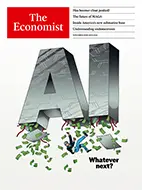
AI Whatever next?
- History suggests an AI crash is likely. But do not expect a financial cataclysm: leader, page 9.
- Can the AI boom make enough money to sustain itself? Briefing, page 20.
- The Jensen Huang scandal is a sorry tale of hubris. His should not be the only head to roll, leader: page 10, and analysis, page 57.
- There has never been a corporate scandal like it: Schumpeter, page 64.
Has boomer clout peaked?
- Across the rich world, the geriatric share of income and wealth is ebbing, page 65.
What next for MAGA?
- The fight over Republicans’ future has begun, page 27.
- Donald Trump has a chance to make real progress. He also has a gift for blowing such chances: Lexington, page 28.
Inside America’s new submarine base
- A trip Down Under to see the future of undersea defence, page 33.
Understanding endometriosis
- Advances in understanding the biology ofa disease from which 190m women suffer should lead to quicker diagnosis and better treatment, page 72.
The world this week Politics
- Russia and Ukraine held their first peace negotiations in nine months. The talks, brokered by America and held in Abu Dhabi, ended with no big breakthrough, though both sides agreed to swap more prisoners of war. Jared Kushner and Steve Witkoff, Donald Trump’s envoys, then flew to Moscow, to try to persuade Vladimir Putin to include other European countries in future negotiations. They also prepared to meet Volodymyr Zelensky. Ukraine is wary about a meeting between Mr Trump, Mr Putin and Xi Jinping, which Mr Putin is seeking to use to discuss an end to the conflict, but without Mr Zelensky.
The cold war
- France accused Iran’s revolutionary guards of being behind a spate of cyber-attacks on the food-refrigeration systems of big supermarkets. In midOctober the hackers tapped into the supermarkets’ cooling systems, which can be controlled over the internet, damaging goods worth tens of millions of euros and raising concerns about an attack on food security. Jean-Noël Barrot, the French foreign minister, blamed Iran, describing it as an act of “unprecedented aggressiveness”.
- In Spain unions held their first national strike in 14 years to protest against the high cost of housing, a big issue in the general election that has been called for November 29th. The ruling Socialists are currently trailing in the polls.
- A 24-year-old man shot dead six people in Krakow, Poland’s second-biggest city. He is also suspected of killing his parents and sister. The incident shocked Poland, where gun crime is rare. The perpetrator, who was shot by police and eventually died from his wounds, was described as a loner. Itis unclear what his motives were. Ministers suggested he was inspired by far-right ideology, a claim that was disputed by conservatives.
- An attempt by a Republican congressman to impeach Pete Hegseth, America’s secretary of war, failed after other Republicans moved to defeat it. Thomas Massie, who lost his primary election in May to a Trumpier candidate, brought several charges against Mr Hegseth relating to the Iran war. Holding a rare press conference, Mr Hegseth defended his record and described the impeachment attempt as a farce. Democrats looked on in glee and vowed to revive the proceedings next year.
- Trying to regain the initiative after the Republicans’ stinging defeat in the midterms, Donald Trump appointed Stephen Miller as his new chief of staff. The combative Mr Miller has advised the president on policy during his first and second terms, pushing for harsh immigration measures and deadly strikes against alleged drug-traffickers in the Caribbean, among other things.
- Scott Colom was declared the winner in Mississippi’s Senate election, becoming the first black person to represent the state in the Senate since the post-civil-war era. He is also the first Democrat from Mississippi to be elected to the Senate since 1982. Counting continued in Alaska’s close Senate race, where the Democrat holds a narrow lead over the Republican.
- An American soldier was arrested in Britain on suspicion of spying for Russia. He reportedly worked at a NATO base. Meanwhile, American military aircraft were withdrawn from a second air-force base in Britain, according to reports, amid heightened security over a possible attack from Iran. American planes flew out of RAF Mildenhall and relocated elsewhere. In September American bombers were redeployed from RAF Fairford because of a potential Iranian plot. America’s Justice Department has laid charges against three alleged operatives for Iran, including in that case.
- Gibran Rakabuming Raka submitted his resignation as vice-president of Indonesia, following court rulings that there was no evidence of his graduating from high school, and he was thus ineligible to stand in the 2024 election. Mr Gibran is the son of Joko Widodo, known as Jokowi, who was president until 2024. Relations between Jokowi and the current president, Prabowo Subianto, have soured amid claims that Jokowi’s allies in the administration wiretapped Mr Prabowo’s phone.
- In Bangladesh supporters of Sheikh Hasina clashed with police. The former prime minister fled the country in 2024 amid widespread protests. She lives in exile in India but wants to return to Bangladesh in December, even though she has been sentenced to death in absentia for her brutal crackdown on the protesters. The Bangladeshi government refuses to issue her a passport.
- There was no clear winner in New Zealand’s election. The final results will not be announced until the end of the month, but Christopher Luxon, the centre-right prime minister and leader of the National Party, is talking to the centrist Opportunity Party about joining his coalition.
- Isaac Herzog, Israel’s president, asked Gadi Eisenkot, the leader of the centrist Yashar party, to form a new government. A majority of members in the newly elected Knesset endorsed Mr Eisenkot, but the opposition parties did not agree on the composition of the new coalition. Mr Eisenkot indicated that he wanted to form a minority “emergency” government, without either Arab or ultra-Orthodox parties. He will have up to six weeks to convince his partners.
- Seasonal flooding swamped Gaza, drenching the tents of around 350,000 people. In unusual criticism, Donald Trump’s Board of Peace warned Israeli politicians that aid provisions are “insufficient” and urged them to let more supplies into the strip.
- Paraguay’s parliament removed Santiago Peña as president amid a scandal that led to the collapse of a popular bank and caused the head of the central bank to step down. Mr Peña, who had offered to resign, was placed under house arrest amid allegations that he used his influence to direct government work towards the bank; Mr Peña used to hold shares in a company tied to it. He denies any wrongdoing.
Missionary zeal
- Pope Leo visited Latin America, just a month after cancer surgery. The pontiff started off in Uruguay and then headed to Argentina, where 2.5m people attended one mass. In a televised address attended by Javier Milei, the pope criticised the president’s austerity programme because of its impact on the poor. He then went to Peru, where he worked for over 20 years as a missionary before taking the top job in the Vatican. At least 3m people turned out to greet him in what he describes as his homeland.
The world this week Business
- Nvidia was engulfed in turmoil after Jensen Huang, the chipmaker’s chief executive, admitted to having an extramarital affair with an executive at Megaspeed, a Singaporean cloud-computing company that buys Nvidia’s hardware. American officials suspect the woman is a Chinese agent and that Megaspeed helps China bypass export controls on American chips. The affair has raised questions about whether Nvidia intervened to thwart a government investigation into Megaspeed last year. Donald Trump said the FBI had started an inquiry. As reports surfaced that Mr Huang also had an affair with an executive at Nvidia, the board deliberated over removing him.
- Nvidia’s share price plunged in reaction to the news about Mr Huang, unsettling already jittery investors. Chip stocks recently recorded one of their worst days ever, which saw the NASDAQ 100 drop by around 6%. The sell-off came on the heels of the Democrats’ victory in the midterms; the party has pledged to curb the construction of data centres and so slow investment in AI. Stock markets had clawed back some of their losses over subsequent days, though investors remain cautious. Markets in Japan and South Korea also sank.
- Investors took some comfort from CoreWeave’s latest earnings, which suggested that its sales remain strong. CoreWeave is one of the neoclouds, a group of fast-growing companies that buy specialist AI chips and rent them out, but are also laden with debt. In October stock markets swooned when CoreWeave raised the prospect of taking on even more debt.
- A former employee at OpenAI’s headquarters pleaded not guilty to spying. Prosecutors allege that the man, a Saudi national, had frequent contact with an unnamed member of Saudi Arabia’s royal family.
- An updated filing with regulators indicated that Anthropic could be worth $1.4trn at its forthcoming IPO, making it one of the biggest ever. Reports suggest that the huge demand for shares in the firm may actually see its value head towards $1.5trn. The stock is expected to start trading on November 19th.
Boom and bust
- SoftBank booked a $3.7bn charge against its data-centre investments in America, driving it to its first quarterly net loss in two years. The charge was reportedly related to energy equipment, including gas turbines SoftBank had reserved to power the data centres.
- Unable to use all the energy SoftBank apparently decided to write off the contracts.
- Alibaba confirmed that its subsidiary chips business, T-Head, has filed for an IPO in Hong Kong. T-Head lies at the centre of Alibaba’s thrust into AI and computing; in September it released its next-generation processor. The details of the stock-market listing haven’t been decided yet, but it should enable T-Head to raise its own capital in the markets.
- America’s monthly inflation rate was 0.4% in October, more than markets were expecting (the Bureau of Labour Statistics did not calculate an annual rate because the government was shut down in the corresponding month last year). Investors are now all but certain that the Federal Reserve will raise interest rates again in December. Speaking ahead of the latest inflation data Christopher Waller, a Fed governor, suggested the central bank may need to lift its benchmark rate by half a percentage point.
- Clare Lombardelli, a member of the Bank of England’s Monetary Policy Committee, said that unless inflationary pressures weaken, interest rates may rise again “in the near term”. The bank recently increased its base rate for the first time in more than three years, lifting it to 4%.
- The value of China’s goods exports surged by 35% year on year in October, as the country continued to pump out chips and AI-related products. China’s cumulative trade surplus for 2026 surpassed $1trn in October, reaching the milestone a month earlier than it did last year.
- Skydance outlined the cost savings it expects to achieve from its takeover of Warner Bros. The film-and-TV company expects to save at least $6bn net over the next three years by reducing management layers, scaling AI workflows and streamlining marketing, among other things. The company is already offering voluntary buy-outs to employees ahead of official lay offs.
End of the road?
- Elon Musk announced on X that Tesla would be “winding down production of the Cybertruck” from the middle of next year in order to increase output of its robotaxi, the Cybercab. It was unclear if that meant the Cybertruck is being phased out completely. Sales of the futuristic-looking pickup truck, more Terminator than Dukes of Hazzard, have been poor and it has faced several recalls.
скачать журнал: The Economist November 14th 2026
|