|
Год выпуска: май 2026
Автор: The Economist Newspaper and The Economist Group
Жанр: Экономика/Политика
Издательство: «The Economist Newspaper Ltd»
Формат: PDF (журнал на английском языке)
Качество: OCR
Количество страниц: 84
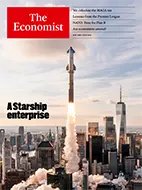
A Starship enterprise
- The listing of SpaceX is capitalism on rocket fuel: leader, page 7.
- SpaceX readies the world’s biggest public offering: briefing, page 14.
We calculate the MAGA tax
- MAGAnomics shows the world what not to do. But also what America keeps getting right: leader, page 8.
- Our estimate of the drag on growth from erratic presidential policymaking, page 63.
Lessons for Britain from the Premier League
- How a deflated country can bounce back: leader, page 10.
- Many things in Britain aren’t working. Football is, page 44.
- Why football attendance is booming outside the Premier League, page 46.
NATO: Time for Plan B
- Europe needs a fallback plan. Mark Rutte, NATO’s boss, is wrong to discourage talk of it: leader, page 9.
- Europeans are quietly working out how to fight if America quits the alliance, page 39.
Are economists amoral?
- From hiring hitmen to buying heroin, new thoughts on “repugnant transactions”: Free Exchange, page 69.
The world this week Politics
- America’s Justice Department charged Raúl Castro with the “murder” of four Americans of Cuban descent. Mr Castro succeeded his brother Fidel as Cuba’s leader before stepping down in 2021. The indictments relate to the shooting down of two small aircraft, operated by a Cuban-exiles group, in 1996 by Cuban military jets, which killed the four men. Mr Castro was Cuba’s defence minister at the time. The charges intensify America’s campaign against the Cuban regime and threat of an invasion. Speaking in Spanish, Marco Rubio, America’s secretary of state, released a video to Cubans telling them that America was offering “to build a better future” for the island.
- Venezuela deported Alex Saab, an ally of Nicolás Maduro, the deposed president, to America. Mr Saab, often referred to as Mr Maduro’s “bag man”, appeared in court in Miami where a charge of money-laundering was presented. He has been arrested before, but prosecutors may now lean on Mr Saab to flesh out their case against Mr Maduro, who was snatched by American forces in January.
- More anti-government demonstrations took place in Bolivia, amid widening opposition to austerity measures proposed by Rodrigo Paz, the centrist president. Bolivian officials in part blame Evo Morales, a former leftist president, for stirring up trouble. Mr Paz’s election to office last year ended two decades of socialist rule in the country. America’s State Department compared the protests to an attempted “coup d’état”.
- Indonesia announced a proposal to centralise the export of commodities such as palm oil and coal through a new state-operated export company. Exporters of natural resources will also have to place their export earnings in state-owned banks, in order to stabilise the falling rupiah. Indonesia’s central bank raised interest rates for the first time in two years, lifting them by a larger-than-expected half a percentage point.
Trade flows
- Vladimir Putin visited China, where he signed several deals on trade and co-operation with Xi Jinping. The leaders discussed a new pipeline that would provide China with Russian natural gas. Meanwhile, China confirmed it will buy 200 Boeing jets following Donald Trump’s recent trip to Beijing. Although the order is smaller than had been expected it represents a step forward; at the height of the trade war China paused deliveries of Boeing jets.
- The WHO declared an outbreak of Ebola to be a publichealth emergency of international concern. The virus kills up to half of those who catch it. The epidemic in eastern Democratic Republic of Congo is thought to have killed at least 139 people so far, with hundreds more infected. The numbers will probably rise. The response to the outbreak is being hampered by war, aid cuts and the lack of a vaccine for the strain that is causing it.
- America and Nigeria claimed that a top Islamic State commander and 175 other militants were killed in air strikes in north-eastern Nigeria, part of a series of collaborative operations aimed at tackling the country’s overlapping security crises. America has stepped up support for Nigeria’s counterterrorism efforts, but there is no evidence that this is reducing the violence.
- At least four people were killed in protests over high fuel prices in Kenya. In response the government cut diesel prices and entered negotiations with transport unions to resolve a strike by bus and minibus drivers. The war in Iran has driven up prices in Kenya, which, like much of east Africa, depends on the Gulf for oil supplies.
- Mr Trump threatened to restart strikes on Iran, warning the Islamic regime that the “clock is ticking”. The American president then said that he had called off an attack at the request of Qatar, Saudi Arabia and the United Arab Emirates. He claimed that “serious negotiations” were under way. Meanwhile, Iran announced the establishment of the Persian Gulf Strait Authority, a new entity tasked with “managing the passage and transit through the Strait of Hormuz”.
- The United Arab Emirates said a drone strike on its Barakah nuclear plant had sparked a fire. Officials said they did not know who was responsible, but confirmed that the attack had come from Iraq, where some Iranian-backed militias are based.
It stinks
- America’s Justice Department created a $1.8bn fund to compensate people who claim they have been targeted by federal prosecutors for political purposes, in effect allies and supporters of Donald Trump. This will probably include the rioters who stormed Congress on January 6th 2021. It forms part of the government’s settlement with Mr Trump in a case related to his leaked tax documents. The president was seeking $10bn in damages and has now dropped his claims.
- A novice candidate backed by Mr Trump won a primary election for a congressional district in north Kentucky. Ed Gallrein defeated Thomas Massie, one of the few remaining Republican critics of the president, in the most expensive House primary election ever. Another thorn in Mr Trump’s side, Bill Cassidy, was defeated in his Senate primary in Louisiana.
- Andy Burnham, the mayor of Greater Manchester, emerged as the favourite to succeed Sir Keir Starmer as Labour’s leader, and thus Britain’s prime minister, in a putative leadership contest. But Mr Burnham is not a member of Parliament. The MP in Makerfield, a traditional Labour seat, stood down to enable him to contest it in a by-election. However, at the recent local elections Reform UK made big gains in the area, suggesting it is not a foregone conclusion that Mr Burnham will clinch the seat.
- Peter Magyar, Hungary’s new prime minister, visited Poland on his first trip abroad. Mr Magyar met Donald Tusk, his Polish counterpart, who also came to office by defeating an anti-EU government. Hungary’s relations with Poland were strained under Mr Magyar’s predecessor, Viktor Orban. Mr Magyar wants Hungarian-Polish relations to return to “normality” as the countries have much in common.
- A NATO jet shot down a Ukrainian drone that had entered Estonia’s air space. Ukraine blamed Russia’s “electronic warfare” for redirecting the drone. Another Ukrainian drone crashed in Lithuania. Latvia also reported drone incursions. Latvia’s prime minister, Evika Silina, resigned recently, after misdirected Ukrainian drones crossed over from Russia and damaged an oil facility. Latvia’s defences had not detected the breach.
The world this week Business
- SpaceX officially launched its blockbuster IPO. The spacerocket firm, led by Elon Musk, hopes to raise around $75bn when it floats on the NASDAQ stockmarket, smashing the record for an IPO held by Saudi Aramco, which went public in 2019. Its target valuation is about $1.75trn. In its prospectus SpaceX laid out ambitions to use its rockets to transport components to off-world data centres in space. It also mentions a vision of carrying people to Mars and of mining on asteroids. The IPO announcement came as the firm prepared the first test flight of its V3 Starship megarocket.
- It was a mixed week for Elon Musk, who lost his courtroom battle with OpenAI and Sam Altman. It took a jury just two hours to reject the case, in which Mr Musk sought damages from OpenAI for allegedly reneging on a contract with him as a co-founder to run the firm as a non-profit instead of for-profit entity. Meanwhile, OpenAI was reportedly ready to launch its own IPO with a view to a listing in September.
- Nvidia presented another stellar set of quarterly earnings. It recorded overall revenues of $81.6bn, up by 85% year on year, with sales from chips for data centres taking in $75.2bn, a rise of 92%. The company announced an additional $80bn in share buy-backs.
- A last-minute deal between management and unions averted a strike at Samsung. Samsung has reaped huge profits from selling its memory chips to data centres and the unions want their cut in bonuses.
- Britain’s annual inflation rate fell to 2.8% in April from 3.3% in March, mostly a result of the government lowering its cap on energy prices. Electricity prices fell by 8.4%. However the cost of motor fuel surged by 23%, prompting the government to postpone a rise in fuel tax this week. Economists expect the overall inflation rate to rise again in the coming months.
When in need
- America extended a waiver on sanctions for buying Russian oil for another 30 days. The waiver applies to Russian oil held at sea and is designed to help poorer countries that have taken a hit from the stoppage of supplies through the Strait of Hormuz. Meanwhile, Britain eased sanctions on Russian oil refined into diesel and jet fuel in other countries. This will enable the country to import jet fuel from India.
- Ryanair, Europe’s largest airline, said it was “far too early” to give any meaningful profit guidance because of volatile jet-fuel prices. Europe is relatively well stocked with jet fuel, and Ryanair hedges 80% of its fuel costs, but it warned that spot prices had hit $150 a barrel for unhedged fuel.
- Adani Enterprises, part of Adani Group, agreed to pay $275m to settle claims that it violated American sanctions by buying Iranian fuel between November 2023 and June 2025. The case was brought by America’s Treasury Department. Meanwhile, the Justice Department decided to drop its criminal fraud case against Gautam Adani, Adani Group’s chairman, and the Securities and Exchange Commission settled with Mr Adani on allegations that focused on investors being misled about his group’s antibribery practices. Under the deal Mr Adani neither denies nor admits the claims.
- Anglo American agreed to sell its coalmining assets in Australia for up to $3.9bn to Dhilmar, a privately held mining firm. Anglo has now divested its coal, nickel and platinum divisions and is in talks with a consortium to sell off its De Beers diamond business.
- A formerly unsolved mathematical problem has been cracked by a model from OpenAI, in what has been called a “milestone” in AI maths. The problem, which asks how many pairs of points can be exactly one unit apart on a two-dimensional plane, was first posed in 1946 by Paul Erdos. The AI proof overturned previous best efforts, and was produced by a general model without any mathematicsspecific training, said OpenAI.
How to make a quick buck
- Swatch’s Royal Pop pocket watch went on sale. Made in collaboration with Audemars Piguet, the watches combine the retail and luxury ends of the market. Hundreds of people queued outside Swatch shops around the world; some disturbances were reported as customers fought over a timepiece. Selling for $400-420, some watches are being resold online for as much as $3,000.
- James Murdoch, son of Rupert and a former boss of News Corporation in Europe, is acquiring a roughly 50% stake in Vox Media. Mr Murdoch wants to be involved in “longer-form, thoughtful journalism”, a contrast to the cut-and-thrust of the daily newspapers he used to run. One of the titles owned by Vox is New York magazine, which publishes articles on Gotham as well as stories of national interest, such as why “The Amish Are Falling in Love With AI”.
скачать журнал: The Economist May 23th 2026
|