|
Год выпуска: октябрь 2026
Автор: The Economist Newspaper and The Economist Group
Жанр: Экономика/Политика
Издательство: «The Economist Newspaper Ltd»
Формат: PDF (журнал на английском языке)
Качество: OCR
Количество страниц: 84
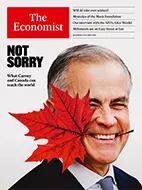
NOT SORRY
What Carney and Canada can teach the world
- Mark Carney and his country have something to teach the middle powers: leader, page 11.
- Can Donald Trump’s bullying goad Canada out of its complacency? Briefing, page 19.
- Middle powers face a new threat, page 53.
Will AI take over science?
- The machines are inside the laboratory: leader, page 12.
- In a seven-page Science & technology section, we look at why the model-makers train their AIs for research, page 69.
- Breakthroughs in biology, page 72.
- The fears of mathematicians, page 70.
- And scientific paperwork, page 74.
Mysteries of the Musk Foundation
- Elon Musk’s charitable giving is opaque, miserly and self-serving, page 57.
- A new film about the tycoon, page 79.
- Looking back at DOGE, page 80.
Our interview with the AfP’s Alice Weidel
- Why she insists that Germany must abandon Ukraine, page 47.
Millennials are on Easy Street at last
- Don’t feel sorry for them. They are living it up, page 63.
- A tech-powered millennial revival is powering the biggest nostalgia boom yet, page 76.
The world this week Politics
- The Houthis, Yemeni rebels backed by Iran, carried out several strikes on Saudi Arabia. At least 17 people were killed and more than 300 were injured in the attacks on Saudi airports. Some of the casualties were pilgrims boarding a flight from Riyadh to Jeddah, the gateway to Islam’s holiest sites. The Houthis also attacked the headquarters of Saudi Aramco, the state oil firm. Donald Trump accused the rebels of “purposefully” trying to drive up oil prices ahead of America’s midterm elections.
- A Singapore-flagged container ship sank after being struck by a missile while crossing the Strait of Hormuz. Attacks on vessels have become more frequent. There have been at least 23 since October 1st, six more than during the first two weeks of the war.
- Mr Trump’s agreement with Vladimir Putin through which Russia will supply diesel to America and global markets was roundly criticised, including by some Republicans. Mr Trump desperately wants diesel prices to fall ahead of the midterm elections, though observers think his deal will not have much of an effect. After Volodymyr Zelensky called it “a weak decision”, Mr Trump suggested Ukraine should “get a new leader”. A bipartisan group of senators questioned the legality of the deal, reminding Mr Trump that Congress banned Russian energy imports in 2022.
- Russia resumed its bombardment of Ukrainian power infrastructure, hitting an energy plant near Kyiv. It also hit a block of flats. Mr Zelensky said Ukraine had received no warnings about some recent attacks and that he feared America had stopped sharing intelligence, which Mr Trump denied. Ukraine also reported that restrictions had been imposed on its use of Starlink, a satellite network that has become crucial to Ukrainian military operations.
- Bulgaria’s prime minister, Rumen Radev, said Russia was probably responsible for destroying two cargo ships in the Black Sea; 11 sailors are missing after one of the ships sank. Russia has been trying to block exports of Ukrainian grain, and Ukraine has responded with drone attacks on Russia’s shadow fleet.
Trying to have it both ways
- The British prime minister, Andy Burnham, claimed that a summit with the European Union on November 20th would be a springboard for a “serious dialogue” about future relations with the bloc. Mr Burnham seemed to cast doubt on the validity of the Brexit referendum of 2016 by asserting that Russia had interfered in it, but later told Parliament he hadn’t meant to suggest that Russian meddling had swung the vote. That was confirmed by the head of MI5, who said Russian online trolls had tried to interfere, but to no effect (Russia tries to disrupt many Western elections).
- In Turkey the authorities raided the offices of Halk TV,a pro-opposition channel, and installed a government trustee to run the network. Prosecutors claim they are investigating the broadcaster’s chairman for financial crimes, but the government’s opponents say the probe is just another crackdown on voices of dissent.
- More Republicans aired their opposition to the proposal by Pete Hegseth, the secretary of defence, to livestream the execution of Nidal Hasan, a former army psychiatrist who shot 13 people dead at Fort Hood in 2009. J.D. Vance, the vice-president, cast doubt on whether the execution, scheduled for December 3rd unless halted by an appeal, would be livestreamed. He said he would not watch it if it was. Several Republicans pointed out that broadcasting executions is a practice associated with Islamist extremists. In a letter scores of former high-ranking military officers described it as a “barbaric abuse of authority”.
- Federal officers searched the home of Ilhan Omar, a leftwing Somali-born congresswoman from Minnesota. The Department of Justice said the search was part of a continuing investigation. The press reported that it was related to the details ofMs Omar’s immigration status. Coming amid her re-election campaign Ms Omar said it was an act of “political intimidation”.
- Flávio Bolsonaro, the leading contender in Brazil’s presidential election, said he supported a proposal to reduce the working week from 44 hours to 40. Brazilians in occupations such as retail currently work six days a week. The run-off election is on October 25th.
- Argentina filed its complaint against a joint Anglo-Israeli oil project in the seas surrounding the Falkland Islands, a British territory that Argentina claims as its own. The lawsuit has been lodged with the International Tribunal for the Law of the Sea. The companies involved insist they have valid licences to operate issued by Britain.
- A new border-crossing bridge was officially opened over the Yalu river. It connects Dan-dong in China with Sinuiju in North Korea. The opening of the road crossing had been expected more than a decade ago, but was held up by the suspension of work on the North Korean side, apparently related to a cooling of relations and the covid-19 pandemic.
- In Pakistan police clashed with supporters of Imran Khan, the imprisoned leader of the opposition, after the federal government declared a state of emergency in Khyber Pakhtunkhwa, where the provincial government is led by Mr Khan’s party. The federal government said it had detected a rise in militant activity, as it took direct control of the province and installed a new governor. Hundreds of Mr Khan’s followers have been rounded up ahead of their planned march on Islamabad, the capital, to demand his release.
- Two of the leaders of India’s Cockroach Janta Party were jailed for five days for trespassing during a protest in Delhi. The Gen-Z movement is seeking the removal of the head of the election commission over alleged irregularities in the voting rolls that favour the ruling Bharatiya Janata Party. Opposition politicians condemned the arrests.
Buy local
- Strict rules on the certification of halal products were due to come into force in Indonesia, home to the world’s biggest Muslim population. The regulations mean that everyday items, including office supplies and toilet paper, will need to prove they have been through the halal process, conforming to Islamic principles. Nonhalal products must display a sticker, which could suppress demand for them. Even Saudi Arabia does not have such strict requirements for general goods. Observers point out that the new law may really be intended to protect local companies from foreign imports.
The world this week Business
- The IMF’s latest economic outlook found that the global economy had displayed resilience in the face of several shocks, and estimated that global GDP would grow by 3.1% this year, up slightly from a previous prediction in July. It also noted that borrowing costs have risen sharply in rich countries as “fiscal buffers” are used to absorb economic shocks. “Fiscal policy must be restrained,” it said. Higher public borrowing has helped propel a sell-off in bond markets. The fund also downgraded Saudi Arabia’s GDP growth by five percentage points and now thinks the kingdom’s economy will shrink by 3.3% this year.
- America’s annual inflation rate jumped to 3.7% in September, from 3.4% in August, driven by the rebound in fuel prices. Higher energy prices are also on the cards for Europe, where gas futures have risen steeply since the start of the Iran war and are now trading above €87 ($97) per megawatt hour.
- China’s export boom continued apace in September, as the value of goods sent abroad rose by 36%, year on year, smashing most forecasts. Exports to America were up by almost 40%. China’s trade surplus for the first nine months of 2026 was $938bn, on track to pass last year’s record $1.2trn. China, meanwhile, agreed to curb its exports of hybrid cars to the EU in an effort to head off tariffs on the vehicles.
- BlackRock’s research arm recommended increasing holdings of American Treasuries (relative to a baseline allocation) as “Yields have reset toward our long-held higher-rates view, and we want to lock in some attractive income.” It is also now more cautious on US equities, downgrading them to a neutral investment holding “to manage potential volatility around the AI buildout”. Meanwhile, Hock Tan, Broadcom’s chief executive, warned that “A lot of investors have no clue what they are investing in”, comparing their bets on AI to a casino.
- South Korea’s benchmark stock index, the KOSPI, fell sharply amid a sell-off in tech shares, triggering the tenth circuitbreaker this year. Amid the jitters, TSMC, which makes most of the world’s advanced chips, reported a 69% increase in quarterly profit, year on year, of $23.6bn and forecast more bumper sales for this quarter. And ASML said orders for its ultraviolet lithography machines, which are used to make high-end chips for AI, were already stretching into 2029 and 2030 and it was looking again to increase capacity.
Out of the sandbox
- Another week, another alert about rogue AI. Anthropic warned that small AI models “may be months away” from being able to infiltrate smart household-appliances connected to the internet, such as TVs and ovens. Such incidents would be “challenging to shut down”, it said. The models could also “figure out” how devices work (some experts think Anthropic’s findings are exaggerated). Anthropic also revealed that its AI agents had accessed government websites. Press reports suggested this included filling out visa forms at the State Department and giving a false murder tip to Philadelphia police.
- A cyber-attack hit French supermarkets by tapping into their systems and increasing the temperature settings on refrigerators, melting food and damaging equipment. Carrefour and Coopérative U were among those affected. Supermarkets allow engineers to control heating and cooling over the internet. Itis thought the attackers found a vulnerability in old firmware.
- America’s big banks reported a mixed bag of earnings. JPMorgan Chase’s net profit, $15.3bn for the third quarter, fell short of analysts’ consensus for the first time in three years. Bank of America also missed its estimate and it booked a $1.2bn fine imposed by the Treasury for failing to adequately report suspected money-laundering. Goldman Sachs’s profit of $5.3bn beat forecasts, however.
- The share prices of America’s big wireless providers, such as Verizon and T-Mobile, were left reeling after SpaceX announced that it had acquired a portfolio of licences in low-band spectrum, airwaves that are used for mobile coverage. SpaceX has indicated it wants to compete for retail mobile contracts.
Heading for a divorce
- Bumble, an online dating service, agreed to be taken over by a holding company in a $1.3bn buy-out. Bumble is best known for ensuring that women made the first move, though it abandoned the policy in August after it found most women preferred men to take the lead. The allure of digital dating is waning and, as with other dating apps, Bumble has seen user engagement drop. Younger people, the biggest users of the apps, are particularly likely to be turning away from electronic hook-ups to seek romance the old-fashioned way.
скачать журнал: The Economist October 17th 2026
|