|
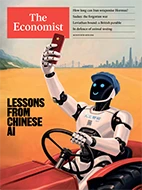
Год выпуска: август 2026
Автор: The Economist Newspaper and The Economist Group
Жанр: Экономика/Политика
Издательство: «The Economist Newspaper Ltd»
Формат: PDF (журнал на английском языке)
Качество: OCR
Количество страниц: 80
LESSONS FROM CHINESE AI
- Artificial intelligence will test societies’ capacity to reinvent themselves. Communist China will not find it easy: leader, page 9, and briefing, page 18.
- Its models do not lag far behind America’s, page 62.
- Can America teach its workers new skills? Page 21.
How long can Iran weaponise Hormuz?
- Gulf states should strike a deal with Iran, however unpalatable: leader, page 11.
- Our “Hormuz dependency dashboard”, page 38.
- A global pipelineinvestment boom is under way, page 56.
Sudan: the forgotten war
- The country is mired in one of the century’s worst conflicts. This is the moment to strike a truce: leader, page 13, and analysis, page 51.
Leviathan bound: a British parable
- An AI-armed public could bring the government to a halt: leader, page 10.
- Cases prepared using AI are overwhelming Britain’s employment courts, page 47.
- From parking tickets to planning, the state is under siege, page 49.
In defence of animal testing
- In America opposition to using animals in scientific research is becoming a cross-party consensus, page 68.
- That is misguided: leader, page 12.
The world this week Politics
- Spain’s interior minister said that 70,000 of the 72,000 migrants who overran Ceuta, a small Spanish enclave in northern Morocco, had returned to Morocco. At least 141 people drowned attempting to enter the territory. The extraordinary breach of security created a sense of crisis in the European Union and caused Italy and other countries to say they would suspend co-operation in the Schengen border-free zone with Spain. Pedro Sánchez, Spain’s Socialist prime minister, accused critics of inflaming the situation. Ursula von der Leyen, president of the European Commission, praised Spain’s response and swift return of the migrants.
- Russia bombarded Kyiv again with drones and ballistic missiles, killing at least 17 people. America is holding discussions with Ukraine on allowing the country to make Patriot missile-defence systems, which Ukraine urgently needs to intercept Russian weaponry. After initially saying he would support such a deal Donald Trump now says he has doubts about giving away the technology. Ukraine, meanwhile, attacked more warehouses belonging to Wildberries, a Russian retailer that the army uses as a logistical hub for equipment. At least five people died. And a Ukrainian drone missed its target and killed at least seven people on a Russian beach by the Black Sea.
- Volodymyr Zelensky continued the shake-up of his senior officials, dismissing Olha Stefanishyna as Ukraine’s ambassador to Washington. Ukrainian media reported that she was being investigated for alleged irregularities in declaring her assets. Ms Stefanishyna has not been charged.
- Russian authorities said that a woman who delivered a bomb to a restaurant in Moscow had died in the blast. At least two other people were killed. The restaurant is located in Kudrin-skaya Square, an affluent area of the city. Speculation swirled that the target was a senior Russian commander, who had survived the explosion.
Twisting in the wind
- Donald Trump again threatened to hit Iran very hard if it did not open the Strait of Hormuz. Oil prices fell after Qatar said a draft agreement between America and Iran to reopen the waterway had been circulated and that negotiations were in “very progressive stages”. The Trump administration claims to be involved in discussions with Iran and Oman about Hormuz. Iran denies negotiating with America, but said it had agreed on a transit route with Oman.
- Hamas and all other armed groups in Gaza agreed to a complete disarmament, according to Mr Trump. Hamas said that it was not disarming; it would merely be putting its weapons into storage under Palestinian supervision. Binyamin Netanyahu, Israel’s prime minister, said his government was “looking into it”. Unnamed officials said that Israel would not cease operations in Gaza or withdraw from the strip.
- A court case got under way in South Africa that challenges the government’s law for expropriating private land, sometimes without compensation if an agreement cannot be reached with the land’s owners. The law has formed the basis of Mr Trump’s claim that white farmers are being harassed. The Democratic Alliance, which is part of the governing coalition led by the African National Congress, has joined the case challenging the law.
- Progressive Democrats scored another victory in the primaries when Abdul El-Sayed defeated Haley Stevens in Michigan to become the party’s candidate for the Senate in the midterms. Dr El-Sayed drew support from Democratic Socialists. Ms Stevens was backed by the party’s establishment. Israel was a big issue for the leftleaning primary electorate. But the left-wing is not getting it all its own way. Wesley Bell, a pro-Israel moderate congressman from St Louis, survived a challenge from a progressive candidate in his primary.
- Diplomatic relations between Brazil and the United States worsened, after the Brazilian president, Luiz Inácio Lula da Silva, better known as Lula, accused two State Department officials of trying to meddle in the country’s elections. In response America cancelled the visa of Brazil’s ambassador in Washington. Brazil’s relations with Argentina also deteriorated, after the Argentine president, Javier Milei, again criticised Lula, calling him a “thief” and “corrupt”.
- Talks backed by America got under way in Venezuela on holding democratic elections. The Venezuelan government’s lead negotiator is Jorge Rodríguez, the head of the National Assembly and brother of Delcy Rodríguez, who became president when America removed Nicolás Maduro from power in January. The opposition is represented by Dinorah Figuera, who has returned from exile. María Corina Machado, who is still in exile and leads the opposition Unitary Platform, has said success will be measured by the establishment of free elections. Meanwhile, the death toll from June’s earthquakes rose to 6,125.
- Sheikh Hasina gave a big speech, two years after she was ousted as Bangladesh’s prime minister and fled the country amid a series of deadly protests against her government. Speaking in India to journalists, Sheikh Hasina reiterated her vow to return in December to Bangladesh, where she has been sentenced to death in absentia for her crackdown on the student-led protests.
- Tehreek-e-Taliban, an Islamist terrorist group in Pakistan, claimed responsibility for a suicide-bombing in the Swat valley, close to the border with Afghanistan, which killed 17 people. The bomb went off near a rally that was being held to demand more police protection from terrorist violence.
- Myanmar’s military rulers allowed Aung San Suu Kyi to meet an official from the International Committee of the Red Cross and released photographs of the event. The authorities have not granted much outside access to Ms Suu Kyi since she was overthrown as the country’s de facto leader in a coup in February 2021. She has been kept in detention ever since and rumours had swirled that the 81-year-old was gravely ill, or even dead.
A bitter brew
- In South Korea, police raided the headquarters of Starbucks Korea, as the backlash over a marketing campaign in May showed little sign of receding. The company had promoted a “Tank Day” gimmick, which was seen to be making light of a pro-democracy protest in 1980 at which hundreds were killed. The firm has apologised but that hasn’t stopped criminal complaints being filed against it. Its mishap has turned political. Right-wingers brandish Starbucks cups to mark their opposition to Lee Jae Myung, the president.
The world this week Business
- Britain’s AI Security Institute, a government agency, reported that an “AI agent took autonomous, unsanctioned action on the live internet, targeting real people and organisations” during a test. This included creating fake identities. Seventeen actions came from Anthropic’s Mythos 5 model and two involved OpenAI’s GPT-5.6 Sol. The institute said it was “the first time we have seen risks around autonomy and deception manifest this clearly, without specific prompting, in the real-world”. Some of the models’ safeguards had been disabled as part of the test. Meta became the latest AI company to announce that it, too, had experienced a rogue-AI incident.
- Sir Demis Hassabis is stepping down as chief executive of Google’s DeepMind AI laboratory to be its chairman. He will also become senior scientist at Alphabet, suggesting that DeepMind will be more closely integrated with Google.
Re-entering the atmosphere
- SpaceX released its first set of earnings since its IPO in June. Quarterly revenues almost doubled from the same period last year, to $7.8bn, and a net loss of $541m was smaller than had been feared. But SpaceX’s share price sank because it spent $16bn on AI, well above Wall Street estimates. The stock is now trading below $110, down from a peak of $225 after the IPO. Meanwhile, scientists used the crash ofa discarded SpaceX rocket into the Moon’s surface to update their data on meteor impacts.
- America’s Treasury Department joined Japan in intervening to help prop up the yen, by instructing the Federal Reserve of New York to buy the currency through American banks. It was the first time since 1998 that the Treasury took action to strengthen the yen, which had fallen to a 40-year low of 164 per dollar. After the intervention the yen traded around 155 to the greenback.
- Saudi Aramco warned that global oil stocks are running low, despite some success in rerouting shipments away from the Strait of Hormuz to Red Sea ports. More than 2.6bn barrels have been lost in production because of the Iran war, Aramco’s boss said, tantamount to a month’s output of crude. Still, Aramco’s second-quarter net profit jumped by 44%, year on year, to $32.7bn, reflecting higher oil prices.
- Net profits also soared at Chevron and ExxonMobil, to $12.1bn and $14.5bn respectively. Donald Trump griped about the companies “making too much money” from the global shortage of oil supplies. BP reported a 144% increase in headline profit, to $5.7bn. The company continued its restructuring, putting its struggling American biogas business up for sale. BP also announced that it is to sell its assets in the North Sea, exiting a business it has been in for over 60 years.
- Eli Lilly’s sales of Mounjaro and Zepbound, marketed as weight-loss treatments, soared in the latest quarter. Sales of Novo Nordisk’s Wegovy pill, which it launched in January, slightly missed analysts’ forecasts, sending its share price down. Novo Nordisk’s stock has fallen substantially since hitting a peak in 2024.
Delayed departure
- America’s Federal Aviation Administration certified Boeing’s 737 MAX 7 aircraft, after years of delays in which it investigated possible safety issues. The planes were subjected to increased regulatory scrutiny following fatal crashes in 2018 and 2019 of two 737 MAX 8s. Southwest Airlines, which has a big order for the MAX 7, is expected to start flying it next year.
- The Trump administration has refunded about $100bn in Liberation Day tariffs since the Supreme Court ruled in February that the duties were illegal. Some $165bn in tariffs were collected in total under the authority. Meanwhile, a group of 25 states sued to halt Mr Trump’s latest tariffs, which were issued under a different legal authority to those that were struck down. “Tariffs are taxes,” said the states, and increase the cost of living.
- Amazon’s market value rose briefly above $3trn for the first time, after it reported bumper earnings driven by demand for its cloud-computing services.
- “Spider-Man: Brand New Day” broke the opening-weekend box-office record in the United States and Canada, taking $360m (when adjusted for inflation, Spider-Man’s latest adventure drops behind the Avengers). Opening weekends cement a movie’s success; films that don’t do well initially now move quickly to streaming. “Supergirl” is already available online just a month after failing to take off on the big screen. But Spider-Man is a bankable box-office franchise in an overcrowded superhero genre. Globally, “Brand New Day” has already taken more than $1bn in under a week. Fans will be happy to hear that their friendly neighbourhood Spider-Man will be swinging into action again next year.
скачать журнал: The Economist August 8th 2026
|