|
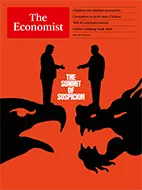
Год выпуска: май 2026
Автор: The Economist Newspaper and The Economist Group
Жанр: Экономика/Политика
Издательство: «The Economist Newspaper Ltd»
Формат: PDF (журнал на английском языке)
Качество: OCR
Количество страниц: 76
THE SUMMIT OF SUSPICION
- A summit shot through with mutual vulnerability is no substitute for global leadership: leader, page 9, and analysis, page 16.
- China wants concessions on Taiwan. Some fear Donald Trump may give ground, page 17.
- China thinks America is declining but still uniquely dangerous: Chaguan, page 34.
- Artificial intelligence revives a cold-war-style dilemma, page 32.
Children: the ultimate accessories
- Big-city parenting has become a financial flex, page 19.
Carmakers try to be more Chinese
- A struggling industry wants to learn from its new stars, page 51.
Will AI arm bioterrorists?
- How artificial-intelligence tools could make it easier to design and build deadly pathogens, page 64.
- Stopping bioterrorists will not be easy: leader, page 10.
Celebs’ irritating book clubs
- Why do so many of the rich and famous now invite readers to join them for a good read? Page 68.
The world this week Politics
- Iran said it was reviewing a proposal from America to end their conflict. Reports from Iranian media suggested that many issues were still unresolved, but Donald Trump said “great progress” had been made towards reaching a “final agreement”. Earlier, America and Iran exchanged fire in the Strait of Hormuz, threatening their ceasefire. The United Arab Emirates and South Korea reported strikes on their ships. Mr Trump announced, and then paused, Project Freedom, an operation to guide commercial ships out of the strait. The UAE intercepted missile and drone attacks from Iran, including one on an oil facility.
A matter of urgency
- Iran’s foreign minister, Abbas Araghchi, travelled to Beijing for a meeting with Wang Yi, his Chinese counterpart. The official Chinese statement on the meeting called for the restoration of safe passage in the Strait of Hormuz.
- Israel struck Beirut for the first time since agreeing to a ceasefire in Lebanon in mid-April. It was targeting a Hizbullah commander; the Iranian-backed militia continues to fire missiles and drones at Israel. The UN said that at least 380 people have been killed in Israeli strikes on Lebanon since the ceasefire began. Its figures do not break down the casualties into civilian and combatant deaths.
- Several drone strikes hit Khartoum, including its airport. The assaults end a months-long period of relative calm in the Sudanese capital, which the regular army retook from the paramilitary Rapid Support Forces last year. They also show that the RSF, which continues to advance in southeastern Sudan, can now inflict damage on most of the country.
- Zambia cancelled a longplanned conference organised by an international NGO promoting digital rights, reportedly because Chinese diplomats had complained about the presence of Taiwanese civil-society activists at the event. The decision underlines China’s determination to use its power over other countries, especially poor ones, to further its political goals when it comes to Taiwan.
- Taiwan’s president, Lai Ching-te, visited Eswatini in an unannounced trip. In late April Mr Lai was forced to cancel plans to attend the 40th anniversary of King Mswati’s accession to the throne because Madagascar, Mauritius and the Seychelles refused to allow his flight through their airspace owing to pressure from China. Eswatini is the only African country that recognises Taiwan. An angry China said that Mr Lai had “stowed away” to get to Eswatini. Separately, Marco Rubio, America’s secretary of state, said Mr Trump would discuss Taiwan with Xi Jinping during their summit in Beijing on May 14th and 15th.
- The Pentagon confirmed that it intends to withdraw 5,000 troops from the 36,000 it has stationed in Germany. Mr Trump had announced the drawdown as a retaliation for remarks made by Friedrich Merz about the Iran war; the German chancellor said America had been “humiliated”. Mr Trump is also considering troop withdrawals from Italy and Spain. And he has threatened to raise American tariffs on EU vehicle imports to 25%.
- Romania’s centrist government was brought down by a vote of no confidence in parliament. The vote was initiated by the Social Democrats, which recently pulled out of the governing coalition, and supported by the hard right. Talks are to be held about forming a new government. The Social Democrats say they are willing to join a fresh pro-EU coalition, as long as it is not led by Ilie Bolojan, the ousted prime minister.
- At least 27 people were killed in eastern Ukraine in a wave of Russian attacks on the region. That included 12 people who died during an aerial bombardment on the city of Zaporizhia. Ukraine said it had initiated a ceasefire and accused Russia of breaking it. Russia announced its own ceasefire for May 8th and 9th to coincide with its commemorations marking the defeat of Nazi Germany in the second world war. Volodymyr Zelensky described Russia’s ceasefire as “utter cynicism” and propaganda.
- A ban on advertisements related to fossil fuels and meat came into force in Amsterdam. The city council is dominated by greens and an assortment of other progressive leftists.
- The Bharatiya Janata Party, which runs India’s federal government, won a landslide in West Bengal’s state election. It has never held power before in West Bengal, which includes the city of Kolkata (formerly Calcutta). The result was a big victory for Narendra Modi, the Hindu-nationalist prime minister, who had campaigned in the state. Incumbents also suffered in other state elections. M.K. Stalin resigned as chief minister of Tamil Nadu after a party led by a former actor gained the most seats there. In Kerala the ruling communists were ejected from power by a coalition led by the Congress party.
- Sir Keir Starmer, Britain’s prime minister, described the recent spate of antisemitic attacks in the country as a crisis, and explicitly blamed Iran for seeking to foment violence and hatred. “It will not be tolerated,” he said. One of the measures he announced would compel universities to track antisemitism on campus and take action to tackle it.
- Australia is also contending with a rise in antisemitism. A commission began hearings into the attack on a Hanukkah event at Bondi Beach last December, which killed 15 people. One expert described antisemitism as a “virus” and that it had become “fashionable” to adopt anti-Jewish views.
- Separatists in the Canadian province of Alberta said they had gathered enough petition signatures to start the process for a referendum on independence, which could take place as early as October. Polling suggests the separatists would have a hard time persuading their fellow Albertans of the merits of breaking away from Canada if the ballot proceeds.
- The International Court of Justice held a hearing on a long-running border dispute. Guyana says that Venezuela’s claim to a large area in the Essequibo river region, which includes substantial offshore reserves of oil and gas, is illegal. Venezuela said the court had no jurisdiction in the matter and only negotiations would solve the issue.
It wouldn’t be a friendly visit
- Donald Trump announced another batch of sanctions against government officials in Cuba. Speaking in Florida, the president said that America would take over Cuba “almost immediately”, and suggested that the American navy would drop anchor off the Cuban coast on its way back from Iran.
The world this week Business
- After failing to secure a bail-out from the American government, Spirit Airlines abruptly cancelled all its flights and began to unwind its assets. The company’s financial officer said it would try to sell the aircraft it owns outright but would abandon the planes to lenders if it cannot. The lowcost carrier had hoped to leave bankruptcy protection in the coming months. But the increase in jet-fuel costs as a result of the Iran conflict worsened its financial position. It had struggled with its debt burden for several years. A proposed merger with JetBlue was blocked on antitrust grounds in 2024.
Fasten your seat belts
- Other airlines have been forced to cut or rejig flight schedules because of higher fuel prices. Meanwhile, the chief executive of Chevron became the latest voice to warn of an impending global shortage of oil supply because of the lengthy closure of the Strait of Hormuz. Mike Wirth noted that Asia and Europe would be hit hard, and that it would take a bit longer for America to feel the effects.
- Shell reported its best quarterly profit in two years as its trading desk benefited from the volatility in oil markets. It expects a big fall in gas production for the second quarter, however, because of the Iran war. Chevron and ExxonMobil reported a drop in profit despite higher oil prices, but both pointed out that this was to do with the timing of financial hedges.
- Battling a surge in inflation driven by costlier energy, Australia’s central bank raised interest rates for the third time this year, lifting its base rate by a quarter of a percentage point, to 4.35%.
- America’s Securities and Exchange Commission began a 60-day consultation process on its proposal to allow stockmarket-listed companies to publish their earnings every six months instead of every three. Supporters of the reform contend that the requirement to release statements on revenue and profit every quarter leads to short-term thinking among managers. Those who favour the current system say six months is too long a gap between reports, which provide investors with solid evidence about a company’s performance.
- GameStop, a video-games retailer that is perhaps best known as a meme stock, announced an unsolicited bid for eBay, in which it has built a 5% stake. GameStop put the equity value of its bid at nearly $56bn, which is vastly more than its own market capitalisation.
- Asked how he would make the sums add up to finance the takeover, Ryan Cohen, GameStop’s chief executive, said “we’ll see what happens”.
- Hong Kong’s economy grew by 5.9% in the first quarter, year on year, the strongest pace since the second quarter of 2021. The global mania for AI has boosted demand for Hong Kong’s related products and electronics, according to the city’s financial secretary. Goods exports were up by nearly 24% in the quarter.
- AMD’s share price soared after the chipmaker reported a 57% rise in sales to data centres in the first quarter compared with the same period a year ago. Overall revenue jumped by 38%. AMD’s earnings along with other tech-related news spurred the S&P 500 and NASDAQ Composite to new highs. Samsung’s market capitalisation passed $1trn for the first time on the back of strong demand for its memory chips, which helped push South Korea’s KOSPI stockmarket index to another record.
- Investors were also pleased by Apple’s earnings. Revenues from the iPhone rose by 20% in the first three months of 2026, year on year, driven in large part by demand for the iPhone 17 in China. Total revenues came in at $111.2bn, more than half of which came from the iPhone. Apple is expected to launch a foldable phone later this year. Meanwhile, Apple agreed to settle for $250m a class-action lawsuit that alleged it misled users about AI capabilities on the iPhone 15 and 16. The company did not admit any wrongdoing.
- The American government’s Centre for AI Standards and Innovation, better known as CAISI, signed agreements with Google DeepMind, Microsoft and xAI that will allow it to study the national-security implications of new AI models before they are released to the public. The agreements build on similar deals struck during the Biden administration.
Slimming world
- More than 2m prescriptions were filled in the year to April 17th for Novo Nordisk’s Wegovy pill, which went on sale in America in January. The company raised its outlook, as it now expects higher revenues from weight-loss treatments. It hopes to start selling the Wegovy pill outside America later this year. However, Eli Lilly, Novo’s main competitor, is threatening to eat its lunch again by releasing a rival weight-loss pill, Foundayo.
скачать журнал: The Economist - May 9th 2026
|