|
Год выпуска: май 2026
Автор: The Economist Newspaper and The Economist Group
Жанр: Экономика/Политика
Издательство: «The Economist Newspaper Ltd»
Формат: PDF (журнал на английском языке)
Качество: OCR
Количество страниц: 90
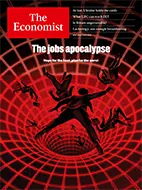
The jobs apocalypse
Hope for the best, plan for the worst
- How to plan for the jobs apocalypse. Hope for the best, prepare for the worst: leader, page 9.
- Mass unemployment induced by AI would be unprecedented, page 67.
- Is AI already putting graduates out of work? Page 69.
- China wants more robots, but not fewer workers, page 69.
- Sharing the AI windfall: Free Exchange, page 73.
At last, Ukraine holds the cards
- Vladimir Putin faces stalemate in Ukraine and stagnation at home, page 49.
What UFC can teach DJT
- Donald Trump has much to learn from the fighters he has invited to the White House: Lexington, page 26.
Is Britain ungovernable?
- No, which is why Sir Keir Starmer must prepare to leave Downing Street: leader, page 10, and analysis, page 55.
- How Labour morphed into the Conservatives: Baghehot, page 59.
- The workers’ parties aren’t working: Charlemagne, page 53.
Lacktology: not enough breastfeeding
- Many women cannot make enough milk. Scientists are starting to understand why, page 74, and leader, page 12.
The world this week Politics
- Donald Trump went to China for a summit with Xi Jinping in Beijing. Mr Xi said China and America had agreed to a “new positioning” on bilateral ties and would increase co-operation in trade. Mr Trump’s delegation included a host of business bosses, including Jensen Huang of Nvidia and Kelly Ortberg of Boeing. Commercial discussions are easier for the two leaders than political ones. Tough topics include the wars in Ukraine and the Middle East, and America’s support for Taiwan. The island’s president, Lai Ching-te, made a point before Mr Trump departed for Beijing of thanking America for its “unwavering commitment” to Taiwan’s security.
Closed for business
- America and Iran once again failed to reach a deal to reopen the Strait of Hormuz and remove the spectre of war from the region. Before leaving for his trip to China Mr Trump claimed America would win the war “one way or the other”. Diplomats say the two sides still disagree on the duration of a moratorium for uranium enrichment, what to do with Iran’s stockpile of highly enriched uranium, and whether Iran should dismantle nuclear facilities, among other things.
- In Israel Binyamin Netanyahu’s governing coalition submitted a bill to dissolve the Knesset and hold a general election. If the bill is approved, an election could come in September or October. The coalition has been under pressure from ultra-Orthodox parties angered by the failure to pass legislation that would excuse religious students from the military draft. The leader of the opposition, Yair Lapid, welcomed the move to call an election, assuring supporters that “We are ready.”
- Earlier, the Knesset passed legislation that would allow military tribunals to impose the death penalty on Hamas militants and accomplices if found guilty of involvement in the attacks of October 7th 2023. The vote had bipartisan support, passing by 93-0 with 27 abstentions or absences.
- In India Narendra Modi urged his fellow citizens to conserve fuel, hold more online meetings and reduce travel to help combat the energy crunch. The prime minister also said Indians should avoid buying gold from abroad in order to save foreign exchange. The government then raised duties on overseas gold purchases.
- A car bombing and ambush killed at least 15 police officers in north-west Pakistan. A local Islamist militant group claimed responsibility. A few days later a bomb at a market in the same region killed at least ten people. Pakistan blames Afghanistan for allowing terrorists to operate across the border.
- Sara Duterte, the vice-president of the Philippines, was impeached again by the lower house of parliament. Her previous impeachment a year ago was struck down as unconstitutional. The charges are similar, ranging from misuse of public funds to threatening to kill the president, Ferdinand Marcos junior. Her conviction in the Senate would require a two-thirds majority. Ms Duterte denies the claims. Meanwhile, a gunshot was heard in the Senate. Ronald dela Rosa, a senator wanted by the International Criminal Court on charges relating to the war against drugs conducted under Rodrigo Duterte, Ms Duterte’s father, had been hiding out in the building to avoid arrest. He has now fled.
- The authorities in Kyrgyzstan indicted eight people for conspiring to overthrow the president, Sadyr Japarov. One of those charged is Kamchybek Tashiev, the Central Asian country’s second most-powerful politician. Mr Tashiev was ousted from his job as head of state security in February. His lawyer says the trial will be held behind closed doors.
- Sir Keir Starmer faced the most serious threat yet to his leadership of Britain’s Labour Party, and thus as prime minister, after several ministers resigned from the government and party rivals circled to launch a leadership challenge. This came after Labour suffered a heavy defeat in elections in Scotland and Wales and council elections in England, which suggested that the populist-right Reform UKis on course to be the biggest party at a general election.
A fragmented state
- In those elections Labour lost 1,500 councillors in England and Reform gained a similar number. The Greens cut into Labour’s heartlands in inner London. The Conservatives lost nearly 600 councillors overall, but won back Westminster council from Labour. Labour lost control of the parliament in Wales for the first time since devolution in 1999 as Plaid Cymru, the Welsh nationalists, surged to victory. In Scotland the Nationalists won another term in the devolved parliament but fell short of a majority. The SNP’s share of the constituency vote dropped sharply to 38%.
- European Union foreign ministers signed off on a new raft of sanctions targeting violent Israeli settlers in the West Bank and organisations that support them. The sanctions had been held up by Hungary’s previous government under Viktor Orban. Hungary’s new government, led by Peter Magyar, was sworn in this week.
- In Brazil a press report claimed that Flavio Bolsonaro, a senator and son of Jair Bolsonaro, a former president imprisoned for plotting a coup, had obtained funds from a disgraced banker to make a film about his father. Mr Bolsonaro junior acknowledged the funding, but said he had not promised any favours in return. The news could tip this year’s presidential election. Mr Bolsonaro junior is the right-wing candidate hoping to defeat Luiz Inácio Lula da Silva.
- The government of Mexico denied a media report that the CIA has been involved in assassinating alleged senior members of drug gangs and has operatives in the country trying to dismantle the gangs’ networks. Two CIA officials died in a car crash in Mexico recently after apparently taking part in a drugs raid; the federal government said it had not been aware of the CIA men’s involvement.
- Cuba’s energy minister said the country had run out of fuel oil and diesel and had very limited gas stocks. America has in effect imposed an energy blockade on the island by threatening to impose tariffs on countries that send fuel.
- Protests reportedly broke out in Havana against a series of blackouts that have left the city without power for up to 22 hours a day.
- Separatists in Alberta suffered a blow to their campaign when a judge dismissed their petition to put the issue to voters in a referendum. Groups representing indigenous minorities had brought the lawsuit, claiming they hadn’t been consulted and that the petition ignored their treaty rights.
The world this week Business
- The International Energy Agency warned that the loss of oil supplies from the closure of the Strait of Hormuz has depleted global oil inventories at a record pace. Oil stocks held on land plunged by 170m barrels in April alone. Analysts at JPMorgan also warned that commercial stocks in rich countries could “approach operational stress levels” by June. And Saudi Aramco’s chief executive said inventories would soon reach “critically low levels”. The Saudi oil company reported a 26% rise in quarterly net profit, year on year, in part because it increased exports in the run-up to the war. It is also pumping more oil through its pipeline to the Red Sea port of Yanbu.
Locks, stocks and barrels
- The disruption to global trade routes caused by the Iran war has benefited the Panama Canal. The head of the authority that runs the Central American waterway said that revenue is expected to have risen by as much as 15% since the start of the conflict. More oil and fuel from America bound for China, Japan and South Korea is passing though the canal’s locks and the prices paid at auction by vessels to traverse it have soared.
- America’s annual inflation rate surged to 3.8% in April, the highest in three years. Fuel-oil prices were up by 5.8% compared with March. At the beginning of 2026 annual inflation stood at 2.4%.
- The inflation problem will land on the desk of Kevin Warsh, the incoming chairman of the Federal Reserve. The Senate confirmed him for the job this week, two days before the end of Jerome Powell’s term.
- The German government’s opposition to the takeover of Commerzbank by UniCredit, an Italian lender, was criticised by the vice-president of the European Central Bank. Luis de Guindos, who is stepping down from the ECB, said that government interventions in business decisions “go against the spirit of a single market”. UniCredit has amassed a nearly 30% stake in Germany’s second-biggest listed bank. Commerzbank has announced 3,000 job cuts to make it more profitable in its fight against UniCredit’s hostile bid.
- The yields on Britain’s government bonds soared amid speculation about whether Sir Keir Starmer would be forced out as prime minister. The yield on the 30-year bond hit 5.81%, the highest level since 1998. The benchmark ten-year gilt yield reached 5.13%, the highest since 2008. Higher yields mean the government pays more to service its debt.
- Anduril, a defence startup that is seeking to challenge the industry’s dominant companies, saw its valuation soar to $61bn after its latest round of fundraising. Founded by Palmer Luckey, a 33-year-old entrepreneur with a taste for shorts and Hawaiian shirts, Anduril was valued at $30bn last June. The firm has won several Pentagon contracts and is ramping up production at its factory in Ohio that makes drones and other weapons.
- Marty Makary resigned as head of America’s Food and Drug Administration. He reportedly left over the FDA’s decision to approve fruit-flavoured e-cigarettes, which he opposed. But his year-long tenure included clashes with food and drugs companies, leading to speculation that Donald Trump was about to sack him.
- General Motors had a clearout of its IT department, according to reports, laying off about 600 workers, or 10% of its IT staff. The carmaker is hiring new employees to work in roles such as AI adoption, data engineering and analytics and agent and model development.
- Best known for its bright-green rental e-bikes strewn across city streets around the world, Lime filed for an IPO on the Nasdaq exchange. The startup, which is based in San Francisco, is backed by Uber. It reportedly hopes to attract a valuation of $2bn upon its stockmarket debut.
- An influential adviser to Lee Jae-myung, the president of South Korea, suggested that all the country’s citizens should receive a payout from the soaring market valuation of domestic chipmakers. Samsung recently reported a quarterly operating profit larger than its annual profit for all of 2025. SK Hynix’s quarterly profit was up by 405%, year on year. Mr Lee quickly pointed out that any payments to citizens would come from the government’s extra revenue generated by the profits, and not a tax on actual profit.
No more popping to the shop
- Amazon rolled out its 30-minute delivery service in Atlanta, Dallas, Philadelphia and Seattle. Residents of those cities can get groceries, household goods and other items in about the time it takes to prepare and eat breakfast. Amazon Now is expanding in other cities, such as Houston and Phoenix, soon, and elsewhere by the end of the year.
скачать журнал: The Economist - May 16th 2026
|